
EPISODE · Feb 6, 2026 · 11 MIN
Bio-manufacturing and Fermentation Technology. (2026 February first week edition)
from Biomanufacturing & Fermentation Technology · host prasad ernala
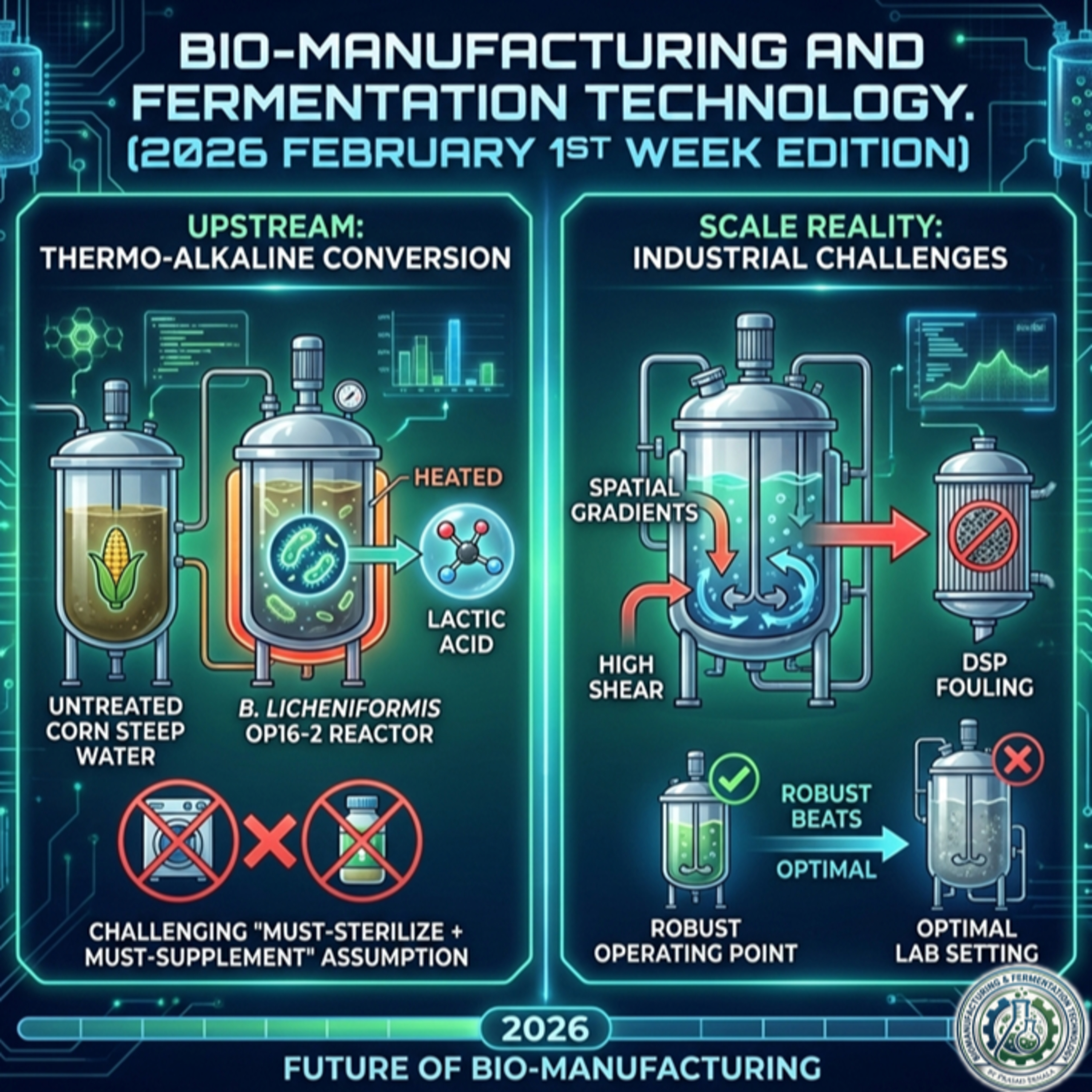
Across microbial fermentation and bio-catalysis, new data is forcing us to rethink where cost curves bend, where scale-up really fails, and where regulation is no longer the bottleneck we thought it was.If you are designing strains, scaling reactors, running manufacturing campaigns, or deciding where to place your next technical bet, this week’s signals matter.Upstream: B. licheniformis OP16‑2 converts untreated corn steep water to lactic acid under thermo‑alkaline conditions without nutrient supplementation, challenging the “must‑sterilize + must‑supplement” assumption.Scale reality: At industrial volume, spatial gradients and high shear can collapse uptake/viability and cascade into DSP fouling—robust operating points often beat “optimal” lab settings.Infrastructure signal: BioMADE is building shared pilot capacity (up to 10,000‑L fermenters plus downstream) to de‑risk scale-up for many teams without each one funding full CAPEX.Contrarian (boardroom): “Cell‑free scales universally” is constrained by mass‑balance/energy economics at larger volumes, so it tends to fit niche high‑value use cases or hybrid workflows rather than bulk commodities.Governance: FDA’s Jan 2025 draft guidance formalizes a risk‑based credibility framework for using AI model outputs in regulatory decision‑making for drugs/biologics, making data/validation strategy a competitive lever.References: 1. Selim,M.T., Salem, S.S., El-Belely, E.F. et al. Nutrient-free biorefinery of corn steepwater into lactic acid by Bacillus licheniformis OP16-2 under thermo-alkaline conditions witha pilot-scale assessment. Sci Rep 16, 4357 (2026).https://doi.org/10.1038/s41598-026-35828-4#Bioprocess #ScaleUp and #TechTransfer,#Industrial #Microbiology,#MetabolicEngineering and #SystemsBiology,#Bioprocessing,#MicrobialFermentation,#Bio-manufacturing,#Industrial #Biotechnology,#Fermentation Engineering,#ProcessDevelopment,#Microbiology,#Biochemistry,#Biochemical Engineering, #Applied #MicrobialPhysiology, #Microbial #ProcessEngineering, #Upstream #BioprocessDevelopment, #Downstream Processing and #Purification,#CellCulture and #MicrobialSystems Engineering, #Bioreaction #Enzymes, #Biocatalyst #scientific #Scientist #Research
What this episode covers
Across microbial fermentation and bio-catalysis, new data is forcing us to rethink where cost curves bend, where scale-up really fails, and where regulation is no longer the bottleneck we thought it was.If you are designing strains, scaling reactors, running manufacturing campaigns, or deciding where to place your next technical bet, this week’s signals matter.Upstream: B. licheniformis OP16‑2 converts untreated corn steep water to lactic acid under thermo‑alkaline conditions without nutrient supplementation, challenging the “must‑sterilize + must‑supplement” assumption.Scale reality: At industrial volume, spatial gradients and high shear can collapse uptake/viability and cascade into DSP fouling—robust operating points often beat “optimal” lab settings.Infrastructure signal: BioMADE is building shared pilot capacity (up to 10,000‑L fermenters plus downstream) to de‑risk scale-up for many teams without each one funding full CAPEX.Contrarian (boardroom): “Cell‑free scales universally” is constrained by mass‑balance/energy economics at larger volumes, so it tends to fit niche high‑value use cases or hybrid workflows rather than bulk commodities.Governance: FDA’s Jan 2025 draft guidance formalizes a risk‑based credibility framework for using AI model outputs in regulatory decision‑making for drugs/biologics, making data/validation strategy a competitive lever.References: 1. Selim,M.T., Salem, S.S., El-Belely, E.F. et al. Nutrient-free biorefinery of corn steepwater into lactic acid by Bacillus licheniformis OP16-2 under thermo-alkaline conditions witha pilot-scale assessment. Sci Rep 16, 4357 (2026).https://doi.org/10.1038/s41598-026-35828-4#Bioprocess #ScaleUp and #TechTransfer,#Industrial #Microbiology,#MetabolicEngineering and #SystemsBiology,#Bioprocessing,#MicrobialFermentation,#Bio-manufacturing,#Industrial #Biotechnology,#Fermentation Engineering,#ProcessDevelopment,#Microbiology,#Biochemistry,#Biochemical Engineering, #Applied #MicrobialPhysiology, #Microbial #ProcessEngineering, #Upstream #BioprocessDevelopment, #Downstream Processing and #Purification,#CellCulture and #MicrobialSystems Engineering, #Bioreaction #Enzymes, #Biocatalyst #scientific #Scientist #Research
NOW PLAYING
Bio-manufacturing and Fermentation Technology. (2026 February first week edition)
No transcript for this episode yet
Similar Episodes
Apr 21, 2026 ·13m
Apr 19, 2026 ·16m
Apr 17, 2026 ·13m
Apr 13, 2026 ·11m
Apr 11, 2026 ·16m