
EPISODE · Jun 6, 2026 · 4 MIN
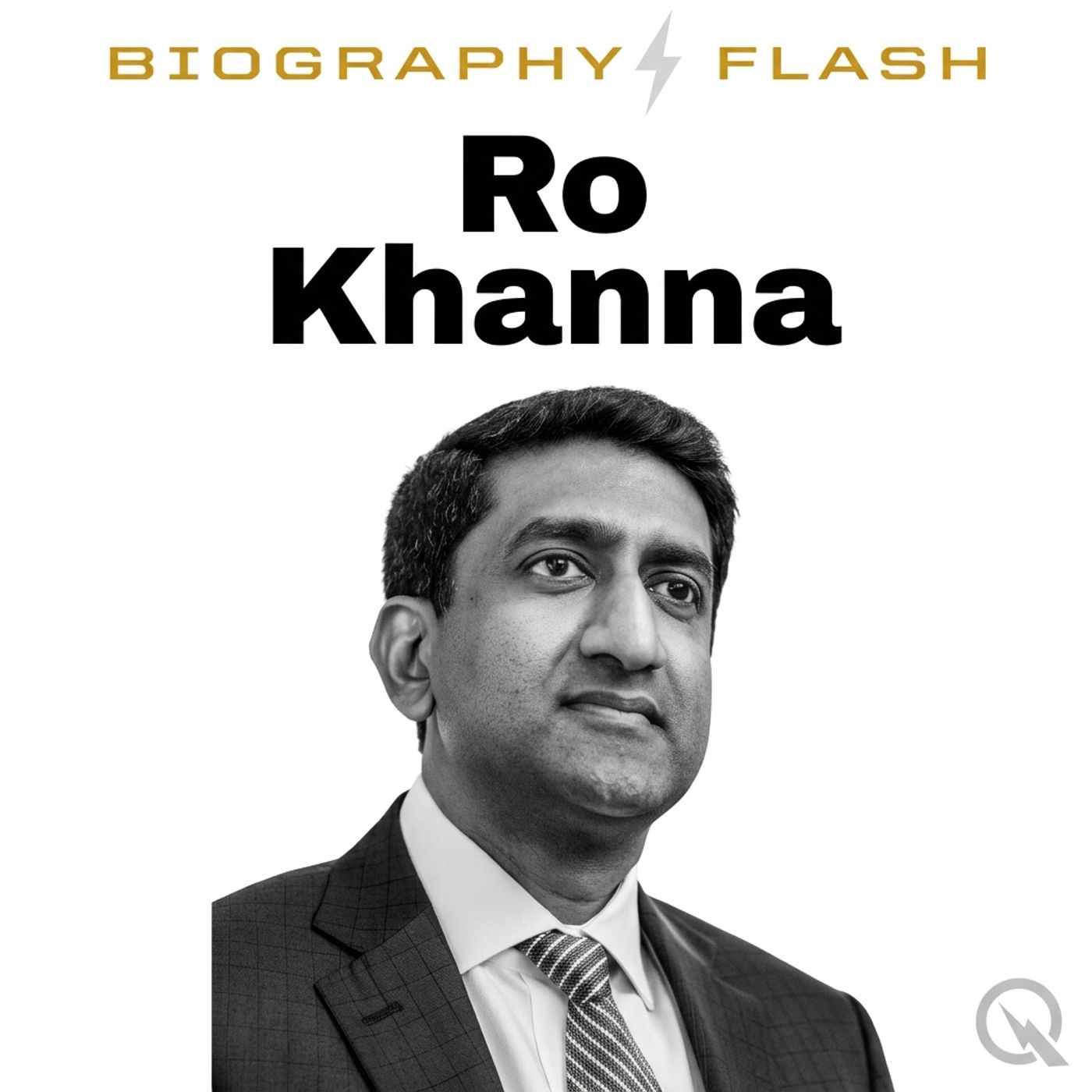
Biography Flash Ro Khanna Wages Wars on Policy Fronts and Reshapes Democratic Identity
from Ro Khanna - Biography Flash · host Inception Point AI
Ro Khanna Biography Flash a weekly Biography. Ro Khanna has been busy writing a new chapter in his political biography over the past few days, and the headlines tell you exactly where he wants to leave his mark: foreign policy, labor, and the future of the Democratic Party. According to the Jewish Telegraphic Agency, Khanna has teamed up with libertarian-leaning Republican Thomas Massie in an unusual left-right alliance to strip a major U.S.-Israel military technology cooperation provision out of the upcoming National Defense Authorization Act for 2027. JTA reports that the pair are targeting language that would require the Pentagon to designate an executive agent to coordinate deep, long-term tech integration with Israel’s defense sector, from research and development to industrial cooperation. That move is not just a policy tweak; it is a potentially biographically defining moment that underscores Khanna’s willingness to challenge establishment pro-Israel security structures from within his own party, and to do it with a Republican partner from the opposite ideological pole. On the economic front, the Cato Institute recently analyzed Khanna’s Living Wage for All Act, introduced with Representative Delia Ramirez, which aims to push the federal minimum wage up to the equivalent of 25 dollars an hour for large businesses by 2031 and for smaller employers by 2038. Cato notes that the bill effectively ties the wage floor to two-thirds of national median earnings, with 25 dollars serving as a cap rather than an immediate target. Framed as a long game on wage policy, it is the kind of structural economic vision that will likely loom large in any future biography, whether as a bold progressive milestone or a cautionary tale, depending on how history judges the politics of inflation and inequality. From his perch as ranking member on the House Select Committee on the Strategic Competition between the United States and the Chinese Communist Party, Khanna also moved on labor and national security. A press release from the committee’s Democratic office states that he joined Democrat Shontel Brown and Republicans Scott Perry and Mike Kelly in demanding that the Department of Justice update Congress on investigations into labor trafficking, forced labor, and unlawful employment tied to CCP‑linked companies in the U.S. auto parts and glass sectors. The lawmakers set a hard response date of June 19, signaling that Khanna is trying to carve out a long-term reputation as a China hawk focused not just on missiles and microchips but on working conditions and supply chains. Recent media buzz has also surrounded his decision to campaign with embattled Maine Democratic Senate candidate Graham Platner. Fox News reports that Khanna plans to rally with Platner despite calling Platner’s past behavior “wrong and toxic” as characterized by the New York Times. This pairing of moral distance with political support is the sort of move biographers will scrutinize later when they assess his judgment, his loyalties, and his appetite for risk in intra-party battles. Commentary segments, including one featuring Republican Senator Jim Banks on Fox News, have already turned Khanna into a kind of foil in the Platner saga, adding a splash of Beltway gossip to his otherwise policy-heavy week. On the election front, India Abroad recently highlighted Khanna’s dominant showing in the California 17th Congressional District primary, where he secured just under 60 percent of the vote, portraying the outcome as a resounding endorsement of his progressive identity and a rebuke to well-funded attacks from wealthy interests. That margin helps lock in his image as a safe incumbent with a national profile, a crucial platform for any future statewide or national ambitions that pundits like to whisper about, even if no serious, verified 2028 or 2032 plans have been reported yet. Any chatter about imminent presidential aspirations at this stage remains speculative and should be treated as such absent hard reporting from major outlets. There have been no widely reported social media meltdowns or out-of-nowhere scandals attached to Khanna in the past 24 hours in major national outlets; instead, his feed and public mentions are largely amplifying these same themes: higher wages, ethical supply chains, skepticism of expansive military arrangements, and a complicated loyalty to Democrats under fire. That is the latest snapshot in the evolving story of Ro Khanna — progressive idealist, bipartisan tactician, and sometimes reluctant party loyalist, all trying to coexist in one very online, very scrutinized political figure. Thank you for listening, and be sure to subscribe so you never miss an update on Ro Khanna, and search the term Biography Flash for more great biographies. Thanks for listening. This has been a Quiet Please production. Get the best deals https://amzn.to/3ODvOta
What this episode covers
Ro Khanna Biography Flash a weekly Biography. Ro Khanna has been busy writing a new chapter in his political biography over the past few days, and the headlines tell you exactly where he wants to leave his mark: foreign policy, labor, and the future of the Democratic Party. According to the Jewish Telegraphic Agency, Khanna has teamed up with libertarian-leaning Republican Thomas Massie in an unusual left-right alliance to strip a major U.S.-Israel military technology cooperation provision out of the upcoming National Defense Authorization Act for 2027. JTA reports that the pair are targeting language that would require the Pentagon to designate an executive agent to coordinate deep, long-term tech integration with Israel’s defense sector, from research and development to industrial cooperation. That move is not just a policy tweak; it is a potentially biographically defining moment that underscores Khanna’s willingness to challenge establishment pro-Israel security structures from within his own party, and to do it with a Republican partner from the opposite ideological pole. On the economic front, the Cato Institute recently analyzed Khanna’s Living Wage for All Act, introduced with Representative Delia Ramirez, which aims to push the federal minimum wage up to the equivalent of 25 dollars an hour for large businesses by 2031 and for smaller employers by 2038. Cato notes that the bill effectively ties the wage floor to two-thirds of national median earnings, with 25 dollars serving as a cap rather than an immediate target. Framed as a long game on wage policy, it is the kind of structural economic vision that will likely loom large in any future biography, whether as a bold progressive milestone or a cautionary tale, depending on how history judges the politics of inflation and inequality. From his perch as ranking member on the House Select Committee on the Strategic Competition between the United States and the Chinese Communist Party, Khanna also moved on labor and national security. A press release from the committee’s Democratic office states that he joined Democrat Shontel Brown and Republicans Scott Perry and Mike Kelly in demanding that the Department of Justice update Congress on investigations into labor trafficking, forced labor, and unlawful employment tied to CCP‑linked companies in the U.S. auto parts and glass sectors. The lawmakers set a hard response date of June 19, signaling that Khanna is trying to carve out a long-term reputation as a China hawk focused not just on missiles and microchips but on working conditions and supply chains. Recent media buzz has also surrounded his decision to campaign with embattled Maine Democratic Senate candidate Graham Platner. Fox News reports that Khanna plans to rally with Platner despite calling Platner’s past behavior “wrong and toxic” as characterized by the New York Times. This pairing of moral distance with political support is the sort of move biographers will scrutinize later when they assess his judgment, his loyalties, and his appetite for risk in intra-party battles. Commentary segments, including one featuring Republican Senator Jim Banks on Fox News, have already turned Khanna into a kind of foil in the Platner saga, adding a splash of Beltway gossip to his otherwise policy-heavy week. On the election front, India Abroad recently highlighted Khanna’s dominant showing in the California 17th Congressional District primary, where he secured just under 60 percent of the vote, portraying the outcome as a resounding endorsement of his progressive identity and a rebuke to well-funded attacks from wealthy interests. That margin helps lock in his image as a safe incumbent with a national profile, a crucial platform for any future statewide or national ambitions that pundits like to whisper about, even if no serious, verified 2028 or 2032 plans have been reported yet. Any chatter about imminent presidential aspirations at this stage remains speculative and should be treated as such absent hard reporting from major outlets. There have been no widely reported social media meltdowns or out-of-nowhere scandals attached to Khanna in the past 24 hours in major national outlets; instead, his feed and public mentions are largely amplifying these same themes: higher wages, ethical supply chains, skepticism of expansive military arrangements, and a complicated loyalty to Democrats under fire. That is the latest snapshot in the evolving story of Ro Khanna — progressive idealist, bipartisan tactician, and sometimes reluctant party loyalist, all trying to coexist in one very online, very scrutinized political figure. Thank you for listening, and be sure to subscribe so you never miss an update on Ro Khanna, and search the term Biography Flash for more great biographies. Thanks for listening. This has been a Quiet Please production. Get the best deals https://amzn.to/3ODvOta
NOW PLAYING
Biography Flash Ro Khanna Wages Wars on Policy Fronts and Reshapes Democratic Identity
No transcript for this episode yet