
EPISODE · Feb 10, 2026 · 18 MIN
Biomass Separation Strategies in Microbial Fermentation
from Biomanufacturing & Fermentation Technology · host prasad ernala
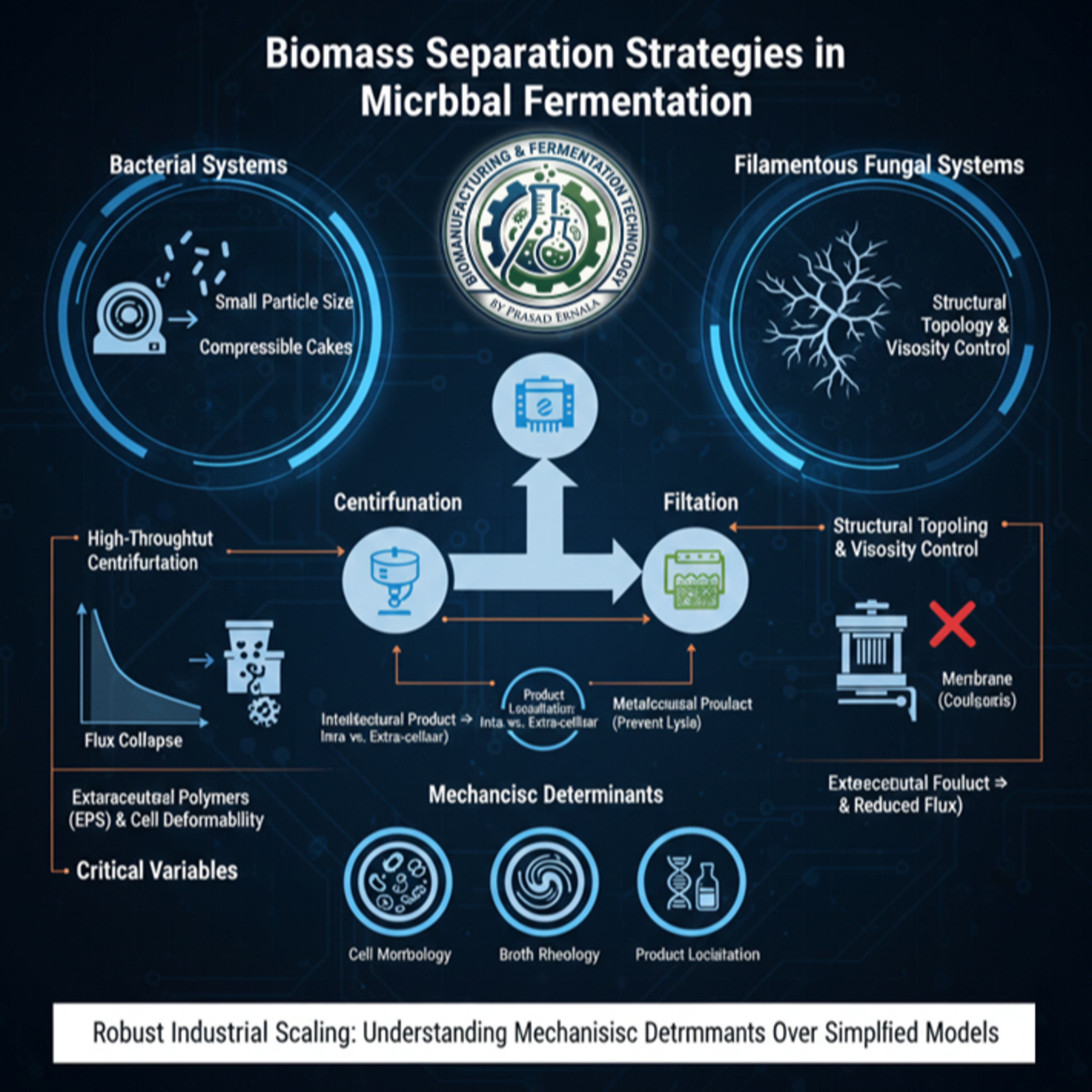
In this episode we focus on the technical criteria for selecting biomass separation strategies in microbial fermentation, focusing on how cell morphology, broth rheology, and product localization dictate industrial success. It explains that bacterial systems often require centrifugation due to their small size and tendency to form compressible cakes, though this carries a risk of shear-induced lysis. In contrast, filamentous fungal processes rely on morphological control to manage high viscosity and ensure efficient filtration. The discussion further highlight how extracellular polymers and solids load act as critical variables that can cause membrane fouling or hydraulic failure. Ultimately, the overview emphasizes that a robust harvest strategy must balance throughput requirements with the need to minimize impurity release based on whether the desired product is intracellular or extracellular.#Bioprocess #ScaleUp and #TechTransfer,#Industrial #Microbiology,#MetabolicEngineering and #SystemsBiology,#Bioprocessing, #MicrobialFermentation, #Bio-manufacturing, #Industrial #Biotechnology, #Fermentation Engineering, #ProcessDevelopment,#Microbiology, #Biochemistry#Biochemical Engineering,#Applied #MicrobialPhysiology,#Microbial #ProcessEngineering,#Upstream #BioprocessDevelopment,#Downstream Processing and #Purification,#CellCulture and #MicrobialSystems Engineering,#Bioreaction #Enzymes #Biocatalyst #scientific#Scientist#Research
What this episode covers
In this episode we focus on the technical criteria for selecting biomass separation strategies in microbial fermentation, focusing on how cell morphology, broth rheology, and product localization dictate industrial success. It explains that bacterial systems often require centrifugation due to their small size and tendency to form compressible cakes, though this carries a risk of shear-induced lysis. In contrast, filamentous fungal processes rely on morphological control to manage high viscosity and ensure efficient filtration. The discussion further highlight how extracellular polymers and solids load act as critical variables that can cause membrane fouling or hydraulic failure. Ultimately, the overview emphasizes that a robust harvest strategy must balance throughput requirements with the need to minimize impurity release based on whether the desired product is intracellular or extracellular.#Bioprocess #ScaleUp and #TechTransfer,#Industrial #Microbiology,#MetabolicEngineering and #SystemsBiology,#Bioprocessing, #MicrobialFermentation, #Bio-manufacturing, #Industrial #Biotechnology, #Fermentation Engineering, #ProcessDevelopment,#Microbiology, #Biochemistry#Biochemical Engineering,#Applied #MicrobialPhysiology,#Microbial #ProcessEngineering,#Upstream #BioprocessDevelopment,#Downstream Processing and #Purification,#CellCulture and #MicrobialSystems Engineering,#Bioreaction #Enzymes #Biocatalyst #scientific#Scientist#Research
NOW PLAYING
Biomass Separation Strategies in Microbial Fermentation
No transcript for this episode yet
Similar Episodes
Apr 21, 2026 ·13m
Apr 19, 2026 ·16m
Apr 17, 2026 ·13m
Apr 13, 2026 ·11m
Apr 11, 2026 ·16m