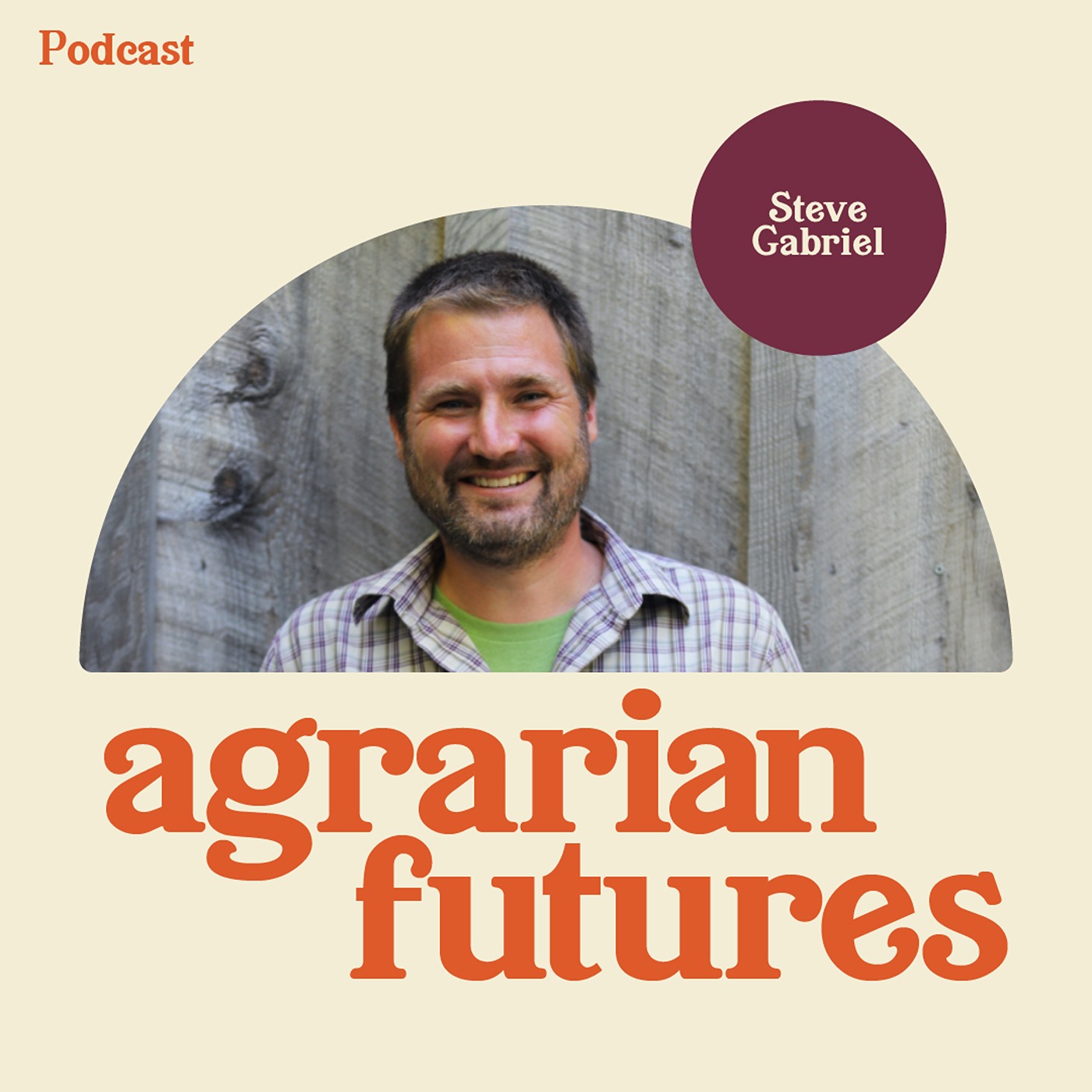
Blending Forest and Field with Steve Gabriel episode artwork

EPISODE · Apr 1, 2026 · 29 MIN

Blending Forest and Field with Steve Gabriel

from Agrarian Futures · host Agrarian Futures

Steve Gabriel joins us to unpack one of the most consequential myths shaping how we grow food in America: the separation between forest and field.As a co-steward of Wellspring Forest Farm in Mecklenburg, New York, author of Silvopasture, and researcher at the Cornell Small Farms Program, Steve has been listening. Through a SARE-funded project called Farming with Trees, he's been in conversation with over 120 farmers, from Bronx-raised beginners to multi-generational stewards, exploring not just how to plant trees, but why it matters and what gets in the way.What he's found is that the barriers to agroforestry aren't just technical. They're cultural, historical, and deeply personal, rooted in a Eurocentric agricultural paradigm that told farmers to clear the land and never look back.In this episode, we dive into: How personal relationships with trees in childhood shape a farmer's vision for the land The paradigm shift required to move from stark field or stark forest toward something in between How indigenous land stewardship modeled a working tree landscape long before "agroforestry" was a word What livestock farmers, vegetable growers, and flower farmers each need from trees and why those needs are so different Why starting with willow and poplar might matter more than starting with chestnuts and apples The role of community, craft traditions, and living fences in rebuilding our relationship with treesMore about Steve (links below):Steve Gabriel is an ecologist, farmer, and educator from the Finger Lakes Region of New York. Throughout his career spanning 20 years, Gabriel has taught thousands of farmers and land stewards about land planning, mushroom growing, and agroforestry. His experience working in academic research and extension, as a teacher and lecturer, and managing several working farm landscapes has built a unique balance of knowledge and practice which he brings to his work.With his family, Gabriel co-stewards Wellspring Forest Farm, which is an agroforestry demonstration farm that produces mushrooms, nursery trees, pastured lamb, maple syrup, and elderberry in Mecklenburg, New York. He also collaborates with diverse individuals and organizations through the Farming with Trees Collective.Gabriel previously served for 12 years as Extension Specialist for the Cornell Small Farm Program, focused on research and education on agroforestry and mushroom production. Steve co-authored Farming the Woods with Ken Mudge (2014) and is the author of Silvopasture (2019).www.MycenaTrees.org -- his new non profit working on social aspects of agroforestrywww.FarmingWithTrees.org -- report on listening sessions with farmers and nursery stewardswww.WellspringForestFarm.com -- Steve's farm websiteAgrarian Futures is produced by Alexandre Miller, who also wrote our theme song. This episode was edited by Drew O’Doherty.

Steve Gabriel joins us to unpack one of the most consequential myths shaping how we grow food in America: the separation between forest and field. As a co-steward of Wellspring Forest Farm in Mecklenburg, New York, author of Silvopasture, and researcher at the Cornell Small Farms Program, Steve has been listening. Through a SARE-funded project called Farming with Trees, he's been in conversation with over 120 farmers, from Bronx-raised beginners to multi-generational stewards, exploring not just how to plant trees, but why it matters and what gets in the way. What he's found is that the barriers to agroforestry aren't just technical. They're cultural, historical, and deeply personal, rooted in a Eurocentric agricultural paradigm that told farmers to clear the land and never look back. In this episode, we dive into: * How personal relationships with trees in childhood shape a farmer's vision for the land * The paradigm shift required to move from stark field or stark forest toward something in between * How indigenous land stewardship modeled a working tree landscape long before "agroforestry" was a word * What livestock farmers, vegetable growers, and flower farmers each need from trees and why those needs are so different * Why starting with willow and poplar might matter more than starting with chestnuts and apples * The role of community, craft traditions, and living fences in rebuilding our relationship with trees More about Steve (links below): Steve Gabriel is an ecologist, farmer, and educator from the Finger Lakes Region of New York. Throughout his career spanning 20 years, Gabriel has taught thousands of farmers and land stewards about land planning, mushroom growing, and agroforestry. His experience working in academic research and extension, as a teacher and lecturer, and managing several working farm landscapes has built a unique balance of knowledge and practice which he brings to his work. With his family, Gabriel co-stewards Wellspring Forest Farm, which is an agroforestry demonstration farm that produces mushrooms, nursery trees, pastured lamb, maple syrup, and elderberry in Mecklenburg, New York. He also collaborates with diverse individuals and organizations through the Farming with Trees Collective. Gabriel previously served for 12 years as Extension Specialist for the Cornell Small Farm Program, focused on research and education on agroforestry and mushroom production. Steve co-authored Farming the Woods with Ken Mudge (2014) and is the author of Silvopasture (2019). www.MycenaTrees.org [http://www.mycenatrees.org/] -- his new non profit working on social aspects of agroforestry www.FarmingWithTrees.org [http://www.farmingwithtrees.org/] -- report on listening sessions with farmers and nursery stewards www.WellspringForestFarm.com [http://www.wellspringforestfarm.com/] -- Steve's farm website Agrarian Futures is produced by Alexandre Miller, who also wrote our theme song. This episode was edited by Drew O'Doherty.

NOW PLAYING

Blending Forest and Field with Steve Gabriel

0:00 29:58

No transcript for this episode yet

We transcribe on demand. Request one and we'll notify you when it's ready — usually under 10 minutes.

Soft, Earthen Futures Storywork Studio Soft, Earthen Futures is a podcast about imagining and crafting a more whole world. We explore what it means to stand at the threshold between what has been and what is trying to emerge, tending to that in-between space, listening for what the earth is dreaming through us, and giving those visions form. This show is for wild-hearted creatives, entrepreneurs, and visionaries. Hosted by founder, story doula, and eco-somatic depth guide, Daje Aloh. What Needs to Get Done – Right Now Its-all-here This is the moment where futures are forged. Where men rise by doing what others delay.So I ask: What needs to get done—right now? The tastylive network tastytrade The tastylive network teaches investors innovative, simple ways to trade stocks, options, and futures, take advantage of market volatility and build a successful portfolio. Tom Sosnoff leads an irreverent and playful band of floor traders who are showing America a new way to quickly find low risk, high return strategies in bullish, bearish and sideways markets. Ray Dalio Academy of Achievement Ray Dalio is the founder and owner of Bridgewater Associates, the world's largest and richest hedge fund. The firm manages approximately $130 billion in global investments for institutional clients including foreign governments and central banks, pension funds, university endowments and charitable foundations. The son of a jazz musician, Dalio began investing at the age of 12 when he bought shares of Northeast Airlines for $300, tripling his investment when the airline merged with another company. After completing his education at Long Island University and Harvard Business School, Dalio worked on the floor of the New York Stock Exchange and invested in commodity futures. In 1975, at age 26, he founded Bridgewater Associates in his two-bedroom Manhattan apartment. As the firm expanded, he wrote a 100-page essay, 'Principles,' to share his management philosophy with his employees. Dalio believes his team must be 'radically truthful and transparent' to achieve excellence. 'We need to kn

Frequently Asked Questions

How long is this episode of Agrarian Futures?

This episode is 29 minutes long.

When was this Agrarian Futures episode published?

This episode was published on April 1, 2026.

What is this episode about?

Steve Gabriel joins us to unpack one of the most consequential myths shaping how we grow food in America: the separation between forest and field.As a co-steward of Wellspring Forest Farm in Mecklenburg, New York, author of Silvopasture, and...

Can I download this Agrarian Futures episode?

Yes, you can download this episode by clicking the download button on the episode player, or subscribe to the podcast in your preferred podcast app for automatic downloads.
URL copied to clipboard!