
EPISODE · Feb 20, 2026 · 14 MIN
Breaking Carbon’s Monopoly: The First Aromatic Silicon Ring Synthesized
from The Deep Dive Lab: Unraveling Materials Science · host Son Hoang
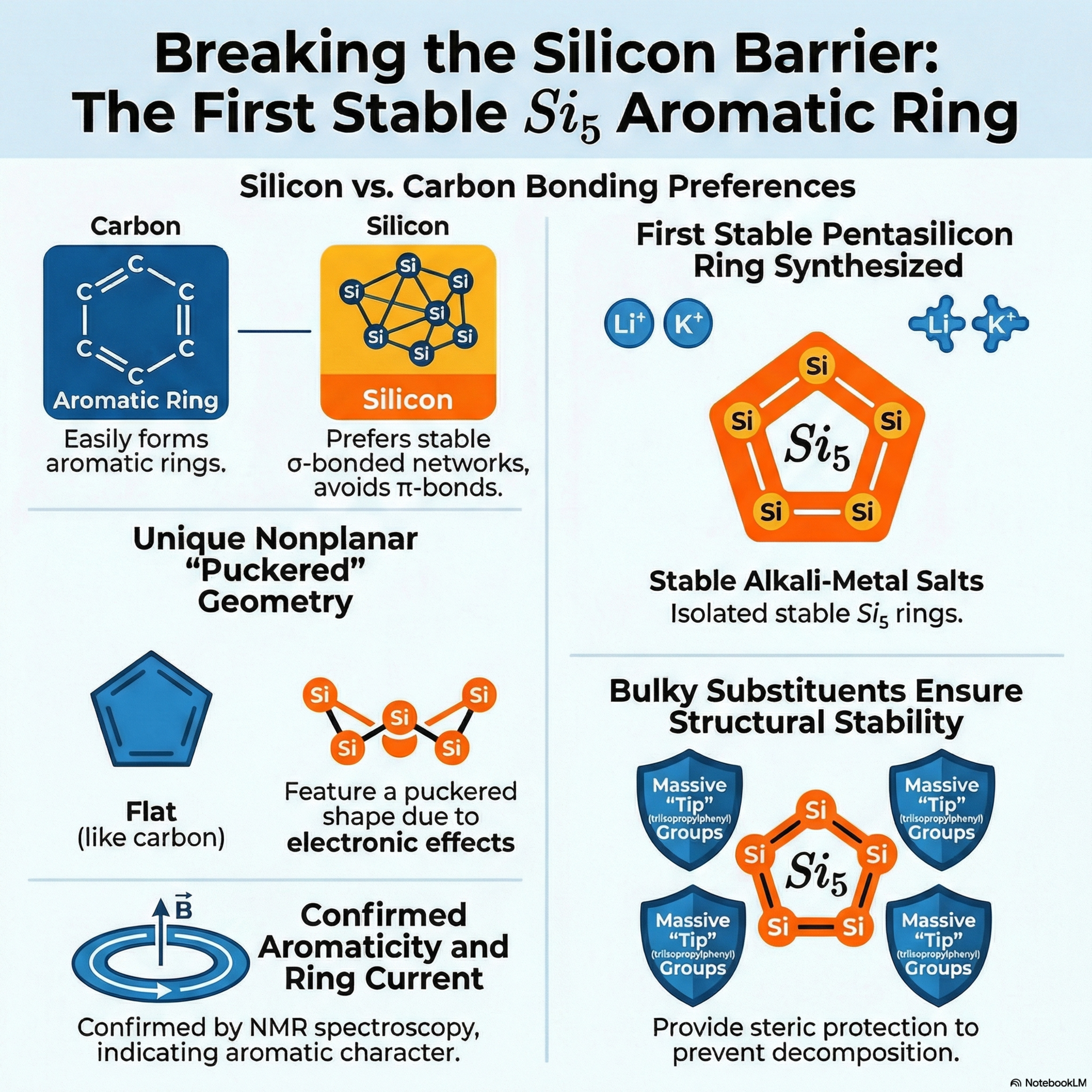
For more than a century, aromatic chemistry has belonged to carbon. Flat benzene rings and delocalized π-electrons defined stability, elegance, and molecular design. Silicon—carbon’s heavier neighbor—was considered fundamentally incompatible with this architecture due to weak π-bonds and a strong preference for σ-bonding.Until now.In a landmark breakthrough, researchers have synthesized the first stable five-membered aromatic silicon ring. Despite adopting a puckered, nonplanar geometry driven by the Pseudo-Jahn-Teller effect, the molecule sustains a true 6π electron system, confirmed by NMR and NICS analyses.Through strategic steric engineering, scientists destabilized the σ-form and flipped the energetic script—allowing the π-aromatic system to prevail.This discovery challenges long-held assumptions about heavier elements and opens new frontiers in organometallic chemistry, catalysis, and functional materials.Aromaticity is no longer carbon’s exclusive domain. 🔬⚡#Aromaticity #SiliconChemistry #InorganicChemistry #Organometallics #MolecularDesign #MaterialsScience #QuantumChemistry #ScientificBreakthrough #deepdivelabFor more than a century, aromatic chemistry has belonged to carbon. Flat benzene rings and delocalized π-electrons defined stability, elegance, and molecular design. Silicon—carbon’s heavier neighbor—was considered fundamentally incompatible with this architecture due to weak π-bonds and a strong preference for σ-bonding.Until now.In a landmark breakthrough, researchers have synthesized the first stable five-membered aromatic silicon ring. Despite adopting a puckered, nonplanar geometry driven by the Pseudo-Jahn-Teller effect, the molecule sustains a true 6π electron system, confirmed by NMR and NICS analyses.Through strategic steric engineering, scientists destabilized the σ-form and flipped the energetic script—allowing the π-aromatic system to prevail.This discovery challenges long-held assumptions about heavier elements and opens new frontiers in organometallic chemistry, catalysis, and functional materials.Aromaticity is no longer carbon’s exclusive domain. 🔬⚡#Aromaticity #SiliconChemistry #InorganicChemistry #Organometallics #MolecularDesign #MaterialsScience #QuantumChemistry #ScientificBreakthrough #deepdivelab📄 Source paper:Silicon cyclopentadienides featuring a nonplanar 6π aromatic Si₅ ring.Science, 5 Feb 2026, Vol 391, Issue 6785, pp. 587–591.
Embed this episode
NOW PLAYING
Breaking Carbon’s Monopoly: The First Aromatic Silicon Ring Synthesized
No transcript for this episode yet
Similar Episodes
No similar episodes found.
Similar Podcasts
No similar podcasts found.