
Welcome to the Daily Drive. I'm your host Ken Nor. This show is dedicated to keeping you educated, informed, and most importantly, driven to succeed. We want your feedback so call us at 1-800-437-5121.
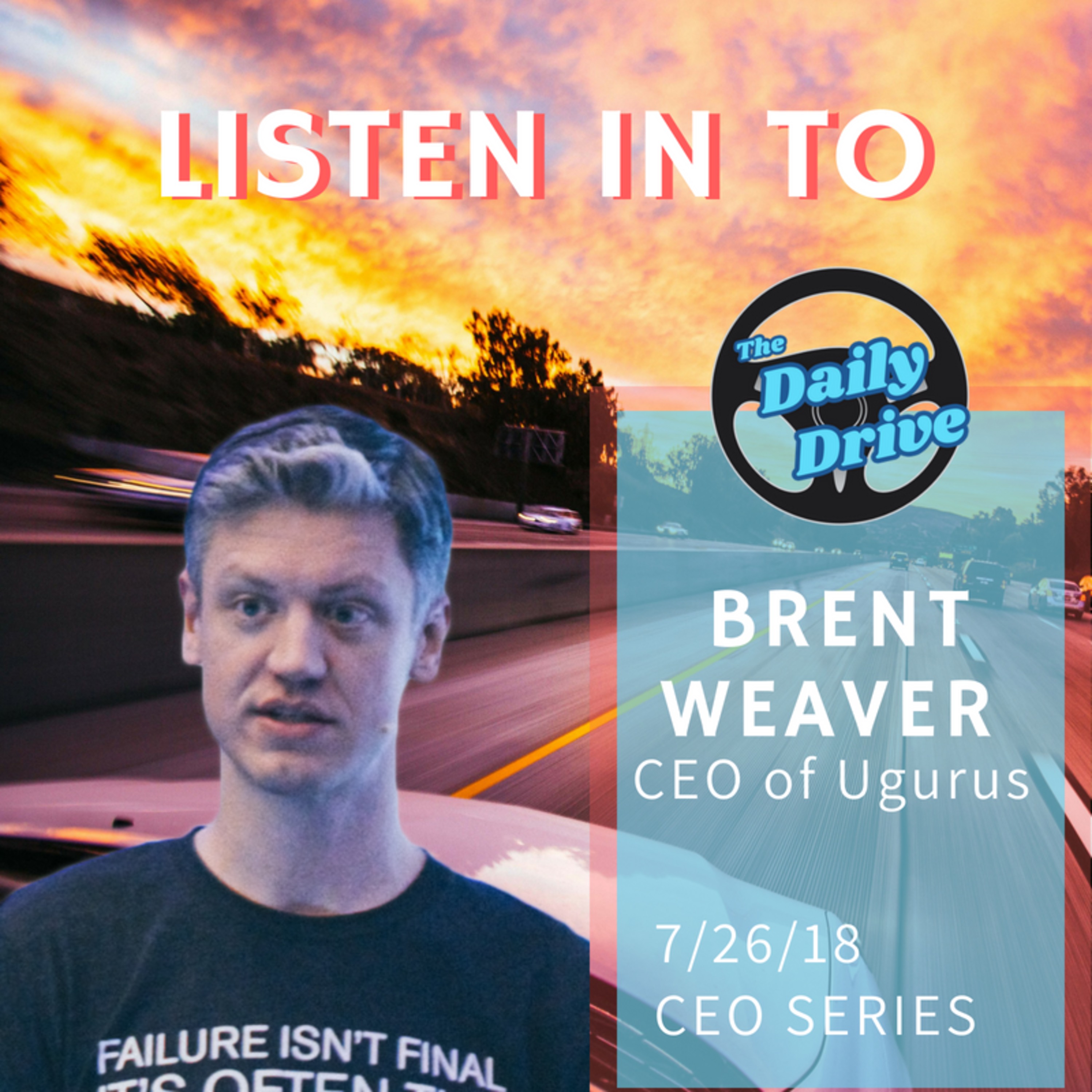
Everyone on the Daily Drive Show team hopes that you enjoy this show. Welcome back to the Daily Drive. Today we have a really special show for you. We have the opportunity to meet with Brent Weaver of You Guru's and he's on the line now.
Welcome to the show Brent. Thanks for having me. You've been doing this for quite a while and tell us a little bit about You Guru's and what you're doing these days. Yeah, so you, Guru's, that is the company I'm currently the CEO, Chief Guru of that business.
We help digital agencies and entrepreneurs achieve freedom in their business and life by mastering business. You've got your elevator pitch down. You really do. And we talked entrepreneurs all the time and they struggle with their elevator pitch.
They couldn't give it as succinctly as you did there. That's a practice. That was draft number 764. So if you're on draft number five or six, don't worry.
There's hope for you yet. It's true. It's okay to rewrite it, isn't it? But when you say you help the master success, just digging a little deeper into what you do, how do you help the master success?
We think there are five core systems that every business has. The first one is their attraction system. So how they attract leads and customers into their business. The second is how they win that business, turn those leads that interest into what we call high value clients.
And then we help people to deliver in delight as our third system. So once you've won that deal and sold the business, sometimes all the bells and whistles, the brilliant experience stops there at the sale. So we teach our clients how to continue to deliver and delight their clients post sale. And then we have what we call our scale systems.
So once you really have those other systems working for you, how do you even break through that next barrier, that next feeling for your business. And at the center of all this is what we call the system of you. So your business, one of the biggest factors of every business is the entrepreneur. So one of those habits, mindsets and practices and network and connections and support that the actual entrepreneur has.
And a lot of times that has more of a determining factor on the outcomes of the other four systems than anything else. So we focus on all five areas in our programs. That's pretty cool. What ignited the spark for you to start this?
Well, I had a digital agency and it took me about I ran that business for about 13 years. And about the first eight or nine of those years, it was a lot of suffering, a lot of disappointment, a lot of frustration, you know, those times where you don't have enough money to cover payroll, or some of the issues that I had in the early days of my agency. And I always thought to myself, you know, once I had kind of figured it out, which took us about eight or nine years to kind of figure out how to run our agency, I wanted to show other people how to kind of skip those eight arduous years. And about 2008, 2007, 2008, we started to really understand some of the secrets of business and sort of scale our business up.
And so I thought to myself, you know, if I could show somebody how to accelerate their path instead of spending 10 years to get to that point, they could spend like one to two years or maybe even 10 weeks. And I could teach everything that we did over 10 years, then that would be important. How important is it to have good employees? How important has that been to your success?
I mean, that's like, you know, how important is it to have good quality water as like a human being, right? Right. So, I mean, is the ones, are the people that are interacting with your customers. So, I'll give you an example.
I don't actually interact with the vast majority of our customers. We have, I mean, I do in certain ways, like emails that I wrote or they might see them or videos that I recorded, they might watch them, but I do not do sales for our business 99 times out of 100 or 999 times out of 1000. We have a sales team for that. So, my sales team is the one that are the ones that are speaking to our customers, our operations team, our mentors are the ones that are delivering our program.
So, I think like a lot of business owners and entrepreneurs, you know, might my dream and I do enjoy the work, but I think I also enjoy seeing a system that I've built be operated in the right way. So, my team are the ones that are interacting with my customers and I can't be there. I don't want to be there over their shoulder watching what they're doing. So, we use a lot of, you know, I think some things we hear a lot about in the entrepreneurial world.
So, we have core values. We have a clearly defined vision and plan for our business that we share with everybody on our team. We train and talk about our core values often. We talk about them in our hiring process.
We hire based on our core values. We have many, many conversations with anybody before we ever hire them to make sure that they, their values match up in the line with our values. And we think that's a really important way to approach business. And because we've taken that approach, the people that are on our team are, you know, highly informed about what we're all about.
But they also like wake up in the morning and that's who they are. They don't have to like try to be somebody that they're not. That's excellent. Would you mind sharing what your core values are?
Be bold and take risks. Carry your own bag. Have a growth mindset. Help first and start strong.
Finish strong. What's one of your primary roles as CEO today? You know, one of my key kind of abilities is the company's storyteller. And I know that sounds maybe kind of fufu or whatever.
But, you know, we have a couple of weekly huddles and I try to bring in, you know, customer stories or headlines from other team members that aren't present and motivate our team. So I do that internally with my company, every quarter. I deliver a company memo where I spend, you know, a few hours writing that. I read it in front of everybody.
I stand up in front of them and I read it and I tell them more stories about our core values and about our customer success. As CEO, I'm there to kind of help bring this narrative together to tell the people that are on my team and our customers that the work that we're doing matters and also keep in mind kind of what our north star is. So always hammering that vision, right? So what business related book has inspired you the most?
I'm in my office at home. So I'm going to just, I'm going to turn my head around just ever so briefly. I'm going to go with obstacles away by Ryan Holiday. In the reason I'm picking out today, just in thinking about favorite, I have read and reread that book and listen to the audio book and re listen to the audio book.
I mean, going on probably dozens of times at this point, it's kind of an introduction to stoic philosophy of not looking at obstacles as, you know, things that should be ignored or worked around, but actually leaning into that, leaning into the hard work or leaning into the challenge and taking that stuff on head on instead of, you know, doing the quote unquote, easy work first, do the hard work first, right? When I wake up in the morning at 4.30, the very first thing that I do is I write, well, the first thing I do is I read, but then after I'm done reading for 15 or so minutes, I write for usually about two hours because that's usually the hardest thing for me to get to. If I don't get to it first thing, I never get to it. And so I start with that most difficult thing first.
And then the rest of the day is like a cakewalk, even if I'm doing like challenging stuff, it's like super easy. It just flows because I've always done that hardest thing first. Well, you mentioned that you had an unusual morning routine and now you alluded to it. So now you have to share what's your morning routine?
So I, yes, it's really not that glamorous. I wake up at 4.30. I usually have set my coffee maker the night before I don't sound super important, but it is because when you wake up at 4.30 and you just know that you have a cup of coffee waiting for you downstairs, it does help. And I usually read for, so I kind of get that stuff ready.
I'm sitting at my desk around by around 4.45. I set a timer for 15 minutes and I read and that kind of gets my brain out of the groggy mode, gets me thinking about words and reading from another author. And I spend 15 minutes or so reading. My alarm goes off.
I'll take a quick little five-minute break, get another cup of coffee, any two water, whatever. And then I use a Pomodoro technique. So I basically do 25-minute timers. So I set another timer for 25 minutes.
And then I write for that, you know, I write for that 25-minute, take a five-minute break. And then I usually do like three to four, what's called Pomodoro. So 25-minute timed focus sessions. And then usually around 6.30 to seven, depending on the day, my four-year-old then comes in and basically he's up.
So it's breakfast time and it's family time. And him and I do breakfast with the family and then I bike him to school and then come back and start my going to normal work day after that. Usually around nine o'clock. So what is your favorite aspect of being an entrepreneur?
My favorite aspect, I mean, I'm going to have to come, I'm going to have to go back to this word of freedom. I think that's what's always appealed to me. Now in entrepreneurship, that doesn't mean you just do what you want whenever you want. I think that's a bad assumption that somebody could make you, you will be disappointed if that's your assumption of what freedom means.
But I think that within certain constraints as an entrepreneur, you have immense freedom. Like you don't really have to ask permission to do what you want to do. You know, if I want to go take a trip with my family, if I want to cut out a work by three, if I want to have some crazy weird wake-up routine, if I don't want to take meetings on a certain day, cool, like there's no boss is going to say no to that. If I want to go work with certain type of customers, offer a certain type of service, do a certain type of work, you pretty much have that freedom.
Like for example, I write a lot as a CEO of this company, I could choose to speak a lot. I could choose to do podcasts or radio shows just like you do. You know, you have that choice as an entrepreneur and you can kind of lean into your passions and your interests in that way. And I think that creates an incredible lot of freedom.
And then there's like the financial freedom of having ownership in something. And if it pays off and you make a lot of money, then financial security can provide other levels of freedom. So I'd say the freedom component is really what appeals to me most. I got you.
What has been your most satisfying moment in business? I've had a few of these, right? But I think probably some of the most satisfying moment as an entrepreneur is when you find products or service, market fit, and you do something and you validate it in the market and the market responds to you in a positive way. And then probably the most important thing that I've done as an entrepreneur is to instead of moving on to the next thing and trying to create other stuff, you know, we double down and said, let's take this one idea, focus all of our attention on it as a team, as a company, and let's see how far we can grow this thing.
What makes you happy? My family. Good, short answer, easy works. Excluding yours, what company or business do you admire the most and why?
You know, I love, you know, the guys over at EOS Worldwide, the Geno Wickman and his team. If you haven't read the book, Traction, in terms of a manual on how to run the basic operations of your business, have fundamentally changed how I think about organizing my business and the discipline, the routine that we have been able to implement from them. They just have a beautiful mindset. They're super open book.
They share tons of amazing resources with people. Their book is, you know, 15, 20 bucks and it can change the future of your business, for sure. Last question. If you were conducting this interview, what question would you ask yourself?
Which part is, can you keep it? Which part is, can you get it? I think this is an important question. Is what is your, what is your main thing?
What is your one thing to be asking in a different way? What is your superpower? But what is your main thing? Are you going to ask it to me now?
Yeah. What is your main thing? What's your superpower? I mean, I think for me, it is something I've discovered and rediscovered, but it's, you know, it's writing and telling, telling the story of my business to anybody that will listen to it.
I've got a little bit of a talent there and I'm continuing to nurture that and trying to make sure that I'm doing that one thing as much as possible. And everything else, finding the best people to do those things and recognizing that I'm not here to do everything in my business that I need to find talented and amazing people that do things that aren't my main thing. Because when you're doing one thing, you're not doing another thing. So once you've really recognized like, Hey, look, here's my main thing.
Here's the thing that's the highest leverage activity that I can do for my business. Then everything else that I end up that pulls me away from that thing is resistance and I need to fight that and I need to stay focused on that main thing. So yeah, that'd be kind of my, you know, a question that I think every entrepreneur should consider. Brent, if somebody wanted to reach out to you, how would they get a hold of you?
They can check out our website, yougarus.com. That's U-G-U-S dot com. You can follow me on Facebook, Facebook dot com slash Brent Weaver, V-R-E-N-T-W-E-E-A-V-E-R. Reach out on Facebook if you want.
You can also shoot me an email at Brent at yougarus.com. Excellent, Brent. Hey, thanks for being on the show. Yeah, thanks for having me.
Absolutely. All right, guys, we don't have very much time left, but we learned a lot of great things today, didn't we? We learned about reinforced, if you will, morning routines. That's pretty important.
It's important to do and know what your superpower is and stay focused on what you do. The highest leverage activity you can do for your business. Those are fantastic tips. We really do appreciate Brent from you Guru's being on the show today and we hope that you guys come back and see us tomorrow.
Thanks for listening and thanks to our sponsor, that company. Why should you work with that company as your private label or reseller partner instead of those other guys? Because we get results for your clients. That's why we're the private label provider of choice for some of the biggest names in the digital industry.
You just don't know it. If you want to give us feedback, call us now at 1-800-4-375-121 or drop by DailyDriveShow.com. Make sure you add us to your Alexa daily breathing skill. Don't forget that you can listen to us live every day on WQBQ at 730 AM.
The show wouldn't be possible without the Daily Drive Show team, web guru, Taz Royer, executive producer, Josh Cardosa, and the social media man with a plan Roy Wilson. Don't forget to tune in tomorrow.