
EPISODE · May 14, 2026 · 24 MIN
Building for the Next 100 Years
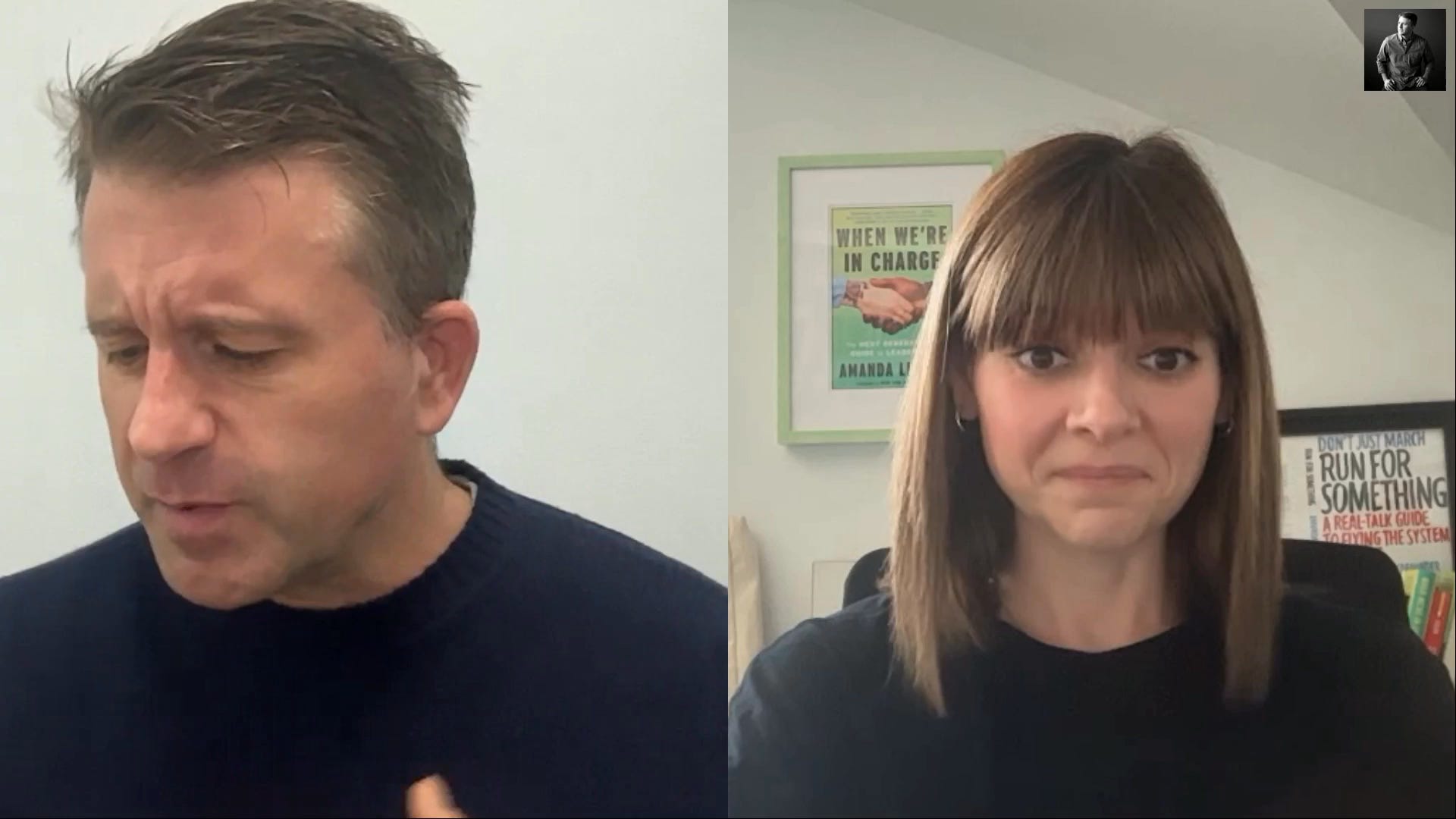
from The Forum with Josh Cowen Podcast · host Josh Cowen and Amanda Litman
I’ve been looking forward to chatting with Amanda Litman for a few weeks now. She’s the co-founder and president of Run for Something—the wildly successful grassroots organizing group that helps recruit and train thousands of progressive political candidates across the country.If you admire a progressive state or local leader in your community, there’s a good chance they’ve worked with Run for Something. A year ago yesterday, Amanda published When We’re in Charge: The Next Generation’s Guide to Leadership. It’s a highly readable approach to building out personal and professional values for decision-making, managing an organization, and seeing it all through for results. Amanda Litman has also worked at the highest levels of American politics—presidential and major statewide campaigns—and appears regularly across the country to weigh in current political events. JOSH: Amanda Litman thanks for being here. So let’s get started with some basics. I have a pretty politically engaged following here and I know you’re going to be familiar to some of those folks, but walk me through Run for Something and how you got started with that work.AMANDA: So I’m Amanda Litman, born and raised in Northern Virginia, went to Northwestern for college, and I was a senior in college, I started interning on the Obama campaign. I was hired before I graduated. And we won. That was so fun. I was doing online fundraising and volunteer recruitment. And I stayed working in Chicago for Organizing for Action for a year.I moved down to Florida to work on the governor’s race in 2014, where I was the digital director for the Democrat running for governor that year. And then I moved to New York, where I now live, to work for Secretary Hillary Clinton’s presidential campaign in 2015. I was her email director, so again, online fundraising and volunteer recruitment. And then we lost, and that was really sad.About a week after election day, I started hearing from people I’d gone to high school and college with who are like, “Hey, Amanda, I’m a public school teacher in Chicago. I’m thinking about running for office because if Trump can do this, seems like anybody can do this. What do I do? Who do I call? You’re the only person I know that works in politics. I don’t know where to go.” And at the time, if you were young and newly excited about politics, you wanted to do more than vote and more than volunteer, there was no way you could go that would answer your call. And that, to me felt like a symptom of really big problems, both in our democracy, but also in the Democratic Party.So I reached out to a whole bunch of people with an idea. What if we started an organization to solve this problem? One of those folks became my co-founder, Ross Morales Rocketto, and we wrote a plan, and we built a website, and then we launched Run for Something on Trump’s first inauguration day back in 2017.I thought it’d be really small. We’d get a hundred people in the first year. We had a thousand people sign up in the first week, and as of today, we have more than 260,000 young people all across the country who’ve raised their hands to run for office. We’ve endorsed more than 4,000. We’ve helped elect more than 1,653 across 49 states plus DC, and we’re the largest candidate pipeline in politics.“Policies as a candidate are less important than what they reflect about your values and who you’re fighting for.”—Amanda LitmanJOSH: So a year ago this week your book comes out: When We’re in Charge. It’s more a book about leadership than politics per se. But obviously you started that work during Biden years. Then Trump wins. Tell me what you were trying to do with the book at first, and now how it feels a year out.AMANDA: It’s an interesting question. So I started working on the book really at some point throughout 2023, because I started hearing from a bunch of reporters who were like, “Hey, seems like all of your candidates,” Mallory McMorrow, Zooey Zephyr in Montana, even the Justins in Tennessee who—while they were not our candidates—were part of the broader conversation around, in particular, millennial and Gen Z politicians who kept like making national headlines.And these reporters asked me, like, “what do these people have in common? Besides, you know, a bunch of them work with you all.” And I realized actually there was something really interesting going on, which is Millennial and Gen Z leaders were entering systems and structures not built for people like us and doing things differently.And that wasn’t just in politics, it was something I’d experienced running a company for most of the last decade. It was something I was hearing from my peers, from my colleagues. I was seeing it in, you know, on my TikTok or over on Instagram: people talking about Millennial bosses doing things a little bit differently.So I thought maybe there’s something here. The more that I read, the more that I talked to folks, the more I realized maybe there’s a book here. So we sold the book actually on my daughter’s 1st birthday, which is very monumental for me, because I was like, “Oh, right, motherhood doesn’t actually have to kill who I am as a professional,” which is really nice.And I wrote it throughout 2024. I ended up doing interviews with more than 130 leaders across a bunch of different sectors. You know, yes, members of Congress and politicians, but also the CEO of Snapchat and rabbis, and teachers, and doctors, and, you know, corporate executives.I kept hearing the same echoes of themes across all those conversations.So the book came out in last May, and I’ve been thinking back about what that moment was like. It was a month before Mamdani won the mayoral primary here in New York. It was a couple of weeks before these stories started coming out, a survey that Glassdoor did that said Millennials now make up a majority of all managers and Gen Z make up about one in 10.It was a conversation about generational change, about a need for a new group of leaders to take over in politics, in business, in media.I’m hearing from people over the last year who’ve read the book or listened to the book or skimmed it at the library. They’ve said, “this gave me a language to talk about a thing I didn’t know I was struggling with.”Or “it gave me this really hopeful, concrete advice,” or from Gen Xers were pissed that they were entirely left out of the book, which…Classic Gen X response. It’s just been so cool to hear and to feel really gratified that I was really speaking to something people were challenged by.“Be very clear about what your values are as an individual or as a leader, and then what your organization’s values are. And what is the difference between the two?”—Amanda LitmanJOSH: Well I think I’m on the tail end of Gen X. I turn 48 in August, and actually saw a lot of folks in my half generation above mid-Millennial in this book, so I appreciated it. Switching gears: put me down as some who thinks we’re in uncharted territory in American politics—and that includes in the ways expect the business community and the legal community interact with government. What’s your advice to people trying to build out a career—maybe not directly in politics necessarily but at least in politics- adjacent work like policy advocacy, consulting, and so on—in this really volatile and difficult-to-predict moment?AMANDA: I think there’s a couple ways to think about it. One is personally, like, make sure that your job is not your political home.Which is a really hard thing to do, especially if you work even quasi-related or mission-related work. If you have a job that feels like a calling, like you’re in education, or, you know, if you’re in media, where it feels like this is the thing you’re meant to do, and it’s how you want to make a difference in the world, that’s important.It’s good, but don’t make that the only place you do your politics, because if you expect your job to fulfill both your political and sort of like moral obligations, as well as your actual economic ones, you’re going to be screwed. You need to have a political home outside of your job, and that’s really important.Now, professionally, you know, I think, and related to this: Be really clear about what are your values as an individual or as a leader, and then what are the organization’s values? And what is the difference between the two? Because often, even if you’re starting your own thing, there is some distinction between the two.And then: where are the places where you can push the organization or the team or the company’s activity to be a little bit more values-forward? Because some of the frustration that people have with their workplaces is when they talk about believing in one thing and then behave differently. So when as much as possible, you can sort of close the distance between those, knowing that they’re never going to mesh perfectly with where you are as an individual.I think that can help deal with some of the cognitive dissonance people feel and the frustration they feel with their employer.“What are we actually trying to build in our public education system that meets the moment and is sustainable for the next 100 years?”—Amanda Litman JOSH: I reached out to you because of two messages I’ve seen you drive in your public engagement. The first is on family policy and politics. You’ve posted about family leave and other priorities Democrats need to embrace. I got involved sort of accidentally in politics as maybe the most visible critic of school vouchers short of Randi Weingarten, who’s a friend of mine. But everywhere I go—23 states now—I hear the same thing. Voter don’t like right-wing plans like vouchers, but what the hell is the Dem plan for schools? What’s the message for kids and families? I don’t mean a policy one-off—I mean the message. Since 2020, Republicans have been talking more about kids and families. Democrats have been talking less. What’s your take on all this?AMANDA: I think you got to get back to—not to be all like techie on you—what are the first principles here? What are we actually trying to accomplish and trying to solve for?And I think we’re at a moment where we get to really reimagine things or imagine anew. It’s not even going backwards but looking forwards. Trump has done in some ways the hard part, which is tearing everything down. I think one of the challenges that Democrats have had, honestly, the last couple of decades, is that because we helped build these institutions and these establishments.We have a hard time sort of thinking. Like, what could it look like if we were starting fresh? It’s why so many of our policies are like nipping around the edges, where it’s like, you know, the 300% increase of this kind of deduction. It’s because we don’t necessarily want to do the hard, scary thing of just starting over. Trump destroyed the Department of Education. Like he did it. He did the hard part. It was terrible. It’s horrible. Huge consequences. Okay, what is a new version of that look like? Like, what are we actually trying to build in our public education system that meets the moment and that could build sustainably for the next 100 years? What are we trying to build with, like our foreign aid, with our family policies? I think this is where you see candidates who can really succeed are ones who have a strong set of values and maybe aren’t as committed to any particular tactic so much as they know what they want to do.Like, you want to build a society where people can live where they want to live, can get their kids a good education, can have, like, fulfilling lives, can spend time with their family and friends, they don’t feel overly burdened by government, but also feel like government is there to support them and enable their ambitions and their dreams.That’s a really hard thing to navigate through, but what would we build if we were doing that? I think that is the question. There’s much smarter policy thinkers. I mean, I am not a policy wonk in the slightest. What I do think is that we have a chance in this moment to start fresh and start from first principles, from what is the thing we’re trying to build? And then work from there. I think that’s where Democrats often get lost is it’s they get stuck in reality and we stop being able to dream, which is really sad.JOSH: On this point. The second thing I’ve seen you talk about is the idea that we need to be flexible on policy but consistent on values. I think you nailed it. This is extremely important and stands out to me as someone deeply engaged in a particular policy space but is also trying to push candidates and electeds into more engagement on the why as much as the what. Can you give me some examples of folks who are good on this—flexible policy, strong on values—and, or, how you to try to drive that framing in the work you do at Run for Something?AMANDA: You know, we think about this in terms of: people have to reflect the place they’re in and be committed to community first and foremost. So in 2025. Good example here. Same night, same election year, same cycle, same team. We were able to elect Kelsea Bond, a DSA candidate union organizer, renter who was running on really aggressive tenant reform, climate justice, workers justice. She was connecting on the idea that housing and transportation issues are working family issues, because if you can’t get to your job, how are you going to make a living? If you don’t have green space to spend, like, to enjoy time with your kids, how are you going to enjoy your family?The same night we helped elect Andrew Harbaugh, who’s a former Republican who left the party on January 6th. So he was all in for Trump I. But the the insurrection was a step too far, which I appreciate. He’s a sports journalist, parent of two, for whom the Department of Education cuts really affected his kid with special needs in the public school system.He was like, you know what? Screw this, I’m gonna run for office as a Democrat. He was running in a deep red rural county in Pennsylvania that Trump won 70-30. He flipped a seat red to blue. Do he and Kelsea talk about the issues in the same way? No. Do they think about the issues in the same way? Kind of. Are they generally rowing in the same direction, and do they reflect the communities they’re in? 100%. And that’s what matters. When we think about how we’re going to win in the future and how we’re going to be able to win in deep red places and purple ones and give people leaders in blue ones who can actually govern. That’s how you do it. It’s making sure that you, you know, we talk about building a big tent.A tent still has a temple in the middle. It also still has walls. That means there are still boundaries, and to a certain extent where you draw the line. I think that’s part of the metaphor that people forget when they’re talking about it like the values are the tent pole borders where we draw the line, and how to make sure that to be inclusive.But still a little bit of the bigots and the hatefulness out.“Everyone of every age is feeling frustrated. Everyone of every age feels like things are harder than they should be.”—Amanda LitmanJOSH: Last question, kind of a wrap-up and wrap-around. All three of my children will be voting in the next presidential election. Two are voting this fall. My own parents are still alive and have opinions and values—and needs. You’ve got kids and you write and talk a lot about parenthood. With the caveat that candidates and political leaders can’t be all things to everyone, what’s your advice for folks trying to speak to voters at different stages in the life cycle? Maybe go harder than advice. What you do want new progressive leaders to be talking about to reach as broad a section of American families as possible—both from the standpoint of winning damn elections but also in terms of what’s the right thing to do?AMANDA: I think sometimes Democrats have a tendency to focus on facts over feelings.And, you know, the Republican Party notoriously over the last couple years has been like, your feelings, you little snowflakes, whatever. It’s like: One, feelings are really important, because people do not engage with politics on an intellectual level. Most people, if you have like an intellectual conversation or a framework for how you engage in politics, you are much more engaged than 90% of the American electorate, 95% electorate. Most people are thinking about it in terms of feelings.I think this is one of the challenges of Biden in 2024, and one of the things that Trump is going to struggle with in 2026 is you can’t tell people the economy is good when they don’t feel like it’s good. Whether or not the numbers are there, and with Biden, maybe they were with Trump, they are absolutely not.If it feels hard, you’ve got to speak to that feeling, and then give people a path out of it. Honestly, it’s very much like parenting. You know, I have a 3-year-old and a 1-year-old, and my 3-year-old had a massive meltdown this morning. We were getting ready to leave for school, and she was upset because her little sister got her shoes on first, and she felt like she was losing, and how could we let the baby win?It’s like one? That’s insane. It’s objectively insane. It doesn’t matter who wins and who loses in putting their shoes on first. But for me to say that to her—and I was because I’m exhausted—that doesn’t help her. That doesn’t help to you got to speak to how people are feeling and then give them permission to feel that way, and then a path to the next feeling. I think that’s where what Democrats are talking about. How do you, like, speak to so many generations right now? You know, everyone of every age is feeling frustrated. Everyone of every age feels like things are harder than they should be.And everyone feels like they can’t have the life that they want. Like whether that life that they want is being able to retire and spend time with their family—but they can’t afford to live near their kids, or their kids can’t afford to live near them. Or if you’re younger, you maybe can’t afford to have the kind of family that you want.Of if you’re younger still it’s like, “screw you. I’m not gonna have a family. I’m going to be gambling, because the future is totally unreliable. Who knows what it could look like? I’m spending it all on Kalshi in the prediction markets.”I think speaking to that anxiety and to that uncertainty, there’s lots of different ways in which policies can speak to that. But those policies as a candidate are less important than what they reflect about your values and who you’re fighting for, and how you understand how people are feeling.So that’s what I would recommend to candidates and to leaders at large now is like, understand how people are feeling. And the way that you understand them is by talking to them and actually listening and then repeating it back to them. Honestly, it’s it’s parenting, but in politics.Amanda Litman is the co-founder of Run for Something, author of the book When We’re in Charge: The Next Generation’s Guide to Leadership. It's a year old now, but more relevant today than ever before. This is a public episode. If you'd like to discuss this with other subscribers or get access to bonus episodes, visit joshcowen.substack.com/subscribe
Embed this episode
Ready to play
Building for the Next 100 Years
No transcript for this episode yet
Similar Episodes
No similar episodes found.
Similar Podcasts
No similar podcasts found.