
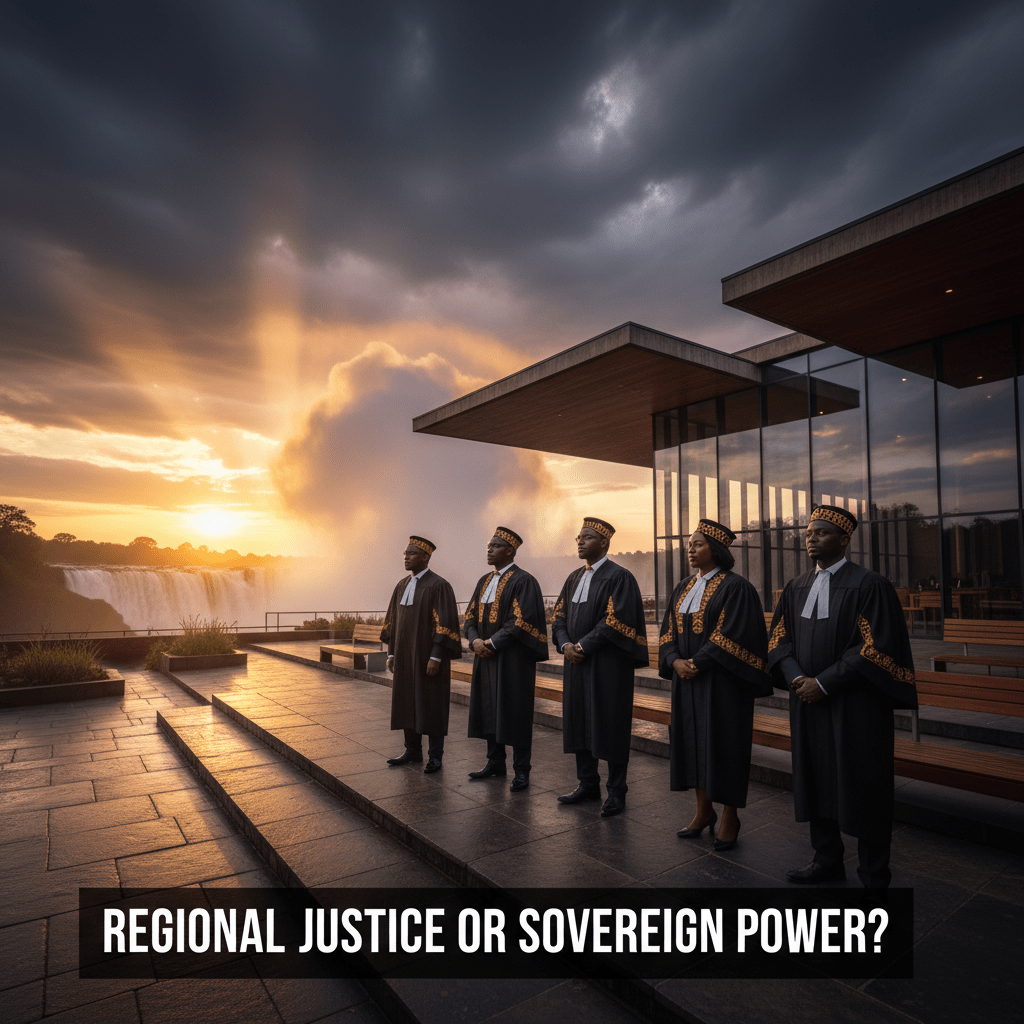
EPISODE · May 27, 2026 · 10 MIN
Can Regional Justice in SADC Survive Host Sovereign Power?
from African Elements Daily · host African Elements
Explore the historical struggle between the SADC Tribunal and national leaders, highlighted by Zimbabwe's controversial hosting of SADC legal meetings. Can Regional Justice in SADC Survive Host Sovereign Power? By Darius Spearman (africanelements) Support African Elements at patreon.com/africanelements and hear recent news in a single playlist. Additionally, you can gain early access to ad-free video content. The Victoria Falls Gathering and a Deep Historical Irony The Southern African Development Community selected Victoria Falls, Zimbabwe, to host its high-level legal gathering (sadc.int). Ministers of Justice and regional Attorneys General met on June 5, 2026, to discuss legal oversight and harmonization (sadc.int, sadc.int). Although the rhetoric from this conference sounds progressive, hosting this meeting in Zimbabwe presents a profound historical irony. The history of regional justice in Southern Africa is defined by a persistent struggle between regional courts and national leaders. To understand this tension, one must look back to the legal origins of the regional bloc. The organization was first formed in 1980 as the Southern African Development Co-ordination Conference (SADCC) (wikipedia.org, wikipedia.org). It was later restructured into the Southern African Development Community in 1992 through a treaty signed in Windhoek, Namibia (wikipedia.org). The foundational treaty of the bloc binds all member nations to key principles (sadc.int). These values include sovereign equality, democracy, human rights, and the rule of law (sadc.int). To enforce these high standards, regional leaders established a specialized court. The SADC Tribunal and the Campbell Case The regional bloc set up the SADC Tribunal in 1992 to enforce the core principles of its treaty (cglj.org). The court became fully operational in 2005 with its official headquarters located in Windhoek, Namibia (cglj.org). This body was designed to serve as an independent judiciary of last resort for the entire region (cglj.org). It allowed individual citizens, corporate entities, and groups to seek justice when their domestic legal systems failed to protect them (cglj.org). This mechanism was a bold step toward creating true supranational oversight in a region deeply marked by post-colonial struggles. However, the regional court soon faced its ultimate test in a landmark case that began in 2007 (africanlii.org, wikipedia.org). The case of Mike Campbell (Pvt) Ltd and Others v. Republic of Zimbabwe involved seventy-nine white commercial farmers (africanlii.org, wikipedia.org). Led by Mike Campbell, these farmers challenged the Zimbabwean government's land reform program (american.edu, wikipedia.org). On November 28, 2008, the SADC Tribunal ruled unanimously in favor of the farmers (jusmundi.com, saflii.org). The court declared that the land seizures violated the treaty, were racially discriminatory, and denied the applicants legal access to domestic courts (yorku.ca, up.ac.za). Decolonial Struggles and Land Inequities The land seizures in Zimbabwe cannot be understood without examining the post-colonial history of the region. The Fast-Track Land Reform Program was launched in 2000 to address deep racial inequalities in land ownership (american.edu). Under British colonial rule, racist policies had systematically dispossessed indigenous African populations of their ancestral lands (oxfordre.com). Consequently, a tiny white minority held the vast majority of fertile, high-value agricultural areas at the time of independence (american.edu). When Zimbabwe achieved independence in 1980, it inherited this deeply unequal distribution of wealth (american.edu). The initial "willing buyer, willing seller" model did not achieve significant progress due to severe budget constraints and legal limitations (american.edu). In response, the government initiated the land reform program to speed up land redistribution (american.edu). While many viewed this as a necessary step for decolonizing institutions, research indicates that the process was heavily politicized. The government allocated seventy-eight percent of prime commercial farms to ruling party elites instead of marginalized black families who needed the land (american.edu). SADC Regional Demographics & Economic Reach SADC Member States 16 Nations Estimated Population 417 Million Combined GDP (USD) $828 Billion+ The Dismantling of Regional Judicial Power The ruling of the SADC Tribunal created an immediate backlash from the Zimbabwean government. The administration under President Robert Mugabe rejected the court's authority (wikipedia.org). Officials declared the ruling null and void, arguing that no international court could override Zimbabwe's sovereign constitution (escr-net.org, american.edu). Fearing that their own domestic policies might face similar international policing, other regional leaders sided with Zimbabwe. This political solidarity resulted in a severe blow to regional accountability in Southern Africa. In 2010, the SADC Summit of Heads of State took the drastic step of suspending the Tribunal (unisapressjournals.co.za). By 2012, a new protocol officially stripped the court of its ability to hear human rights petitions from individual citizens (up.ac.za, ejiltalk.org). This change limited the court's jurisdiction to disputes strictly between member states (southernafricalitigationcentre.org). This action left millions of citizens without a neutral regional avenue to address promises of legal protection that their own governments had broken. Global Backlash and the Fight for Restoration The decision to dismantle the Tribunal caused widespread international and regional outrage. Global human rights organizations, including Human Rights Watch, condemned the action (hrw.org, hrw.org). They argued that SADC leaders had weakened the rule of law to protect a single government from accountability (hrw.org). Legal associations across Africa also took action to reverse the decision (southernafricalitigationcentre.org). Activists and legal groups launched several major court challenges. The Pan African Lawyers Union and the Southern Africa Litigation Centre petitioned the African Court on Human and Peoples' Rights (africalegalaid.com, southernafricalitigationcentre.org). Furthermore, local judiciaries stepped in to challenge their own governments. In 2019, the High Court of Tanzania ruled that Tanzania's participation in suspending the Tribunal violated regional treaty obligations (unisapressjournals.co.za, dullahomarinstitute.org.za). Similarly, the South African High Court declared that former President Jacob Zuma's signature on the 2014 protocol was unconstitutional (hsf.org.za, verfassungsblog.de). Despite these domestic victories, SADC heads of state have kept the Tribunal's human rights powers inactive (southernafricalitigationcentre.org). Zimbabwe Rule of Law Deficit 7.9/10 (where 10 is the worst deficit) GBV Rates in Zimbabwe 68% Lifetime rate among women The Modern Dialogue and the Performative Agenda The June 2026 meeting in Victoria Falls shows SADC's ongoing efforts to project an image of legal credibility (sadc.int). During preparatory sessions chaired by Zimbabwe's Minister of Justice Ziyambi Ziyambi, ministers put the "re-operationalization" of the Tribunal on the agenda (sadc.int). They also discussed amending the regional protocol on finance to combat financial crimes (sadc.int, sadc.int). Yet, critics argue that these discussions lack genuine political will. Regional leaders continue to resist any efforts to restore individual citizen access to the regional court (southernafricalitigationcentre.org). Because any binding changes to the SADC Tribunal require unanimous agreement, governing elites easily block any reform that threatens their domestic power (southernafricalitigationcentre.org). Consequently, the discussions about rebuilding the court remain largely performative, designed to appease international donors. The Host Selection Puzzle and Geopolitical Realities The choice of Zimbabwe as the host for these legal meetings highlights the complex geopolitics of SADC. The selection of a host country is normally linked to the rotating chairmanship of the regional body (ulisboa.pt). Under standard guidelines, the nation holding the chairmanship hosts the high-level summits and ministerial meetings (sadc.int). However, a series of political crises disrupted this rotation. In August 2025, Madagascar assumed the rotating chairmanship from Zimbabwe (sadc.int). Unfortunately, a political coup in Madagascar in late 2025 forced the island nation to step down from its leadership role. In response, SADC selected South Africa as the interim chairperson until August 2026 (sadc.int). Because South Africa was managing a sudden transition, President Emmerson Mnangagwa of Zimbabwe offered to host selected regional meetings (sadc.int). The heads of state accepted this offer, which placed Zimbabwe at the center of the regional justice dialogue. Financial Laundering Standards and FATF Pressures A key focus of the Victoria Falls meeting is aligning regional laws with global financial regulations. SADC ministers are recommending changes to the SADC Protocol on Finance and Investment to combat terrorist financing and money laundering (sadc.int, sadc.int). These changes are designed to align regional policies with the standards set by the Financial Action Task Force (sadc.int, sadc.int). The Financial Action Task Force is a powerful global watchdog created by the G7 in 1989 (participedia.net, oam.org.mz). It sets international frameworks to prevent financial systems from being used for illegal activities (oam.org.mz). SADC nations face heavy pressure to comply with these rules. Failing to do so risks being placed on a global "grey-list," which severely limits a nation's access to international loans, foreign direct investment, and global banking (issafrica.org, issafrica.org). Nevertheless, these highly technical standards strain the limited resources of developing African nations (issafrica.org, pmg.org.za). State Violations 113 Unique recorded acts during 2024 Summit Arbitrary Arrests 160+ Activists and leaders preemptively detained Affected Individuals 6,284 Impacted by policing during the event Rhetoric Versus Reality on the Ground While SADC ministers debate human rights and governance in Victoria Falls, the reality on the ground tells a very different story. The host country has a long record of suppressing domestic opposition. For instance, when Zimbabwe hosted the SADC Summit in August 2024, the government launched an aggressive crackdown (hrw.org, amnesty.org). State security forces carried out preemptive arrests to prevent any protests from occurring while regional leaders were in the country. Authorities arrested over one hundred and sixty civil society activists, union leaders, and political opponents (civicus.org, zimbabwesituation.com). These individuals, including opposition figures like Jameson Timba, faced prolonged pretrial detention and torture (jurist.org, zimlive.com). This systemic violence shows the ongoing challenges that citizens face in their struggle for survival under oppression. After the summit ended, ruling party officials openly admitted that the arrests were designed to secure the event, showing a complete disregard for due process (newziana.co.zw). The Modern Political Landscape This domestic crackdown is a direct reflection of Zimbabwe's current political landscape. The nation is dominated by the ZANU-PF party, which has held power since independence in 1980 (oxfordre.com, freedomhouse.org). ZANU-PF maintains its absolute control through the systematic use of state security forces and the weaponization of the judicial system (freedomhouse.org, freedomhouse.org). This dynamic makes genuine democratic competition nearly impossible. The primary opposition party, the Citizens Coalition for Change, was formed in 2022 to challenge this authoritarian monopoly (jurist.org). Led by Nelson Chamisa, the party quickly gained popular support (jurist.org). However, the ruling party targeted the opposition with arrest campaigns and court battles designed to destabilize the organization (jurist.org). In January 2024, Chamisa resigned from his party, stating that the state had completely hijacked the democratic space (jurist.org). This political closure highlights the urgent need for communities to continue addressing historical injustices in their fight for true democratic representation. About the Author Darius Spearman is a professor of Black Studies at San Diego City College, where he has been teaching for over 20 years. He is the founder of African Elements, a media platform dedicated to providing educational resources on the history and culture of the African diaspora. Through his work, Spearman aims to empower and educate by bringing historical context to contemporary issues affecting the Black community.
NOW PLAYING
Can Regional Justice in SADC Survive Host Sovereign Power?
No transcript for this episode yet
Similar Episodes
No similar episodes found.