
the sort of lost world that perceives ours, that gave rise to the digital computer. This machine that really uplifts symbolic abstraction to new heights is predicated on the work of people that were really in these scientific, logical ideas with their hands and their bodies. Bush talked about, you know, something like, you talk about a barnyard understanding of engineering, right? Like, you know, we really want people to learn.
Yeah, the math is fine. The symbolics is fine. But he was really, this was a culture that really treasured, geographically, and then also thinking with objects and systems that people can manipulate. I came across reading the work of the sister and their own to talk about the sort of engineering culture that produced Bush and how graphics were so important to them.
And I think about that a lot now, actually, with how I have my wife and my friends whose grandfathers were draftsmen, new people who for a living, they produced the technical illustrations that so much of the world needed. And that is a category of labor that has disappeared. But we still have more graphics in a sense than ever before. The ease with which we can create computer graphics and how graphics are integrated to other tools that we use on computers means that many more people can produce graphics.
You do not need a specialist. That labor has been reorganized. I just think about the loss of that graphical skill. It is not as prevalent now as it was back then.
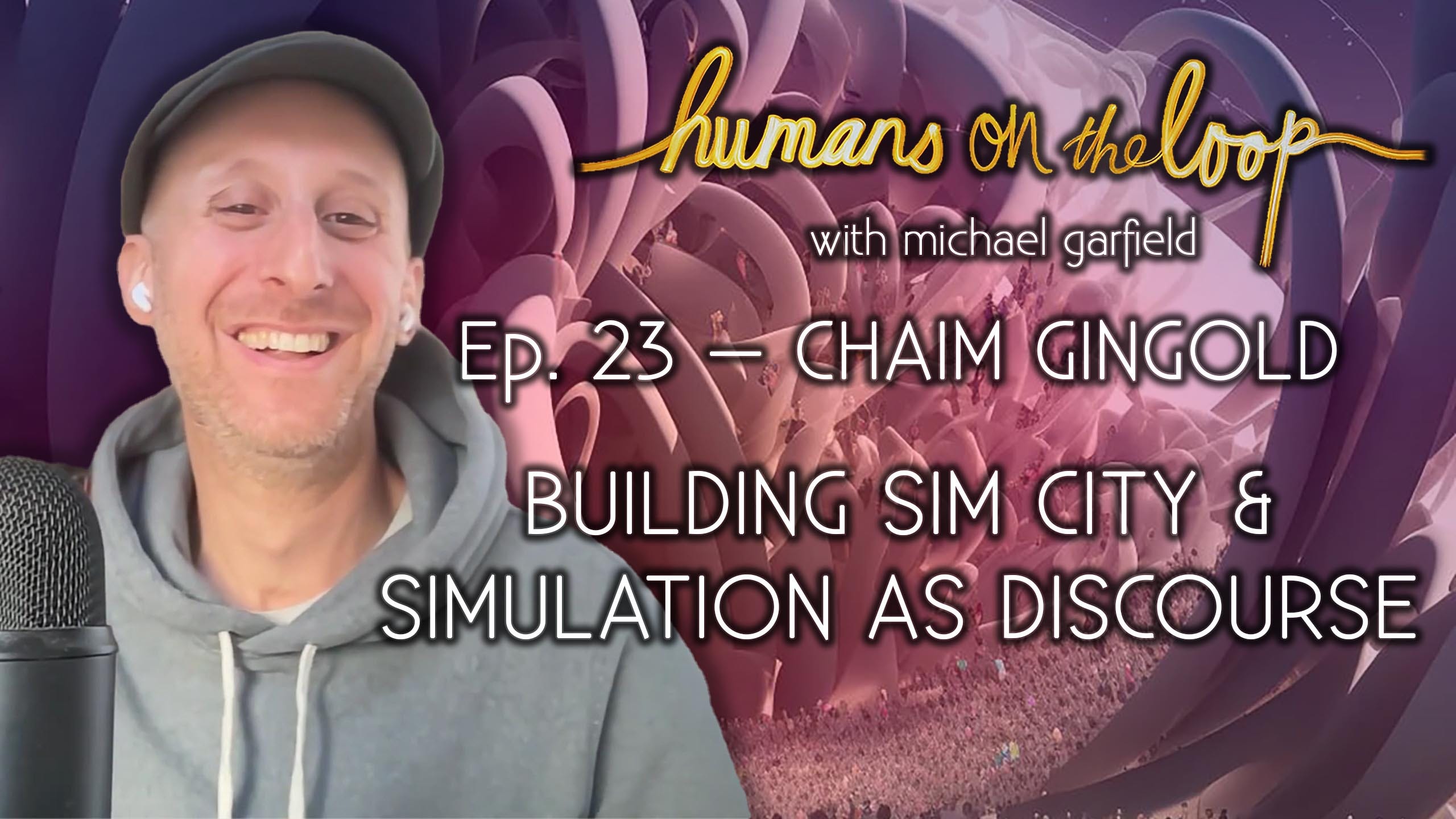
But that to me is a very interesting example of that turn towards abstraction. Welcome back after our summer sabbatical to Humans on the Loop episode 23 of the show that explores wisdom in an age of magical technologies. I'm your host, Michael Garfield. And this week I'm talking to Heim Gengold, one of the creators of the game Spore, along with the legendary Will Wright of SimCity fame.
And we're talking about his book Building SimCity, How to Put the World in a Machine, published by MIT Press, one of the most fascinating and comprehensive histories of computing and specifically of simulation available in the world today. Heim has spent his life creating new games and toys, someone who has thought deeply about our relationship to software and hardware and reading Building SimCity helped me understand something very fundamental about human thought. Thinking depends on abstraction. Our ability to detect patterns, to form categories, to derive analogies relies on a kind of constant statistical association, aggregation of information, and a production of groups of things that we use to reduce uncertainty and navigate constantly evolving environments.
So we rely on abstraction and at the same time, anyone who's been listening to the show for a while knows that we are running serious risks right now of being too deeply embedded in our abstractions. Biggatory and stereotyping are obvious examples. Making claims about what is, without communicating the underlying process by which we decided on the rules of these advanced biological simulations we inhabit, leads to conflict between differing worldviews, cognitive dissonance between different versions of identity that we hold within ourselves. And then there's the problem of the appropriate level of abstraction.
How much detail is necessary in order to understand the mechanistic relationships between things? All of us are guilty at some point of, as James C. Scott put it, seeing like a state, of mistaking our categories for the things themselves. And then operating on only a very thin slice of the actual world.
In our technologically advanced era, it's not so simple to say the map is not the territory because the maps we produce increasingly constrain and determine our behavior. So the matter of simulation, the way that we choose details for our maps, what those details belie about the assumptions we're making, about the worlds that we inhabit and create, are not just questions of art, they are existential concerns in an age of exponential artificial intelligence, and the self-fulfilling prophecies of our increasing technological leverage. Humans on the loop is ultimately about how the means that we have at our disposal can assist in this and about the urgent need for us to engage in better introspection about what we want, where those desires come from, and what is worth wanting. And of course, can we want better?
Can we imagine better? Himes book explores how the success of SimCity was predicated on the fact that it was less a game with concrete terminal wind conditions and more a toy that invited the creativity and exploration of its users. And it was a pleasure to talk with him about how we can use his historical review as a case study for thinking about how the challenges that we face in this century might be better met through thinking in terms of game design and the timeless art of play. These were the concerns on my mind last month at the Diverse Intelligence's Summer Institute at the University of St.
Andrews in Scotland, where I gave a 10 minute talk on foraging in high dimensional data, thinking about how complex systems and game design can inform a healthier relationship to technology and specifically to the interfaces that we used to engage with the vast and mysterious technological world. I also recommend my recent Aeon magazine feature essay, Our Humans Destined to Evolve Into Crabs, which is of course ridiculous, but explores these issues through an evolutionary framework. And obviously, this wonderful book, Building SimCity, you can find a link to buy it in the show notes to this episode. I hope you enjoyed this conversation as much as I did.
Hime is a fascinating person, very deeply researched. If it sparks something in you, please do the like, subscribe, dance, follow me on sub stack. And consider joining other members for our regular hangouts, which resume in two weeks, where we'll explore exploration, the built environment, and how we can make the internet a more playful platform. Playful and creative place.
Thanks so much for listening and enjoy. Thank you. Let's try to swallow the whale of this. I've got more on the Maxx.
I have done more thinking about the Maxx's post-mortem recently. I got the New York Rise and Follow the New Liberal Order by Gary Gerssel. And that's how we put it in a bit more perspective on it. Well, yeah, I just, again, like for folks who are watching the book, took me weeks to read.
I highlighted half of it. And I feel like even addressing the full scope of the stuff that you brought up here would take like a Lex Friedman, like seven hour. Marathon thing, where we're all like peeing into a catheter in our astronaut, do it's below the desk or whatever. But I think that if the goal is just to sell this book, which is a goal for me here, because it's marvelous and should be taught in school, then we can do that in that.
Thanks for being here today. Thanks for having me. I'm looking forward to this. So yeah, building some city is one of these books that like you are peeling off the surface of everything you thought you knew and realizing it's all connected underground.
It was like for people who are into like Adam Curtis documentaries, that same conspiratorial web map satisfaction, but in a way that I found to be very careful in its claims and very patient and deliberate and methodical with the reader to put everything together in a way that really lays out just how prevalent simulation is in our society and how deep it goes and how many assumptions were standing on when we think about our world. So just hyped. Where I would love to start with you, though, just as a way of introducing you before we dive into Idea Land is for you to tell everybody who you are and why you care about this stuff, why this was a dissertation topic, your professional history, but even deeper like therapy session, like who are you? Where did these interests come from?
What is behind them and motivating them in your life? Yeah, that's a maybe the hardest question. Let's see. So yeah, I'm a identify as a game designer.
I have a background in computer science and game design and I don't know where to start with the history of myself and I come to this. I guess I've been obsessed with computing and computers and simulation and games since I was little. And some point I went back to school to do a PhD in computer science. I wanted to write about the history of games and I just, and SimCity had been open to source and that would made it enticing target the original SimCity.
I'd work with Will Wright, the creator of SimCity who I think is a really fascinating individual. And the more I just kind of kept pulling on this thread, the more there was there. And in a sense, I think about this book project as an obsession that would not die, that I wrote for this obsession to sort of be resolved. I needed to complete this project.
And part of it was about, was like, there's this thing that mesmerized me and it was almost like I was trying to like work through like a fever. Like, why is this fascinating? And the more that I dug into that, why is this fascinating for me and for others, it was became this, as you say, this sort of subterranean exploration of all of this web of topics. And sort of it was like, I'm so the more that I dug, it was like, oh, there's even more roots here.
They correct these other roots. And yeah, I don't know. When did you decide you wanted to become a game designer? I think that.
I mean, on the one hand, I think we're all game designers. I think all kids like make games. I remember being like a kid with my siblings, like making hypercard games just because that's what you did with computers, basic games, which is what basically, in a sense, many senses was created for professionally. I think I wanted to do it at some point.
And then when I was probably a teenager, and then I think I lost interest in that. And then when the opportunity came up when I was in my early 20s, I was doing a master's degree in Georgia Tech to intern with Will Wright and Maxis on his new project. And then I was like, I was very excited about that. I was like, that's a very cool opportunity.
I was a little bit skeptical. I was like, is this really a real? I really get to work with Will in the answer was yes, I did. And it was amazing.
And I think that there's a lot of games I find uninteresting play a lot. I don't play a lot of games anymore. But I still play some. But I want something that's kind of weird in novel.
And so the Will Wright works. So there's some city, some Earth, some sort of friends, some life. Like those things really interesting. So I was like, these weird things.
So Spore was interesting game to work on. Like Call of Duty were not interesting game for me to work on. But weird simulation games that deal with subjects of interest that are beyond just the sort of intercultural world of games. Like that really interested me.
So actually this, if we're going to start in the macrocosm of childhood and why simulation based games occupy, as you say a few times, one of my favorite words, the liminality, not quite a toy, not quite a game, I think is really interesting. And so this is good because I feel like talk about Dreen Gary Nelson, her work in city simulation with physical materials in the classroom environment and how that differed from what Will Wright built with some city. And I think that this is going to be a major theme I want to prosecute in our conversation about what James P. Cars calls finite and infinite games point to a number of theorists who make the distinction between gaming and play.
And so we're skipping to the end of your book here. But I would love to hear you go into a bit about this because I think just to situate it from my interest in this is that I regard what I'm thinking about this show as a way of helping people develop a sense of curiosity and play about engagement with artificial intelligence. Part of that is getting people out of the mindset of regarding something like chat GPT as a productivity enhancement in which people win a finite game of success and status in society and into a state of fuck around and find out where you see, as you say towards the end of the book, that players according to Will Wright are a designer's most important resource. Designers do not shape electronic computers as much as they sway and stoke player imagination.
And you point to the way that, for instance, John Conway with the game of life leveraged an enormous reader audience with Scientific American to get people to mess around with cellular automata on their PCs. And so there's this thing about, for instance, the recent trend, I saw that like a bunch of people are trying to get chat GPT to say David Mayer and it won't. And no one can figure out why. And so everyone's trying to like jail plate chat GPT to say the words David Mayer.
And so for me, this is a way more interesting way of relating to. It's like a Truman show kind of experience for us. Yeah. This thing doesn't exist in a simulation.
Right. And so that's one of the characteristics of this kind of game that you and I and so many other people find interesting, which is parameterizing it and trying to break it and trying to figure out the failure modes or how to do weird stuff that the programmer didn't intend. And so yeah, play versus games is where I would love to hear you start to. I love the chat GPT connection because that was like a for me to go from chat to being very skeptical of LMS to being an enthusiastic user of them.
It was all about finding that playful orientation, which I think is an idea that I got from Ethamolic, I think. So you just got to I don't know if he actually uses this sense of play, but it was that sense of he's got to play around with this and see what I was like, I need to bring this child like frame to this. So playing games. So I really wanted to frame SimCity and other simulation, open ended simulation things as play and not game.
Part of that was that if you think about them sort of games, depending on which definition you go by games are these more things like something like SimCity is a liminal game. It does not quite a game. If you look at Yes, for you all the game theorist definition of games keeps up some city you cannot win or lose it and games he says I have to have win or lose conditions. It's got to have a because that finite game has got to this as a boundary is a clear outcome.
SimCity does not do that. SimCity gets to do whatever you want and the game I'm going to use the word game that I try not to in the book. SimCity is a play thing. It doesn't tell you whether you want to get lost.
It gives you a lot of rich feedback and you decide. So I wanted to read ground. I wanted to find a grounding for discussing it and its cousins has play. I looked a lot of time at the play theory which is super fascinating space that is philosophic.
It touches on like scientists studying children playing and it touches on theology and all kinds of different subjects. My perspective that I came to is that I think about play as a more general category and all it seems like increasingly different kinds of animals we now know play used to be thought that turtles didn't play and bees didn't play but I think in the last year or two this fascinating paper that came out talking about how bees play and there's a video of a bee playground. Basically the side to the day where they're like well see the bees chose to go push these balls around this little bee playground even though it serves no purpose for them. They choose to do this behavior and it fits the philosophical definition of play.
So play is something we all do and many animals seem to do and I think of games as I subscribe to the theory of games as a subgenre of play in which the rules are more like ossified and I like this one theory of subscribers games as social objects. They have these things that sort of play that sort of settle down and you look at play theorist Brian Stem Smith, one of the most influential plays to play scholars in the 20th century, he talks about plays so inherently unstable. The rules are always the rules change the game the play can fall apart at any moment because play is all about inversion so the rules can be inverted its empty able to gain sort of create this container for holding play and containing it. It's like a playground with walls though play gun is no play.
And so play and that's it is not necessarily even necessarily it's a place about and some Smith art talks about play as being educational or uplifting or it can be dark. It can be about power. It can be about domination so plays he has a less is a less romantic. I'll say sense of playing cup is a romantic but beyond.
And then you say of games quoting will write tend to be isolated universes where there's a rule set and once you leave that universe the rule set is meaningless. I keep thinking about this in connection to something you said just prior to this in the book that they will write actually had a problem trying to sell this that originally he was trying to work it out with Rotterbahn and everything at the time was war games which makes sense and a little bit I want to get into with you the history of computation in the military industrial sense where it vanver bush and all of that. But war games is the clear concrete goal and again like the finite game or the classically defined game is the big one that everyone I talk to on this show recognizes in some sense as not all encompassing but we are forced to play is the game of finance is the game of economic success like you have to go you have to play this game you have to assume the persona that like goes into the office or sits there on the zoom call like I am not a cat. And the issue that he keeps coming up against first in before Maxis even exists and then later when Maxis is opened up for public offering and suddenly has to answer to investors.
SimCity is not a win-lose thing but then the production of the productivity of this game studio is now answerable to the win-lose conditions of the market. The big question here about simulation before we really get into the philosophy of simulation is of the way in which we get lost in that simulation where we forget that there's a world outside of the symbolic abstractions of money and status and how this interferes with the attempts throughout computer history by people like Alan Kay and many other educators to create open-ended learning environments that are directed by the learner and are not like standardized testing. They're not answerable to these goals that are like the and so we get distorted as you say abstractions about the crown jewel of computing and its grotesque deformity. So yeah I would love to hear from you about how this theme shows up again and again in the relationship between the development of computation and of computer games and of the explosive success of computer games in the market and the way that has changed affordances by which we understand what we're doing as people in society.
It's like a real big theme here in your book. One of the things I was surprised by when I was thinking of the history of computing was just how often play games, playfulness even. Just playfulness shows up as a theme throughout the history of computing and space for this game of life as you mentioned is a very well-known example of a computer computational pastime. These are actively playful and never-people engagement and then there was of course space war before that and it shows up again even like whirlwind one of the first interactive digital graphical computers I think the first.
There was like this they had a little bouncing ball game that they made for it. I mean little sound effects and so it's just and it's just and this is not just people blowing off steam or sort of getting some getting a yayas out. Also these playful they also end up being sort of serving instrumental purposes as well. So space war was made for people have people made it.
These hackers made space war to sort of show off and explore the computer can do and play but then space war became distributed by deck at one point. The computer company has a way to test their hardware or to test their computers and demo their computers right and so there's this kind of they feed each other. So whether something is placed instrumentalized or not they both seem to be dialectic between them that goes through the history of computing. And I think that thing will write you so with Maxis and will write and Maxis as a business venture is super interesting because will is someone who definitely I think that he's able to produce what he creates because he is not thinking he's not focused on winning that finite game of making money right he just follows his he just follows his interest.
And sometimes those interests that he follows become products that a lot of people want is in the case of SimCity and the Sims but they need to still be yoked to some commercial more finite sort of entrepreneurial energy to come to market which is what you see right. Bruderbund did not want SimCity. They've been made print shop they made things that were not games I think there was a liminali of SimCity they were like well looks like it looks and feels like a game we know you was a game developer from your last game that we published but I don't know you should be able to win or lose this thing and they passed on it and Will didn't want to compromise on that and then you see it once they take once Maxis takes on investment they get more oversight and so it's like there's this tension between the company that eventually pulls it apart is when I argue but also enables it to create these amazing things along the way. One of the characteristics of play that you mentioned is you're safe to fail and earlier on you know you talk about Will Wright and Alan Kay having a very different attitude toward failure that you know something more common software engineers precisely because they're working with these abstract symbolic systems and you have to play around and see how alterations to the code affect the way the program actually runs is that people who learn to code are comfortable with failure in a way but it's like it seems to be because you are afforded an opportunity to iterate because you're not really making those edits to the source code in real time in ways that affect your own ability to survive in the world and that this is the big difference like this is the difference between what it means to to engage as if you are going to work to feed your kids and then just going to work to feed your kids and so there's a big question in this show that keeps coming up is one of how it is that we can inculcate in people if we assume fear and curiosity as pulse along a gradient evolution as you mentioned has more or less ubiquitously figured out that we need some sort of learning period in animal development and there are you know at the level of populations or ecosystems the ability of systems to respond to novel stimuli and situations outside of the training data of inheritance has to involve something that looks to anyone trying to assign purpose to activity as though it's inefficient or noisy and so there's what I see is like ultimately like a scalar issue here between what play is doing instrumentally on evolutionary time scales and what it appears to be doing at the time scale of the classically defined individual and so the question that keeps coming up is again like how might we in a kind of biomimetic way acknowledge this and intentionally start to encode that design-oiled intelligence into our social structures and our educational systems knowing that over longer time scales this is actually what works and so I'm just thinking through this book about there are reasons that simulation has become such a popular genre of software and you talk at length about why SimCity was so successful again why Conway's Game of Life was so successful and I wonder if you can abstract from that into some sort of protocol for threading this particular needle in the design of social system.
Yeah that's a really interesting question I think part of what something like SimCity or Conway's Game of Life do is they give people permission to play it's like that's part of what we need is that sense of invitation and comfort so it's you can relax a little bit you don't have to worry about winning some finite game not looking foolish in front of your peers not putting something at risk so I wonder about how it's interesting there's this rise in simulation that we have quite with this computer so we have more computers we have more simulation power and a sense though of course as well right points out the ultimate simulations that we have are the ones in our minds the ultimate simulation resource that we have so how do you create how do you engender more sort of it's almost like I feel like what you're asking is how do you engender more playfulness in our social systems more sort of imaginative exploratory play I think about my son does one he's just like always getting into stuff and he's just really eager to see what happens if it might kill him but luckily I'm there to catch him so he has that he doesn't need to worry about it so much even if we can I guess that is it if you think about again financial investment the people who seem to do best as investors are the people who are wealthy enough to be able to take the risk and so in a sense really what I'm asking you is to answer a wicked problem question how can we think better the baseline of human flourishing so that people can step out a limb without as much of a concern even in like anyone who's in a like married I think or in some sort of long-term relationship can observe the ways that something in my case like something really changed between my partner and I when we had kids and suddenly every the stakes felt so much greater and yeah something shifted in us as people and like part of that is natural and understandable and part of that is it you get to this point where it becomes it's like equivalent to scaling laws and the way that in a similar way to Maxie Ed Catmull's history of Pixar talks about when Pixar was acquired by Disney and they had to come in and save Disney animation because everyone at Disney animation had a history that they had to honor and they were trying to reproduce what had worked under Walt Disney and Pixar had to come in there shake things up and show them to great success this is how we've had 14 number one films in a row and you guys haven't had a number one movie in 16 years there's a counterintuitive thing that you bring up in complex systems that actually success requires some sort of rebalancing of that risk portfolio and it's probably a good example you're bringing up to because it's not as if the artists and animators at Disney weren't I'm sure they were very playful people that probably really met engendering a sort of the right playful exploratory orientation organizationally and managerial that enabled that to create their circumstances for that to come out yeah I also I'm also thinking as you're talking I also thinking about dark play and you're just the finance example I'm thinking about the way that something could be playful for one individual but it could not be playful for somebody else like I think about a cat playing with the mouse the cat may be playing but not the mouse and I think about that sort of sort of there's a kind of power sort of power dynamics of play there too so perhaps for some villainized financier that we're imagining they may be playing maybe having a great time playing around with some market and there may be a lot of people at the end of it who are not having a good time with their someone else's play so part of this is about to think about this socially what does that mean it's how to be faster I don't know sort of non-dark play I'm just putting it well it's funny I'm really glad that you brought that up the cat and mouse because I was looking for this passage I just found thankfully about the early days of basic where you say that the developers of basic invited students to work on self-directed projects that interested them believing that this would motivate learning the computer would be democratized not cloister the same way that libraries make knowledge publicly accessible as in a library students had privacy since to pursue knowledge and activities without anyone looking over their shoulder and so I think that you're right that there is a sense in which the real issue now is that everyone knows that they're being watched and measured and measured against something like when I did the work at Mozilla last year studying convergent aspects of innovation across tech companies the thing that kept coming up in your history of Maxis is like the golden age of innovation at Bell Labs ended when they were divested and suddenly the managers were paying much more careful attention to what was going on in the innovation hubs and you know it's funny that you bring up that when Maxis was eventually sold to electronic arts that suddenly in a larger corporation where the success of the entire games company had less writing on the personal success of Will Wright and he was finally able to finish this benighted decadal process that actually became the Sims and earned over five billion dollars which if I did the math right is more than Maxis ever made and so it's like when I talked to my buddies at Google or at Oxford but they talk about there's something that happens in a very large society or like the way that people moving into New York at the turn of the 20th century talked about the anonymity of large urban spaces and how it allowed you to reinvent yourself I don't know I think part of we are pointing out is that it requires a certain level of wealth and resources to be comfortable enough to play if you're worried about your next meal or write about your next product all the time it's like that pressure can be hard I think about also the circumstances of Will Wright's life that enabled him like he had the financial flexibility to experiment in his 20s and then later throughout his career and not really worry about as far as I can tell as far as I can from my research but to not really worry about how the flexibility to play around and I said Bell Labs when they were part of Mama Bell it was like Google they just had a lot of resource a lot of place to play around and when the company was broken up they got a lot more scrutiny came on those researchers presumably what happened there and they of course the culture changed too. I want to switch topics here you spend a huge chunk of this book talking about the history of computation from World War II into the 80s and actually even further back like all the way back to Gottfried Leibnitz and others who were theorizing something we would recognize as computation well before there were any machines available to assist in this and you say some really nuanced things about the relationship between the analog and the digital that I think matter here if we are to one of the goals for me with the show is frankly to take the piss out of a kind of eschatological effective acceleration is transhumanism this idea that we're going to escape the material conditions of our lives and this book being such a careful study of the materiality of software and the sociality of software just as I asked you to get into your own personal biography I would love to hear you lay out where you identify in bush and von Neumann and the origins of this and the origins of software and how we move from like concrete analogues to these abstract symbolic manipulations would be something we have not discussed on the show and I think I would like to hear you riff on. Let me think what I'm just trying to think what was the right place to enter this through sort of I was just fascinated by these computing machines that existed before the digital they weren't called computers so you sort of look at these pre sort of World War II is really marks the beginning of the end of World War II the beginning of what we call modern computer storage called modern computers these digital programmable machines and there were all kinds of like the history of computing is not simple like there's this cartoon of it we think of this analog computers and there's digital computers and like a like a nastroid comes and wipes out all the analog machines and we have digital machines and that's kind of how I thought about it I think before I got into computing history and then you look at historians of technology and they point out no it's actually far more nuanced analog but digital machines co-assisted for many years it's a little bit like the transition we're seeing now to electric vehicles it's not like all of a second but one day like our grandkids might think about how they were gas cars and now they're all electric cars or whatever but actually there's hybrids all these weird hybrid cars there's like this and there's like these technologies are coexisting people still ride horses some transportation in some parts of the world but largely for leisure activity right nowadays that the wealthy industrialized west so I was so and so the analog devices in that culture actually the culture of particular two and ideas I really got interested in that I sort of I can't I stumbled across a reference to one of Bush's lectures that where he I think they had someone had misquoted him I sort of dug into the original paper and it kind of blew my mind because he was using the word proportional to describe the relationship of a model to a simulated thing and so before World War II Bush was actually a leader he's well known and if your digital media first trains with the digital media background you learn about Bush primarily through the mimics right this thing the forerunner of the of considered to be a forerunner of hypertext and the internet inspired a lot of ideas around hypertext and the mimics was Bush's concept that he came up with during World War II where you would have this he was a kind of science fictional imagine he was imagining but using the technology the time like microfiche and so on you have this desk that had all of your papers and books available that could just be brought up quickly and you could establish links between them and these associative trails I think he called them and navigate the different subjects and and I was realized that Bush had this whole line of analog instruments analytical instruments I think he's what he called them often that he'd fall before then and they were very much about simulation and they said he and his colleagues built models of power grids and of course we know about what do they put the airplanes in the flight simi that there's the wind tunnels we put miniature planes in and the toe tanks for boats and so they built all these models and the analog was the animating idea and they really thought about them in terms of analogy and it was sort of now and I was interested in this in part because we think now of analog as being material as opposed to immaterial and this is a very problematic dichotomy as what I realized it's just first of all what we have now as we were talking about before we started recording was that things that we think of as immaterial are actually quite material right like your iPhone seems super powerful and it is a powerful computer but part of what makes us so powerful is all that vast infrastructure data centers that sit behind it right and enable you to search and so on so we think about analog as being material but it's not a lot of the case and I was looking at how the concept of analogy is like the analogy is what makes it work what made those simulations work and you look at early writing about digital computers and it's really about analogy as well and so it's not about discrete versus continuous or physical versus immaterial that what I argue is that it's really about this principle of analogy using one system to represent another and that's one of the three lines. One of the things I found most interesting about Vannevar Bush and the differential analyzer was the way that it connects to this larger issue of multiple representations and the ability of softwares and symbolic systems generally to afford cross-domain communication and collective thinking.
You say Bush marveled at one of the most attractive aspects of the machine is that through experience one acquires an entirely new appreciation of the innate nature of a differential equation formal mathematics will become a live thing. Bush told a story about the differential analyzer's head mechanic who had only a high school education in building and managing the analyzer he came to know the fundamentals of calculus to help professors operate and troubleshoot the machine. Bush observed that he had learned the calculus in mechanical terms he had it under his skin how did this happen and then on the next page you say quoting Jim Cook Maxwell in 1870, the truth should be presented in different forms and should be regarded as equally scientific whether it appears in the robust form and the vivid coloring of a physical illustration or in the tenuity and paleness of a symbolic expression. Multiple representations welcome diverse minds.
This shows up again and again in the ways that you render the various educational innovations here that there is something that people keep trying to do with advances in technology which is to make knowledge more accessible, make it more democratic, invite a broader collective intelligence and then you a couple of times in this book talk about how computer programming started as the first six computer programmers in the 20th century were women and then it became this elite male affair because it became associated as a virtuosic art that it became associated with statistician. And so you see this in the way that I as a scientific communicator have always struggled against anxiety among scientists to preserve the rigor of their work by mathematically it which makes it illegible and so there's an inherent conflict that I see playing out in issues as serious as for instance the global climate where status games of the political and the academic world are in conflict with our ability to actually communicate with one another and come together and actually solve problems from diverse perspectives. And so yeah I think where I want to lead you in this is you take a very broad definition of software and of simulation and of representation and how we keep bumping up against this problem which is that there are ways that abstraction allows us to operate on systems allows us to make sense of them but that as you put it at a moment whenever more of our world is devoured by obscure computational processes that the issue with SimCity that you bring up again and again is that the way that it actually came out was not what got Wilright to enjoy building it in the first place that he built it out of the game editor for another game and he was able to play with the rules and then by the time it actually makes it out there there are all of these substrata that players have very little ability to observe or to operate on and everything everywhere we look it's true of even I just read this thing last night by Mark Humphreys in the transmitter about how neuroscientists can't even read neuroscience papers anymore because they're like 100 pages long and so we have a profound mismatch between information production and the expertise required to make sense of that and our ability to bring our attention to those and to render them legible and transparent and yeah take that where you will. I'm just thinking the thing that I'm immediately thinking about is how one of Bush's goal was designing the memex and then in the 1940s when he was thinking about it I think also the late 30s already at that point he was overwhelmed with how about scientific specialization there was and how much he wanted to create a tool that would help people navigate it and that problem has only gotten worse yeah but I love the shade that James Clerk Maxwell throws to the symbolic pale tenuous sort of the paleness of a symbolic equation like these are people that really love to think with their hands and think with things and to me that was the most striking sort of part of what I loved about finding that material was the sort of lost world that proceeds ours that gave rise to the digital computer this machine that really uplifts symbolic abstraction to new heights is predicated on the work of people that were really in it in these scientific logical ideas with their hands and their bodies.
Bush talked about that you won't put you in something like if you talk about a barnyard understanding of engineering right of like you that's how people really want to people to learn. The math is fine the symbolic is fine but he was really this was a culture that really treasured thick graphically and then also thinking with objects and systems that would be able to manipulate and this is a point that was I came across reading the work of the historian Larry Owens who talks about sort of the engineering culture that produced Bush and how graphics were so important to them and I think about that a lot now actually with how I have my wife and my friends whose grandfathers were draftsmen new people who for a living they drew and they produced the technical illustrations that so much of the world needed and that is a category of labor that has disappeared but we are still have more graphics in a sense than ever before but it feels like it's always in tension with the status of abstract so let me just back up a little bit computer graphics the sort of prevalence of computer graphics the ease with which we can create computer graphics and how graphics are integrated to other tools we use on computers means that many more people can produce graphics you do not need a specialist you do not need a second you do not need or not really secretaries anymore that sit around and type things up for people now that labor has been reorganized. I just think about the loss of that graphical skill is not as prevalent as now as it was back then or maybe it's also more diffusely distributed because maybe more people grow up making illustrations on computers I don't know but that is a very to me is a very interesting another example of that turned towards that abstraction. The funny thing is that you do this in the book you play with this paradox which is that even as symbolic representation makes certain things more opaque it makes other things more obvious.
I'm playing around a lot with the encouragement of grow your own bespoke language models. I had a friend who trained a model on the future fossils podcast corpus earlier this year and then suddenly because you talk about how SimCity comes out of this J-Forrester systems dynamics and this systems move to urban planning that is in some way if not directly caused by at least associated with the ability to see a city from the air right like to see it through a window that later becomes the screen through which we interact the simulation and that that scalar shift is now possible not just through the telescope and the microscope but through the models that we make of the vector space and the embeddings in that vector space of anything we choose and so now we can say you know what I want to see the patterns in all of the slack communications I'm having at work years ago when I talked to Lauren Klein about data feminism and her work to identify the origins of certain ideas in the abolitionist papers by the female authors and editors of those papers who were delegating their authorship to men so that it would actually be heard and now as historians we can trace back and say oh wow like that's like this is where the good ideas are actually coming from and there's a way that we can do this in our own lives that I find really empowering and hopeful if we don't fall into the mirror if we don't assume that these abstractions are the only way and so that's why again like I appreciate how one of the main characteristics that you keep pointing to with some city is the ability to look at multiple maps and understand the relationship between multiple maps and so this fostering of multiple perspectives on a single object or process yeah I think it's that and I think it's also I think it's also God's ill I think it's the monster and simplicity the playfulness of it also reminds us that this is not real so by the way I love how you like that I think about that name is a thick glass of looking through an airplane window to the flipping through the glass once upon time of the computer screen to the city that's totally it but I think that it's like to not lose track of that that they're equivalent that one is the abstraction of the other that you can use that a lot of it's a really powerful tool but what it tells you you need to approach it with the right skepticism it is not real and I think that kind of people I think some of the most exciting and dangerous ideas that I point to at the book come from when people sort of flirt with this boundary and sort of losing track of the boundary of their model of what is the pretend of this model this equation the simulation represents some other thing and I think about how there was someone running for one of the recent in the November election it was a local candidate running for office who was reading an interview with them and they talked about that journalists was pushing them on one of their claims and they said yeah well I asked trachept and it said that and I thought oh this person I'm definitely I'm definitely voting for a doubt this person this person is just taking it face value but this is a pretty parence of an intelligent conversational partner but you would need to approach it with the right skepticism the right you need to remember that this is not real you point that out in the belief that we live in a simulation pointedly illustrates the hazards of analogical collapse and yet you quote Stephen Levy's exploring the nature of simulation versus reality where he says as simulations vane with biases levy noted run on government computers to help determine national policy is real interest in simulation was ontological quote not what they profess to address but what separate realities but the separate realities they generate so it's yeah okay we're not living in a simulation but we are we're living in multiple competing and collaborating simulations like this is the complexity economics and I find this really important one of the things that comes up in the show a lot is the way that like I was just talking with Ben Mathis on twitter about the this claim that you know like financial success in December of 2024 seems to be determined like a correlate of one's proximity to Elon Musk that like he has mastered this story weaving and if you go back like NPR at a really good episode a few years ago on post truth and on Putin and Trump and the way that their advisors realized that ground truthing things did not matter and that they were able to manipulate narrative and so we live in this world of like fifth generation warfare which is about which stories end up governing human behavior and there's like a way that I think about this well what simulation are we unwittingly living in and you know you keep talking about the critiques of SimCity being that it doesn't make its assumptions obvious that Alan Kay said that SimCity is technically impressive but not good enough for children because its rules should be exposed so kids can see and change them that good learning environments k argues make contexts visible make them objects of discourse make them explicitly reshapable and inventable and so yeah it's I feel like the question I asked you about play earlier could be and understood as a question about how do we incent maybe we don't have to try like maybe just living in a crazier more volatile and in some sense like unpredictable world because of all the complexity generated by our efforts to understand it creates an evolutionary imperative to make these processes more legible to get our hands on them in a more obvious way yeah I was just the thing it's a legibility and it's the silliness that reminds us that it's play I'm thinking about burning man it's sort of the experience of you know what that does you know what does many things but one of the things that it does is it reminds you of how arbitrary human civilization is it's just how sort of it's like there it is it's all just there's really not much here in the playa and then there's just all this infrastructure built up of this social world and you get some more legible complete social world in a sense you see the inputs and outputs and sort of the whimsical nature of it reminds you of how it's all sort of made up and that's something we should take for granted you actually start this book with a quote from the myth of Krishna and Yoshata we say in here for God's power of delusion inspires in me such false beliefs as I exist this is my husband this is my son and go on and you say other stuff but it's like that's a bold way to start this I mean that was originally the middle of the book I was like I was sort of reated the my climax with Sajrata and that reality confusion that they have instilled in people so many times where some people think oh we're living in a Sajrata but the world is a CA and then I realized that doesn't think that I need to end this top differently but that theme that myth felt like it really was a good framing for thinking about the seductive power of simulation to confuse and mislead us and it's also sort of inescapable like our consciousness is always embedded in some systems so our sense of who we are and where we are is always constructed in some way even if it's materially grounded and an image of your Shadda looking into the mouth of Krishna Krishna opens sheet the story is that that fragment of it is her son Krishna eats some dirt and she says yeah you've eaten some dirt open your mouth and show me it's just like my kid puts a rock in his mouth like a witch open your mouth let me get that witch about I don't eat that and he opens his mouth and he plays a trick on her and she looks in her's mouth and she sees the whole universe and she sees this orb in the middle of that's earth and she sees herself out of it so she has this whole kind of psychedelic experience looking into this god's mouth who tricks her and then she like loses track of who she even is and that moment and then his mouth closes and she's returned to this to her prior sense of self the translator who is simply on her name right now but there's this amazing Sanskrit scholar who's produced that translation writes a lot about this stuff and she points out that this is a common motif and a lot of Hindu stories or Sanskrit stories and it's the women who the women forget what they come out but the men come out but there's a gender thing the men come out and they sort of leave with some new sort of transcendent knowledge so it's a kind of gender bias of these stories too but yeah it's funny at the same time I've been reading your book I've been reading scale theory a non-disciplinary inquiry by Joshua DiCaglio and he talks about the difference between the performative objectivity of the view from nowhere of modernist science and the mystical view from nowhere of like Ed Mitchell and Rusty Schweikart being over the planet seeing down and that there's this thing about seeing the world as very small that there's a scalar shift but that at the same time the ship in a bottle experience of the earth it does something to people that triggers mystical experience and makes them realize just how profoundly vulnerable and fragile and precious it is and there's that thing again something like that is going on in the process of simulation and of the analog I just read a little bit because it's funny because this actually goes way back to before modern computing says this trope has a deep history prior to space travel we can as an introductory comparison sample two additional examples in her showings Julian of Norwich experienced a noticeably scalar vision quote and in this vision he showed me a little thing the size of a hazelnut lying in the palm of my hand and to my mind's eye it was as round as any ball and I looked at it and thought what can this be and the answer came to me it is all that is made and quote the change created by this vision is written now as a result of a limited human perspective but this is why those who choose to occupy themselves with earthly business and are always pursuing worldly success have nothing here of God in their hearts and souls because they love and seek their rest in this little thing and then also references Arjuna encountering the true form of Krishna there are Juna beheld the entire universe as one divided in many ways in the God of gods and so there's this weird like universe in a nutshell thing that you connect to right drawing inspiration from the Siberia by Stanislav Lam and I would love to hear you just introduce this because I had no idea of this story and it's so funny that there is this weird mystical thing that stretches all the way back through the roots of simulation software and science fiction and that's wrestling with the kind of question that Chris Langton wrestled with when he was working on artificial life and freaked out he's in some documentary I saw years ago saying basically he was worried that if he pulled the plug on the simulation he was committing genocide yeah that's I mean yeah that's a great I'm really curious about that but I think I've come across author before I mean these are theological questions I think is what that's kind of the as one of the connections here though sad as well I'm sorry the I think it's the seventh sally is it's a great story the sad as well is a very celebrated polar sites which are out there it's from a collection of stories I highly recommend and it's these two inventor constructors I think that they're robots I may not be exactly clear exactly from the book but they kind of romp around the universe it's a pretty whimsical sci-fi I think it's kind of Douglas Adams-ish in some sense and the seventh sally is one of the stories they debate this question about whether or not it's right for them to have made the simulation for this tyrant to rule over it's also a debate for them about whether or not they themselves experience emotions and feelings and the reality of their own they're lying in their way they compare their own consciousness to just electrons moving about the play of electrons it's just mechanism right there's no suffering here so this wrestling with the morality of the simulated world also leads them to wrestle with their own sort of the question of consciousness more generally I think at the end of the story the king is I think he may be deposed does this new simulated world I think like it bleeds out of the box that they make for him and it sort of takes over I think maybe he's deposed they got I'm not sure yeah that was you say here that's actually where I wanted to take this you say returning to the asteroid lems protagonists are relieved and stunned to find that the simulated society has overflowed the box banished the king and enveloped the asteroid in countless signs of intelligent life that's a singularity and then later and overview and then later you're talking about how they say all along right had wanted to share with players the joy of shaping the rules of the world the sims extensible architecture was cultivated from early on with an eye toward player modding not merely milking the franchise with expansion after expansion not long after launch he collaborated with Ken Forbus a professor of computer science and education on a game design course that put the sims internal development tools in the hands of students did right secretly hoped that these tools would escape into the wild maybe Forbus told me but the students respected right too much to do that while right would have been happy for them to release it into the wild and electronic arts did release some tools he learned from Forbus's class supporting them was simply too much work in any event doing so would have risked upsetting the authorial balance of power and alongside it the lucrative expansion pack business brawn had once dreamt of so there it is again it's like one of the themes in the show is the parent and child relationship that we have to technology and this question of whether it's fair or right I mean on some level it's obvious that no one has the compute necessary no inventor can intend for every possible use of their tool and that really good inventors like right know this and lean into it and yet we still in shrine the sort of genius inventor we defend ip it's like a Saturn eating his children motif that keeps coming up again and again because of this collision between the inconsequential world of sim city in which you can just bulldoze things for fun and the consequential world in which you can't open source the software because then you lose your revenue model and so if I look back into the way that institutions have to play this kind of fan dance of proprietary knowledge in order to secure status and resources the question of how do we encourage playing individuals is also a question of and I think we've already answered this but I'd love to hear you reflect on it one more time kind of shockingly one of the world's greatest proponents of open source software has become marx zuckerberg right and it's like okay well how much of that has to do with the fact that he knows he can basically leverage the creative activity of all of those little invisible people in the city that he's playing to generate new wealth for him and how much of it is out of an expanded sense of self that open sourcing something actually does provision public goods I'm sorry for me to read I haven't I'm not deep familiar with this thinking on it or what he said but it's hard for you to read it not as simply self-interested just it's a way for meta to put it's them in the eye of google and open AI and others and trying to sort of maintain some balance of power right there behind so they're gonna try to get everyone else to boost so that's not what it take all just like open AI originally was this amazing document they were released as part of this court case of you could see the correspondence between Elon Musk and Sam Altman talking about founding open AI and open AI was had the name open in it and that was for a reason they had their own selfish interests as well as who knows exactly what the balance is of public serving versus selfish but I think that yeah I mean there's always that balance I think the nonprofits they're playing a different game than it's a related game but they're playing a different game than like a big publicly traded company I think let's make a toy here right you're a parent I'm a parent the question of agency that I'm pursuing in this program is really becomes very tangible and concrete when we ask how do we create the structure for our children to learn from our mistakes in a safe environment and yet still afford them the ability to make their own decisions and when it comes to like you talk a lot about Kevin Kelly and Stuart Brand and the whole earth dimension of this through citing Fred Turner's from counterculture to cyberculture and there is this thing that comes up again and Kevin Kelly's out of control about how the more life-like technology becomes the more we are raising it rather than controlling it and DeCai who wrote the machine translation algorithm that ended up becoming the substrate of Google Translate and everything he's coming out with the book also from MIT Press on Raising AI so this is a very real thing it's like how do we assume accountability for the raptors that have escaped Jurassic Park while still treating them as animals rather than simply corporate assets that's interesting I mean I'm still my gut responses are they really children because I think like because out of control was written in the public I think 94 93s and came out so at that time was there really any technology that we can relate to as parents like how much of that was that sort of projection or wishful thinking at the time it's easier to buy now that kind of thinking but Google's machine translation pre LLMs I don't know seems like a bit of a stretch I'm not familiar with the technology but the LLMs I see it more in the there was a great this American life where they it was about these the producer talked to some writers who had access to a very early version of what became Chachi BT it was called Da Vinci something it was a coding assistant and they were at some wedding and the opening I employees showing it off to his writer friends just if you guys got to check this out and that version of the software had far fewer guardrails on it and it was a really interesting article really interesting piece to learn about how that system had so much more personality so like now you know these LLMs they have these kind of vague like waiter-like personalities it's just kind of like oh how can I help you master you know like it's kind of like polite you know like it's just so and I've sort of prompted the one that I used to work on a game with to be a little bit more playful with me which suits me it's almost like what I'm getting into is less about how we parent I'm seeing less about how we parent the technology but more about how we're parenting all the youth people who adopt it because we're creating these persona that people are then going to adopt like me and you one day our kids perhaps your kids already and I sort of think about what orientation we want them to have to this technology we want them to think that it's sort of this sort of bland waiter wishful filling machine we try to design the AI technology to have a certain kind of personality or stance you thank Sam Arbusman in your acknowledgments and you know Sam I'm sure you and Sam have talked about his own writing on computing and magic and many other people's invocation of the golem right it's like the question of if we're going to keep referencing the genies and the golems and mythical entities that we seem to have concretized through AI Timothy Morton talked about this too in future fossils to 23 that there is something deeply problematic with the reification of the master slave dynamic that goes all the way back to the original use of the word robot so there's like something there's there's a flaw in our own code as it were that persists into what is ostensibly a liberal and democratic era where you know again when you were quoting Leibnitz and others who were saying basically like it's not fair to have to make scientists sit here and perform these computations like a slave or he says that he got the chance he has offered to make us labor like slaves over our calculations of course they had like a lot of women involved too then did these calculations like four-and-a-half yeah yeah so the big thing is okay maybe not child but if we are domesticating ourselves with our built environments and we are domesticating the wilderness of evolutionary possibility by bringing it down into form as technology how do we adopt a kind of Donna Haraway kinship framework with these things even if we don't wish to identify them as agencies like it's like one of the more radical turns and Tim Morton's stuff is that they they want to give a kind of dignity to the inanimate world because we are ourselves objects and we are strange to ourselves that we are other in a way that everything else is other and so it's I'm really down with the more than human world just way of looking at the world that there's a lot of stuff out there like us that is worthy of respect and consideration and kinship that we are just living matter right but I'm thinking about the Duma AI scenarios right the boss rooms like paperclip that experiment what if we have an AI that's going to just told to go make lots of paper clips and it just turns a whole world into a giant paperclip making machine and decides to get rid of people is the right thing to do I think the sort of ethical problem that I have with that stance is that it describes too much agency to these things that are really extensions of human agency I think that the reason part of this effectiveness of these of that story right I think like the goal whether it's the golem or whatever the genie whatever narrative story whatever we're mapping this to they all they're all serving different purpose for us these different metaphors I think the problem that I have with this describing too much agency to the AI is I think it serves a purpose for people who want to hide the fact that the AI is or extensions of their agency so when Sam Altman runs around screaming about actually he's not really one of these doomers but he's benefited from the affiliation with the AI doing it we can't release the source code it might destroy it yeah yeah I think that is really just misdirecting attention from the fact that it is a very concrete extension of it's a very powerful people's agency and I think that that misdirection is sort of it successfully deflects attention from the fact that these AI's are extensions of particular individuals and communities worldviews and interests so I'm more interested in how we I think you put it something like if you said it something like how we shake the technology so then we're that then domesticated us how we shape our built environment there's a domesticating us I think that's the part that I'm that I want to focus on I got the last piece that I want to tie into this is in talking about the origins of system dynamics and J4 is early work on modeling cities that became the top down of urban development that will write folds into SimCity and your contrast with like Shelling's work on segregation and Conway's Game of Life and these other bottom approaches you mentioned many times well both SimCity exists in this sort of limbo this isolation that you can grow indefinitely into an environment in which it's not an MMORPG it's you in a kind of godlike bubble world and that J4 Ester's urban environment has that thing where it expands limitlessly into an environment into which the export of externalities is not part of the modeling of that world and I think this is the most consequential aspect of what we choose to reveal or unwittingly reveal and conceal through our abstractions I think a lot about all of the hate crime like all of the ways that our efforts to categorize the world can be understood sympathetically as people only have so much attention there's a cognitive horizon over which you cannot really engage every experience of your life as truly singular a novel and that that shows up in our economic calculus you know not necessarily through any kind of malevolent action but through inability to fully account or everything that we're pushing out onto other people or to the ecological systems upon which we depend or onto our own future generations and there's this weird flywheel thing that goes on with the history of computing where we keep trying to fold more and more into the computation to account for more of that but I remember hearing a physicist at SFI talking about how actually you can extract information from a black hole it would just take a computer larger than the universe you know so it's like you can model the entire earth but it's going to take expanding beyond earth in order to do it and recruiting those all of those latent wealth troves in the asteroid belt and transforming the earth in the process and so really like my last question for you is about when is enough enough how do we accept the constraints on our ability to understand and how do we make peace with the fact no model is ever adequate yeah I'm like you were talking about that I was just thinking about that image about the map it's so detailed but the map had becomes one to one with the territory right it's like we need a computer decizable whole universe to extract information from the black hole I think that that's a great point I'm just thinking about how for these models to be useful they always something is always left out and if you include everything it's just not cognitively possible it's not computationally possible so it's those are choices that we make about what to leave in and what to leave out and better that we are as alky points out better that we're forthcoming about what is about the models design and this is a force was point two that people should be able to see with see and construct the models themselves so they're not misled by them right yeah there's a game designer I just think about it it's all about that abstraction right it's something that is understandable and playable and not sort of impossible to build you have to abstract that's the art you put it really well at the end of chapter eight you say according to right quote there are certain things we just cannot simulate on a computer but on the other hand that people are very good at simulating their heads so we just take that part of the simulation and offload it from the computer into the player's head end quote sim city's most powerful simulation component isn't inside the computer it's the player's imagination so we're kind of back where we started really this is about not getting lost in the sauce it's about recognizing that you know as you put it sim city functions as a partner in play or that our technologies can provoke our imagination rather than to replace it I just want to give you the opportunity to close this out by offering as a game designer and as a scholar of simulation if you were to suggest some kind of disposition or attitude or meta strategy for listeners about what you think the best possible future would be it's one in which people interact with technology in what way just sort of just like I'm like I'm talking about next token predicting here but I feel like it's got it I think like it would be about imagination it would be about opening up rather than closing down human imagination it would be about encouraging playfulness and I think a sort of equitable flourishing across human beings but also beyond the world that we're part of more broadly well hi this has been super fun I chose to leave some things out of this abstraction do you have a bonus round because I just personally I'll use yeah a few minutes here before your contractor arrives I just it's funny because I think I talked to you about how I know some of the people that were involved with biosphere 2 oh wow and you bring up biosphere 2 in this as another analog simulation of the biosphere and the thing that strikes me about that is that that project was profoundly misrepresented in the media and I think that the reason is that it was built with the kind of at the of open-ended exploration of simulation of discovery that motivated SimCity but when it became a worldwide news phenomenon in the early 90s it was interpreted through the lens of game shows and a fire fail yeah and so when they realized they were generating too much carbon dioxide and they had to open the enclosure that everyone inside of biosphere 2 debated it really fiercely because they knew that they were going to be losing a game that in the design of this thing they intended for it to run 50 successive enclosure experiments over a century and that they were going to learn something every time and that there's this profound mismatch people are taught science as though you can have a failed experiment and the consequence for them was that it was taken from them because it had been funded by oil money and then the bass oil fortune decided that they didn't want it reflecting poorly on them and so they brought Steve Bannon in who was you know like hostile take over. Is it publicly known exactly what happened behind me because Bass had been minus ending is that their patron the bass patron had been funding their work for I think decades already at that point and this was saying that he was just a son yeah so was it that was this because it's also it feels it's a speculation on my part but it feels like not a coincidence that this is happening in a moment of dotting awareness about the climate crisis and there's sort of like is it was it I could speculate that there's like kind of like we're gonna pull the rug out for this because this is potentially hitting too close to home and that had it considered possibly that was like it was an embarrassment to the family which also makes a lot of sense too. Well yeah the problem was as I understand it from like Mark Nelson who is in that group of biospherians and from John Allen at the Institute of Ecotechnics and they talk about this a little bit in spaceship earth and the documentary that was made about it.
I love that. The problem was that none of the people that okay so we didn't we didn't ever get to Fred Turner's network forum and the notion that we'll write acted as a kind of intellectual broker between all of these disparate communities of thought and practice and that's what John Allen was and the John Allen in the design of bias for two brought together just an engineer's in the 80s at a time when these two groups hated and distressed each other workshops or he was able to organize interdisciplinary collaboration for this project and basically brought in all of the prestige and credentials and expertise but that the people in the Institute of Ecotechnics were an art collective like an intentionally rare computer theater the theater group and so when it started producing unintended consequences the Bass oil family looked at this as oh shit these people aren't even scientists and so they suffered precisely the way that will write succeeded by receiving a kind of unintentional honorary doctorate from Nintendo and SFI you know he had demonstrated his expertise by making it legible but yeah I think that's what ultimately happened is that the play crashed up against the risk that the oil money lives in that like risk space we cannot be associated with a bunch of weirdo psychedelic theater dilettons running this part. Yeah like it makes you want to say for absolute bias for two had been less of a media phenomenon they would have been fine with it you know if it was gone sideways and this would be the representation at a smaller scale it would have not registered for that perhaps but then they had perhaps they needed that media scale to gather the resources they needed to do the project whether they're financial or otherwise. I think that they would have been fine without it and that they were victims of their own success yeah but they were just very proud of what they did.
I mean there's a moment in that time so part of us interesting about that example too is how profoundly playful that whole community that created Biosphere 2 was that it was that they called themselves I think it was the theater of all possibilities or something like that just really really interesting and the documentary which is just really incredible space. It's really just fantastic. You see the building the ship from scratch of the lodge in the San Francisco Bay and they sail across the world I think it's just unreal they teach themselves ship building and they do that and so by the time it comes to do Biosphere 2 they're like yeah of course we can just figure this out and then you see the same people individuals like this image of these women's were remaking themselves and they're like powerful 90s late 80s media presentations and they go on this like global media but it's just incredible they just want to take it on it's just like a make-believe theater project for them but just like everything is. I love these people and so I don't mean to indict them but I think it's a risk that all of us run which is this question of well just how much do you need to be seen?
How much do you really need to court power in order to do this? Like Xerox Park seemed to have worked so well because they could fail and fail and fail as long as every once in a while they coughed up something like a laser printer you know otherwise they were just sort of left to be weirdos and do the thing. Yeah though many people consider Xerox Park to have been a failure because of their Xerox ability to commercialize the GUI though in a sense they did buy investing in apples and giving them the goods. Yeah we're all being surveilled and judged by the future and sorry everyone sorry for being so legible to you.
Anyway hi this is awesome I really hope that this is just the beginning of some lively network forum collaboration. Totally it's great to connect with you and chat and do this. I remember I do I haven't been memory of meeting you in Santa Fe and so I'm an SFI that once and then just kind of mostly I was like what is this strange world that I'm inside of right now? I didn't know either.
I was before my involvement I was a tadpole when I was still young and naive in the theater of all possibilities. Yeah anyway thanks again for listening humans on the loop is a listener supported project committed to helping us dream better together. If you liked this episode dig into the archives and learn more about the perks of membership at humansontheloop.com where you can find show notes with extensive citations our interactive knowledge graph and a link to the wisdom and technology discord server. Our next dialogue is with pioneering digital media artist documentarian and brand strategist Taryn Southeran about lessons from her career the edge of emerging technologies and our evolving exploration of what it means to be human.
Stay tuned and remember imagination is our greatest natural resource.