
EPISODE · Jan 24, 2026 · 4 MIN
Chapter 3 — Your Life as a System of Thought
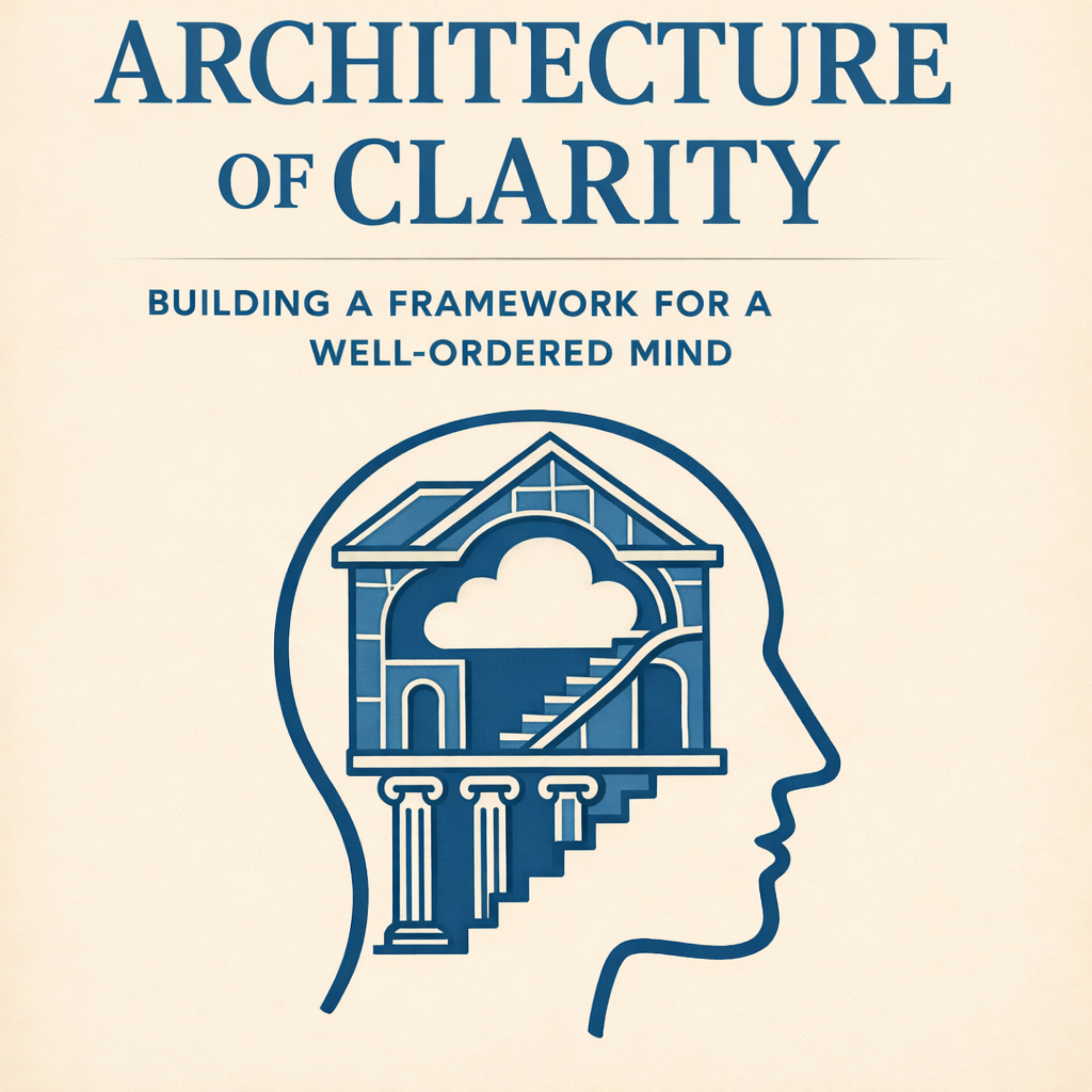
from The Architecture of Clarity: Building a Framework for a Well-Ordered Mind · host Only Life After All
Your Personal LibraryImagine walking into a library that contains everything you’ve ever learned, believed, or experienced.It’s all there—books representing life lessons, shelves for values, journals filled with memories, boxes stuffed with half-formed ideas.Now imagine the library is in complete disarray.The books are stacked in random piles. The most important principles are buried under trivia.There are duplicates of some ideas, each with slightly different wording. Some volumes contradict others without either being labeled as “obsolete” or “pending review.”This is how most minds operate—not from lack of intelligence, but from lack of organization.Your mind is not a static warehouse of facts. It’s a living, breathing system of thought.New experiences add to the collection.Old beliefs can be revised, archived, or removed.Principles can be promoted from footnotes to headlines as their importance becomes clear.Without conscious maintenance, the system becomes reactive and cluttered. With care, it becomes a personal knowledge architecture—a structure that supports clarity, resilience, and purposeful action.The Foundations — Core PrinciplesThese are your anchor points: the values and truths that remain steady even as details shift.Example: “Convert Time into Love” from the Guideposts for Living Wisely is more than a moral sentiment; it’s a priority filter. When faced with competing demands, it asks: Which choice turns time into genuine connection?The Structure — Organized KnowledgeThese are the patterns and categories that allow you to connect facts across domains.History and human nature inform decision-making.Psychology and philosophy explain behavior.Personal experience validates or challenges abstract ideas.The structure turns isolated insights into a network.The Flow — Tools and PracticesThis is how ideas move in and out of your system.Reflection and journaling to capture and clarify.Questioning and dialogue to test ideas.Updating and reorganizing to keep the framework alive.CloudMind itself is an example of such a flow—insights are collected, connected, and refined over time.The shift begins when you stop thinking of your mind as just you—and start thinking of it as something you can work on.Ask yourself:What’s my current filing system? Do I connect new knowledge to what I already know, or just store it loosely?Which ideas deserve “front-shelf” status? Which beliefs or values guide most of my actions, whether consciously or not?Where are the contradictions? Do any of my current principles quietly undermine each other?You will never have a perfectly complete or contradiction-free framework—and that’s the point. A living system grows through maintenance, not finality. You review, refine, and realign over time.Think of your mental framework as a garden:You plant (gather ideas and experiences).You prune (remove what no longer serves).You fertilize (connect and deepen what matters most).You harvest (apply insights in real life).A neglected garden becomes overrun by weeds. A tended one flourishes.Ultimately, this is not about having a beautiful intellectual archive. It’s about having a functional compass—a mental system that tells you, even in the fog of uncertainty, which direction is truest to you.By treating your mind as a system of thought:You reduce decision fatigue.You handle complexity with calm.You live more deliberately, because you know why you choose what you choose.Key Takeaway: Your mind is not just a container for knowledge—it’s a system you can design, maintain, and improve. The more coherent that system becomes, the more clearly you can navigate the complexity of life.The Mind as a Living SystemThree Layers of Your Mental SystemDesigning Your Own System of ThoughtMaintenance Over PerfectionFrom Library to Compass
What this episode covers
Your Personal LibraryImagine walking into a library that contains everything you’ve ever learned, believed, or experienced.It’s all there—books representing life lessons, shelves for values, journals filled with memories, boxes stuffed with half-formed ideas.Now imagine the library is in complete disarray.The books are stacked in random piles. The most important principles are buried under trivia.There are duplicates of some ideas, each with slightly different wording. Some volumes contradict others without either being labeled as “obsolete” or “pending review.”This is how most minds operate—not from lack of intelligence, but from lack of organization.Your mind is not a static warehouse of facts. It’s a living, breathing system of thought.New experiences add to the collection.Old beliefs can be revised, archived, or removed.Principles can be promoted from footnotes to headlines as their importance becomes clear.Without conscious maintenance, the system becomes reactive and cluttered. With care, it becomes a personal knowledge architecture—a structure that supports clarity, resilience, and purposeful action.The Foundations — Core PrinciplesThese are your anchor points: the values and truths that remain steady even as details shift.Example: “Convert Time into Love” from the Guideposts for Living Wisely is more than a moral sentiment; it’s a priority filter. When faced with competing demands, it asks: Which choice turns time into genuine connection?The Structure — Organized KnowledgeThese are the patterns and categories that allow you to connect facts across domains.History and human nature inform decision-making.Psychology and philosophy explain behavior.Personal experience validates or challenges abstract ideas.The structure turns isolated insights into a network.The Flow — Tools and PracticesThis is how ideas move in and out of your system.Reflection and journaling to capture and clarify.Questioning and dialogue to test ideas.Updating and reorganizing to keep the framework alive.CloudMind itself is an example of such a flow—insights are collected, connected, and refined over time.The shift begins when you stop thinking of your mind as just you—and start thinking of it as something you can work on.Ask yourself:What’s my current filing system? Do I connect new knowledge to what I already know, or just store it loosely?Which ideas deserve “front-shelf” status? Which beliefs or values guide most of my actions, whether consciously or not?Where are the contradictions? Do any of my current principles quietly undermine each other?You will never have a perfectly complete or contradiction-free framework—and that’s the point. A living system grows through maintenance, not finality. You review, refine, and realign over time.Think of your mental framework as a garden:You plant (gather ideas and experiences).You prune (remove what no longer serves).You fertilize (connect and deepen what matters most).You harvest (apply insights in real life).A neglected garden becomes overrun by weeds. A tended one flourishes.Ultimately, this is not about having a beautiful intellectual archive. It’s about having a functional compass—a mental system that tells you, even in the fog of uncertainty, which direction is truest to you.By treating your mind as a system of thought:You reduce decision fatigue.You handle complexity with calm.You live more deliberately, because you know why you choose what you choose.Key Takeaway: Your mind is not just a container for knowledge—it’s a system you can design, maintain, and improve. The more coherent that system becomes, the more clearly you can navigate the complexity of life.The Mind as a Living SystemThree Layers of Your Mental SystemDesigning Your Own System of ThoughtMaintenance Over PerfectionFrom Library to Compass
NOW PLAYING
Chapter 3 — Your Life as a System of Thought
No transcript for this episode yet
Similar Episodes
Mar 26, 2026 ·1m
Mar 19, 2026 ·34m
Feb 18, 2026 ·11m
Feb 11, 2026 ·45m