
EPISODE · Jan 14, 2026 · 57 MIN
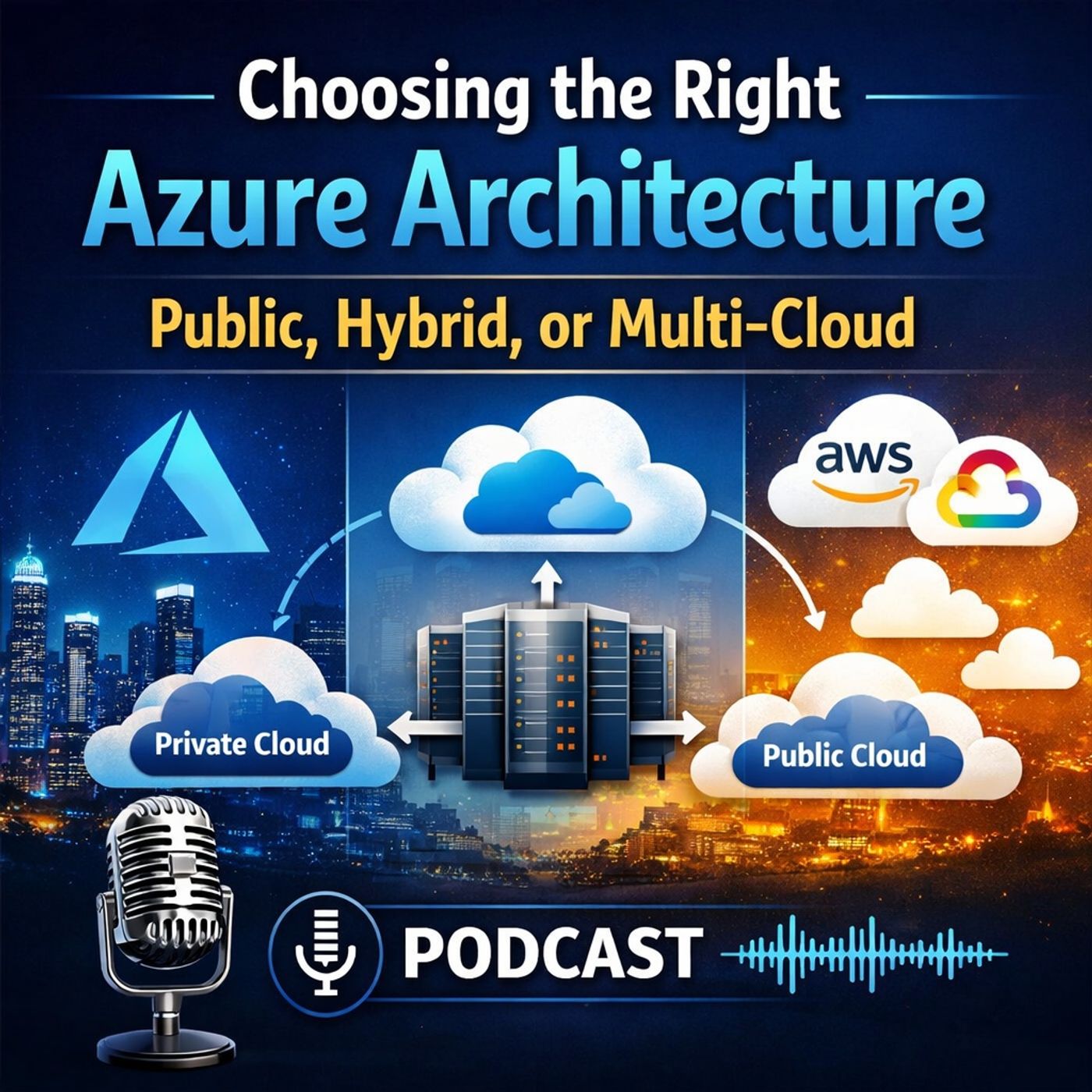
Choosing the Right Azure Architecture: When Public Cloud, Hybrid, or Multi-Cloud Actually Makes Sense for Enterprise Microsoft Environments
from M365.FM - Modern work, security, and productivity with Microsoft 365 · host Mirko Peters - Founder of m365.fm, m365.show and m365con.net
(00:00:00) The Cloud Conundrum (00:00:27) The Misconception of Cloud as a Place (00:01:15) Intent vs. Configuration in Cloud Adoption (00:04:06) The Inevitability of Hybrid Cloud (00:07:57) Azure's Strengths in Public Cloud Adoption (00:11:53) The Breakpoints of Public Cloud Adoption (00:15:49) The Reality of Cloud Economics (00:19:40) Reframing Hybrid Cloud as a Strategy (00:28:23) Azure's ARC: A Control Plane Projection (00:28:33) Azure ARC: Beyond Product, Beyond Cloud Most enterprises still talk about “choosing an Azure architecture” as if it were a slide on a strategy deck. Public cloud, hybrid, or multi-cloud — pick a box, pick a vendor, pick a slogan, and declare the direction set. But at scale, architectures are not chosen that way. They emerge from years of exceptions, acquisitions, latency constraints, regulatory demands, and unowned decisions that quietly harden into an operating model nobody would design on purpose — but everybody now has to keep alive.In this episode of M365.FM, Mirko Peters examines why so many Microsoft cloud environments ended up hybrid or multi-cloud by accident rather than by design, and why treating Azure as “just another place to run VMs” almost guarantees rising complexity, cost, and risk. This is not a conversation about which hyperscaler is best or who has the cheapest compute. It is a conversation about treating Azure as a control plane — the place where identity, policy, visibility, governance, and lifecycle management live — even when your compute and data remain spread across data centers, edge locations, and other clouds.The organizations that will actually win with Microsoft cloud are not the ones that chase the purest public-cloud story. They are the ones that start with a different question: where must we distribute compute, and where must we centralize control? That means accepting that hybrid is often inevitable — because of:Regulation and local legal constraintsLatency, data gravity, and physical placement realitiesLegacy systems and vendor lock‑ins that cannot simply be replatformed— while refusing to let management, identity, and governance fragment across a dozen consoles and policy engines. The goal is not a perfect reference diagram. It is an estate where you can answer four boring but critical questions at any time:What exists?Who owns it?Is it compliant?Can it be changed or recovered safely?WHAT YOU WILL LEARNWhy many Azure, hybrid, and multi-cloud “strategies” are actually the accumulated result of unmanaged constraints and exceptions, not deliberate design — and how that shows up in day‑to‑day operations.How to see the early “architecture entropy signals”: duplicate identity systems, conflicting policies, overlapping tools, and environments that nobody can fully inventory.What a control-plane-first approach looks like: using Azure, Entra ID, policy, and Azure Arc to centralize identity, governance, and visibility before you argue about placement.How to think about public Azure when it works best (identity‑led, policy‑driven, platform‑service centric) and when it quietly recreates your old datacenter problems with more moving parts.Why hybrid should be framed as distributed compute with centralized control, not “cloud plus leftovers” — and what that means for Azure Arc, management groups, and policy baselines.When multi-cloud genuinely adds value (hard separation, unique capabilities, regulatory isolation) and when it mostly multiplies entropy, tooling, and burnout.THE CORE INSIGHTEvery placement decision is an operating model decision in disguise. When you decide that a system stays on‑prem, moves to Azure, stretches across regions, or adds another cloud, you are choosing:Its blast radiusIts identity surfaceIts policy coverageIts cost behaviorIts incident response storyWhen you allow “temporary” exceptions — a second identity store here, a one‑off policy bypass there, a separate monitoring stack for that acquisition — you are deciding how much architecture entropy you are willing to inject into your future platform. None of those choices show up in the high‑level cloud strategy slide. They all show up in how hard your Microsoft estate is to understand, govern, and change three years later.Mirko argues that this is why so many Azure and hybrid environments feel strategically aligned on paper but fragile in reality. The “strategy” ends once the slogan is chosen and the first workloads run in the cloud, but the operating model needed to run them safely, repeatedly, and economically has not been built. Identity is a patchwork of old groups and new roles. Policy is a mixture of global standards and local exceptions. Monitoring is noisy but untrusted. No one owns the platform as a product; everyone owns “their” slice of infrastructure. The result is an architecture that is technically in cloud but strategically unfinished.CONTROL PLANE FIRST: AZURE AS THE ANCHORA control‑plane‑first approach does not start by asking “public, hybrid, or multi‑cloud?” It starts by defining how environments will look and behave regardless of where workloads run:Which identities exist and how they are governedWhich policies are mandatory and who can create exceptionsWhich sources of truth describe inventory, ownership, and complianceOnly then does it ask where specific workloads should live — in Azure regions, on‑premises, or in other clouds — based on latency, regulation, and technical fit.Azure, Entra ID, and Azure Arc become the backbone of that control plane. They provide:A single identity fabricA single policy frameworkA single way to onboard, tag, monitor, and govern resources— whether those resources run natively in Azure or are merely attached to its control surface. Instead of every environment inventing its own rules, the platform encodes your risk appetite, compliance obligations, and operating model once and projects them outward. The architecture stops being “whatever happened” and starts being whatever the control plane allows.WHO THIS EPISODE IS FORCIOs, CTOs, and digital transformation leaders trying to make sense of complex Azure, hybrid, or multi-cloud estates that don’t match the original strategy slides.Cloud platform and Azure architects responsible for landing zones, Entra ID, Azure Arc, and governance.Enterprise architects who need to connect business intent with the messy reality of existing Microsoft cloud footprints.Security, risk, and compliance leaders who must ensure that distributed architectures still have provable, centralized control.Microsoft partners and consultants advising customers on Azure, hybrid, and multi-cloud strategy and operating model design.Become a supporter of this podcast: https://www.spreaker.com/podcast/m365-fm-modern-work-security-and-productivity-with-microsoft-365--6704921/support.
Embed this episode
What this episode covers
(00:00:00) The Cloud Conundrum (00:00:27) The Misconception of Cloud as a Place (00:01:15) Intent vs. Configuration in Cloud Adoption (00:04:06) The Inevitability of Hybrid Cloud (00:07:57) Azure's Strengths in Public Cloud Adoption (00:11:53) The Breakpoints of Public Cloud Adoption (00:15:49) The Reality of Cloud Economics (00:19:40) Reframing Hybrid Cloud as a Strategy (00:28:23) Azure's ARC: A Control Plane Projection (00:28:33) Azure ARC: Beyond Product, Beyond Cloud Most enterprises still talk about “choosing an Azure architecture” as if it were a slide on a strategy deck. Public cloud, hybrid, or multi-cloud — pick a box, pick a vendor, pick a slogan, and declare the direction set. But at scale, architectures are not chosen that way. They emerge from years of exceptions, acquisitions, latency constraints, regulatory demands, and unowned decisions that quietly harden into an operating model nobody would design on purpose — but everybody now has to keep alive. In this episode of M365.FM, Mirko Peters examines why so many Microsoft cloud environments ended up hybrid or multi-cloud by accident rather than by design, and why treating Azure as “just another place to run VMs” almost guarantees rising complexity, cost, and risk. This is not a conversation about which hyperscaler is best or who has the cheapest compute. It is a conversation about treating Azure as a control plane — the place where identity, policy, visibility, governance, and lifecycle management live — even when your compute and data remain spread across data centers, edge locations, and other clouds. The organizations that will actually win with Microsoft cloud are not the ones that chase the purest public-cloud story. They are the ones that start with a different question: where must we distribute compute, and where must we centralize control? That means accepting that hybrid is often inevitable — because of: Regulation and local legal constraints Latency, data gravity, and physical placement realities Legacy systems and vendor lock‑ins that cannot simply be replatformed — while refusing to let management, identity, and governance fragment across a dozen consoles and policy engines. The goal is not a perfect reference diagram. It is an estate where you can answer four boring but critical questions at any time: What exists? Who owns it? Is it compliant? Can it be changed or recovered safely? WHAT YOU WILL LEARN Why many Azure, hybrid, and multi-cloud “strategies” are actually the accumulated result of unmanaged constraints and exceptions, not deliberate design — and how that shows up in day‑to‑day operations. How to see the early “architecture entropy signals”: duplicate identity systems, conflicting policies, overlapping tools, and environments that nobody can fully inventory. What a control-plane-first approach looks like: using Azure, Entra ID, policy, and Azure Arc to...
NOW PLAYING
Choosing the Right Azure Architecture: When Public Cloud, Hybrid, or Multi-Cloud Actually Makes Sense for Enterprise Microsoft Environments
No transcript for this episode yet
Similar Episodes
No similar episodes found.
Similar Podcasts
No similar podcasts found.