
EPISODE · Nov 21, 2024 · 10 MIN
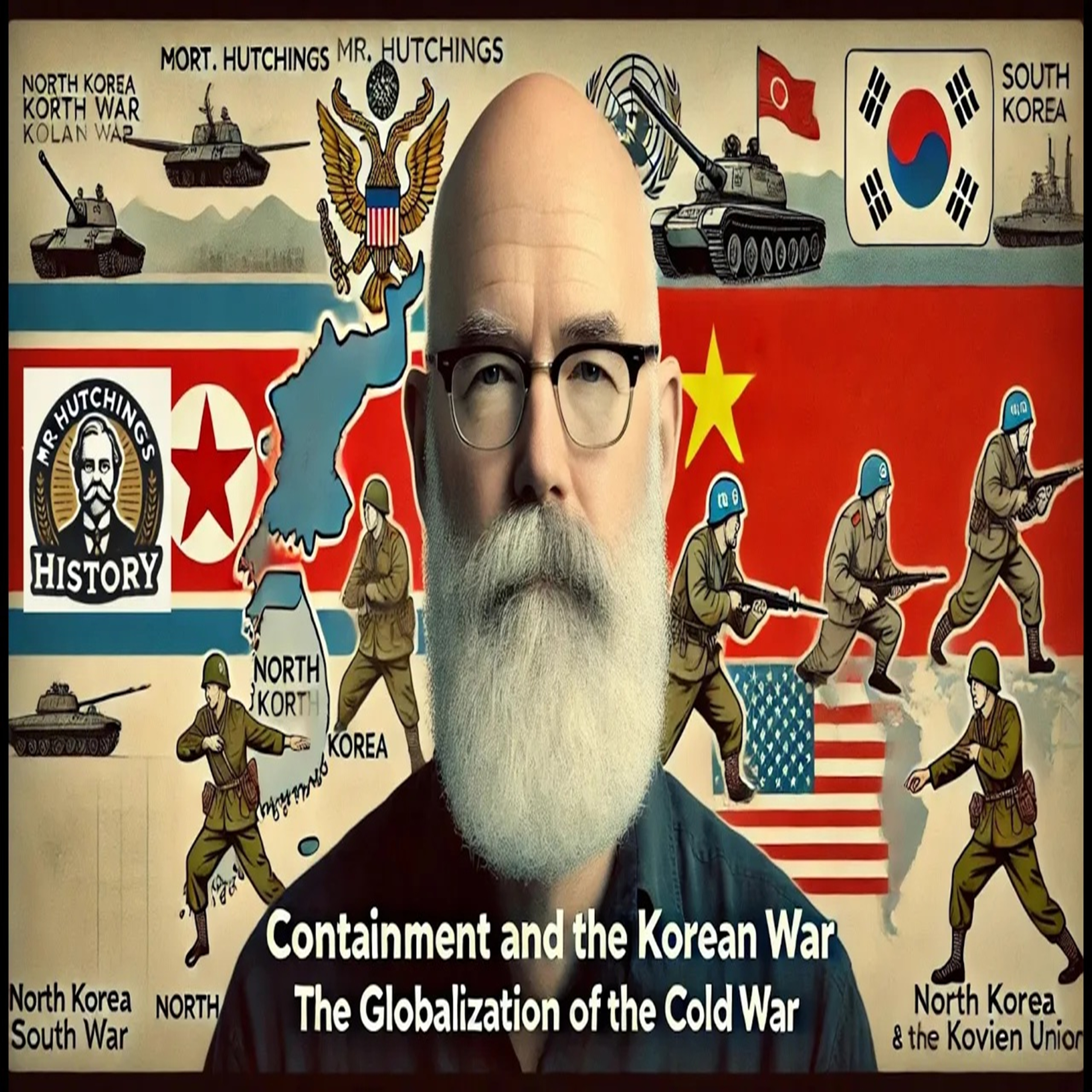
Containment and the Korean War – The Globalization of the Cold War
from Mr. Hutchings History · host Produced, created, and written by Harold M. Hutchings
Welcome to Mr. Hutchings History! In this episode, we focus on the Korean War (1950-1953), a pivotal conflict that shaped the US policy of containment and escalated the Cold War into a global struggle. We’ll explore how the war became the first direct military confrontation of the Cold War, how it spurred increased military spending through NSC-68, and its long-lasting impacts on global politics. The episode will also cover key historical interpretations of the Korean War’s significance.We'll dive into the consequences of the war, including the US's involvement in Asia, the creation of new military alliances like SEATO, and how the war’s outcome solidified the US's role as the defender of non-communist states. We’ll also engage with various historical perspectives—from Orthodox to Revisionist to Post-revisionist views—on how the war influenced Cold War policies.Key Topics:The Korean War as a turning point for containmentThe role of NSC-68 and military spendingDiplomatic consequences and the US’s commitment to TaiwanHistorical interpretations: Orthodox, Revisionist, and Post-revisionist viewsThe globalization of containment and its impact on Cold War diplomacy#Paper2WorldHistory #KoreanWar #ColdWar #Containment #USForeignPolicy #TrumanDoctrine #SinoSovietSplit #NSC68 #ColdWarHistory #SuperpowerRivalryWorks CitedCohen, Warren I. The Cambridge History of American Foreign Relations: Volume 4, America in the Age of Soviet Power, Cambridge UP, 1993.Gaddis, John Lewis. We Now Know: Rethinking Cold War History, Penguin, 1997.Leffler, Melvyn P. For the Soul of Mankind: The United States, the Soviet Union, and the Cold War, Hill and Wang, 2007.Schlesinger, Arthur Jr. The Origins of the Cold War, Foreign Affairs, 1967.Chapters(0:00) Introduction – The Korean War and the Cold WarHow the conflict turned containment into a global strategy.(0:36) Why Korea? The First Hot War of the Cold WarWhy the Korean Peninsula became the first battleground of containment.(1:28) NSC-68 and the Shift in U.S. StrategyHow a secret document shaped U.S. military expansion.(2:46) The Korean War Begins – A Turning PointNorth Korea invades, and containment is put to the test.(3:40) The Global Ripple Effect – A New Cold WarHow Korea escalated Cold War tensions beyond Asia.(4:18) West Germany, NATO & the European BalanceWhy the war pushed Germany into NATO and reshaped Europe.(5:06) Taiwan & Asia’s Cold War FrontlineHow the U.S. used the Korean War to solidify Taiwan’s role.(6:02) Historians Debate – Was Containment Justified?Different perspectives on the war’s necessity and impact.(7:05) The Globalization of ContainmentHow the Korean War led to Vietnam and other conflicts.(8:14) Did It Work? Evaluating U.S. Cold War PolicySuccesses, failures, and the cost of global containment.(9:26) Lessons from Korea – The Long-Term ImpactWhy the Korean War still shapes global politics today.
Embed this episode
NOW PLAYING
Containment and the Korean War – The Globalization of the Cold War
No transcript for this episode yet
Similar Episodes
No similar episodes found.
Similar Podcasts
No similar podcasts found.