
EPISODE · Mar 19, 2026 · 36 MIN
Corporate Influence, Billionaires, and American Politics
from The Forum with Josh Cowen Podcast · host Josh Cowen
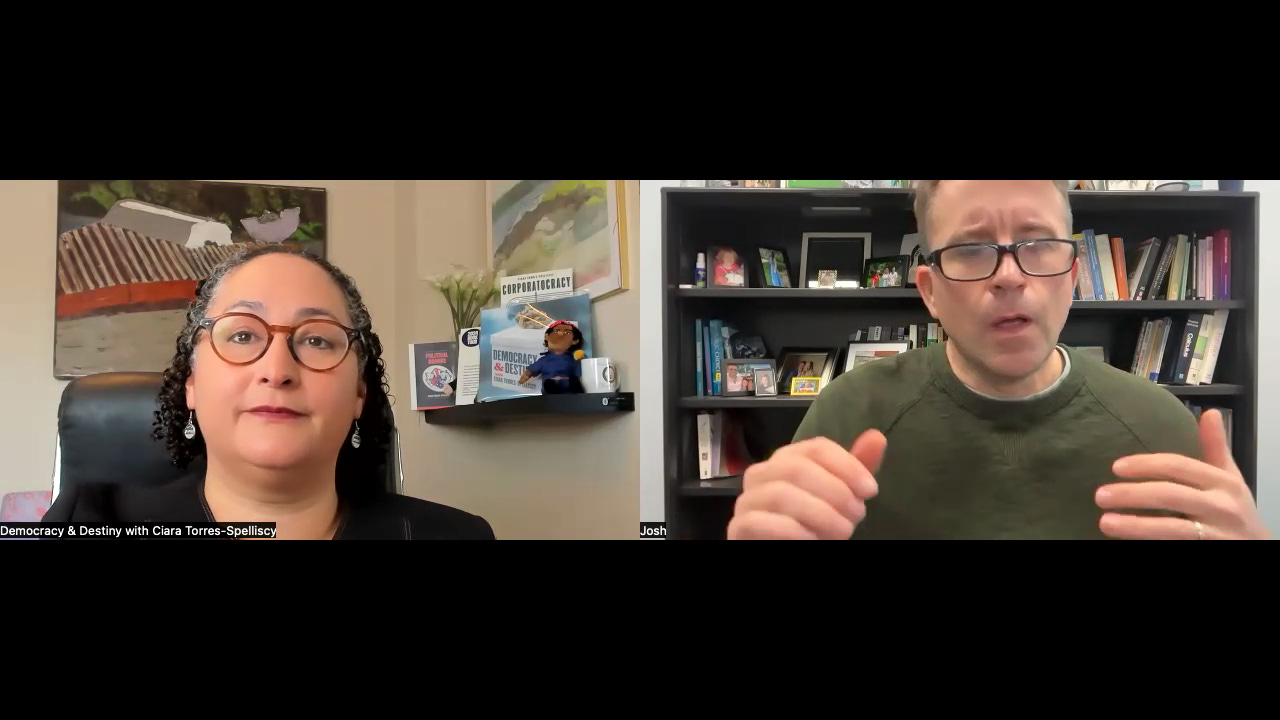
One of the persistent themes in American politics right now is the influence of dark money on our elections and public policy. Especially dark money when it comes to corporate dollars, right-wing advocacy, and billionaire influence. The entire point of my book The Privateers is that a handful of billionaires created right-wing think tanks to stand up arguments for specific policy priorities in education. Most notably, school vouchers. But obviously the issue goes well beyond education. And we’re heading into a critically important election season. So to tie some of this all together I wanted to talk with an expert in campaign finance, law, and corruption. Ciara Torres-Spelliscy is a lawyer, professor at Stetson University College of Law, and an expert on election law, corporate governance, and campaign finance. She is also a fellow at the Brennan Center for Justice—one of the most important organizations for safeguarding democracy in the United States.Her most recent book is Corporatocracy: How to Protect Democracy from Dark Money and Corrupt Politicians.I met Professor Torres-Spelliscy when we were both invited by Nikole Hannah-Jones to speak at the Democracy Summit organized at the Center for Journalism and Democracy, which Nikole had founded at Howard University. NOTE: I’ve been asked by readers and subscribers to provide reading options for that chats we do here. So in that spirit, you can watch my full conversation with Ciara Torres-Spelliscy in the video, or read an abbreviated version here (edited only for clarity and length). My Conversation with Ciara Torres-SpelliscyLet’s start with some background. One of your chapters is called “How corporations benefit from civil death?” Can you explain “civil death” and how that sets up the issue of campaign finance and corporate influence?So, the concept of civil death is the collateral consequences that go along with felony convictions. As I explain in my book, Corporatocracy, the concept of civil death is a really old one. It goes back to ancient Greece and ancient Rome.And essentially, if you committed a particularly heinous crime back in ancient Greece you lost all of these abilities to participate in civil life, including voting. And that old concept is alive and well in the United States today.Corporations benefit from this in a number of different ways. Our 13th Amendment, famously, ends slavery, except for punishment for crimes. And that means that you actually can be put to slavery if you are convicted of a felony. That is part of your civil death.And that means that corporations have the ability to have workers who are in prison, who are basically modern-day slaves. And this has its own history in the United States. Right after the Civil War, when we abolished slavery, we get convict leasing. Convict leasing was this ability to lease out convicts to corporations, and that happened for decades and decades and decades. I think that lineage is sort of still alive and well today, because you have corporations who are using prison labor. Which means that their labor costs are either actually free in some instances, or way below market. It’s one of the ways that corporations undercut the minimum wage and get labor for a lot less than its true value.But, another way that civil death is still with us is prisoners in the United States lose their right to vote in 48 states. The only place where you can vote while you’re incarcerated is Vermont, Maine, and DC.Everywhere else, while you’re incarcerated, you cannot vote. In many states, even after you’re out and back in the community, you still can’t vote, including here in Florida.I think corporations benefit from that because it changes the electorate. If you have a felony conviction in many states you cannot vote. In some states, it really is like a lifetime ban, and so I think corporations benefit from that.Because people who might be against corporate interests, just can’t vote for policies that would hamper or hem in corporate greed. So corporations benefit both from the cheap labor, and from the changed electorate.Is that the on-ramp to the conversation about corporations and politics? Like, a good chunk of the book itself is about corporate influence on politics through dollars. We’ll get to that in a second, but I thought this was sort of an interesting and really important way to kind of frame the conversation around this, because there’s a lot of folks talking about corporate influence on politics, but you’re beginning from a different place here with this kind of notion of civil death and the effect on the electorate and the effect on voting. So, the inspiration for me writing this book was January 6th. And I wrote it during the Biden administration. Trump was president, he was running for re-election while I’m writing this book. And one of the things that struck me as someone who has to teach constitutional law, is there is no prohibition in our Constitution on convicted felons running for office. And that got me to look at, well, what are the restrictions in our Constitution for people running for office? And that brought me to the disqualification clause. The disqualification clause basically says that if you are a oath-breaking insurrectionist, then you can’t run for office in the United States.There was an enormous amount of litigation around this during the Biden administration, trying to get candidate Trump off the ballot for the 2024 election. That effort went all sorts of different places, so there were at least 31 litigations trying to get Trump off the ballot.The one that got the furthest was in Colorado, so the Colorado Supreme Court, right at the end of 2023, kicked Trump off the ballot, and they kicked him off the ballot because the Colorado Supreme Court came to the conclusion that Trump had engaged in an insurrection on January 6th, and that was disqualifying for him under the 14th Amendment.That then gets appealed to the Supreme Court, and the Supreme Court, in, I think, a very frustrating and sort of strange opinion, Trump vs. Anderson, says he’s not disqualified, because under our reading of the Constitution, no state can disqualify a candidate for the presidency.That is a wild opinion to come to because our states run our federal elections. And they act as gatekeepers to make sure that everyone who’s on a presidential ballot, for example is 35, and is a citizen. You would think that they would also have the ability to disqualify oath-breaking insurrectionists, but here we all are: the Supreme Court 9-0 said no.So, that leaves us in sort of a very strange place, and for me, all of this comes back to the question of civil death. Because while there are lots of different consequences for felons in terms of losing their civil rights, one of them that they do not lose is the ability to run for office, even federal office and even the presidency.Alright so let’s get to the finance piece. And speaking of January 6th. You write in the book about some of the organizations (ALEC, Heritage Action and so on) behind the Big Lie, working closely with corporations. Where do these “non-profit” or political organizations and their various tax structures fit specifically into the general problem of corporate money?Corporations have been trying to control American elections for a really, really long time. And there have been reactions from Congress and from state legislatures going back at least 100 years.One of the things I think people misperceive about this is that corporations are actually banded from giving money directly to federal candidates under an old law called the Tillman Act. That’s an act from 1907, and it says that corporations cannot give to any federal candidate, including for the presidency.But over the years, corporations have found many different ways of weaseling their way back in. And one of the ways that corporate money gets into politics is through the use of nonprofits. So, nonprofits are in this very weird liminal space where if you really looked at the tax code, then certain nonprofits shouldn’t be in politics at all. Those are the 501(c)(3)s, so that’s your basic charity. They are supposed to be completely nonpartisan and to stay out of elections entirely.Then, there are the c4’s and c6’s, so the 501(c)(4)s are social welfare organizations. They can spend about 50% of their resources on politics, and the c6s are trade associations, they can also spend 50% of their resources on politics. My favorite trade association is actually the National Football League. They are a non-profit, which is sort of wild, given how much money the NFL has.But nonetheless these groups, especially the c4’s, have played a really outsized role ever since, uh, the Supreme Court decided Citizens United in 2010 [editor’s note: the American Federation for Children, a group founded by Betsy DeVos and about which I’ve been critical in this space and in The Privateers, is a 501(c)4)].So, the thing about these nonprofits is by placing them sort of in the middle, you create dark money. So dark money is money that is spent in politics where the public cannot tell what the original source was. The way that dark money is created is the following: You either have your neighborhood billionaire or a corporation who doesn’t want to spend under their real name. And so, instead of spending under their real name, they give the money to one of these c4’s, and then the c4 spends it in politics. And the reason why that creates dark money is under the tax code, c4’s are generally allowed to keep their donors private. And this is where two parts of law overlap and sort of interfere with one another.The norm in elections is that spending should be transparent. We get that from the Supreme Court, going back to Buckley v. Valeo, that there is a value in telling voters who is spending in politics.Meanwhile, we have these non-profits who are pulling on a different line of case law. that allows for anonymous donations.So, you use these c4’s, in politics, and that thwarts the transparency that you would otherwise have to figure out who is giving money.They have been a huge source of dark money in recent elections. In the 2024 election cycle, there was around $2 billion of dark money, so whenever I’m asked who the biggest spender in the 2024 election is… my honest answer is I don’t know.The related issue with nonprofits is not everything is captured by the campaign finance system. There are nonprofits like ALEC, which is the American Legislative Exchange Council, and ALEC has sort of a different mode of being than the dark money nonprofits.With ALEC, they get together mostly Republican legislators from state legislatures. And they then partner them with corporations. And then what they do is they have these big conferences. And they invite both the Republican lawmakers and corporate representatives, and then they sit them in a room, and they write legislation together.And some of the legislation that they’ve written together includes voter ID bills, and I think we’re now seeing the fruits of that at the national level, where we’re having a fight over the SAVE Act.And I think the ultimate point of these voter ID laws is to disenfranchise otherwise completely lawful voters.If I could ask about that specifically, about the SAVE Act in the news a lot, being debated this week in Congress. Because states run their own elections, as you said. So what is the kind of legal theory of action that the folks behind SAVE Act are trying to push to argue that Trump’s federal government should be involved? In terms of federal elections, the Elections Clause of the Constitution gives the first cut to the states, but does reserve power to Congress to amend the time, place, and manner of how federal elections are run.Depending on the way that, say, the SAVE Act is actually passed, you could have a lot of challenges on 10th Amendment grounds if they are trying to enforce it on state elections, because state elections have been the purview of states. States are allowed to have rules for their elections, and they run state elections. So because of efficiency, most states run their federal and state elections at the very same time. From the point of view of the voter, it looks like it’s one election, but it’s actually two different elections that have different constitutional roots to them.One of the challenges that I think, if we get the SAVE Act, it will be subject to are federalism objections that this is overstepping what Congress can do. It’s possible that we might, you know, in a few years, end up with different rules for what you need to vote in a federal election compared to what you need to vote in your state or local elections, which would cause a bit of chaos.A lot of the current language in Democratic politics is around billionaires. There’s certainly plenty left for corporations, but much of the focus has been on extreme individual wealth too. Good development and framing? Or should we be sticking with the corporate side.Well, it’s an interesting question. Let me just give the thumbnail on Citizens United. Citizens United was a Supreme Court decision from 2010 where the Supreme Court decided that corporations could spend an unlimited amount of money in U.S. elections, so long as it was independent of candidates and political parties. So, what that then led to was the creation of what are known as Super PACs.A Super PAC can take in money from any source except for foreign nationals, and then they can spend it in an unlimited amount. And one of the things that happened after Citizens United is while the biggest spenders for a very long time had been billionaires, not corporations, what we’ve seen post-Citizens United is actually corporate spending which, while still dwarfed by the billionaires, is now quite large.So, in the 2024 election, the biggest corporate spenders were from cryptocurrency firms. And they were—for the new players on the block—wildly successful in getting their candidates of choice elected.They intervened in the U.S. Senate from California race in the primary. They gloated about defeating Katie Porter, who was running for that race. They focused on Sherrod Brown who was a senator from Ohio, and then basically gloated about defeating him in the general election.And they have been supporting both Democrats and Republicans, which makes them a little bit unique, so long as those politicians are “pro-crypto,” as in, they will allow for cryptocurrencies to continue to be very deregulated or not regulated at all.That type of corporate spending can be just wildly effective in getting out good people who used to be in the government. And it can be wildly effective in getting the nose of the camel into the tent in terms of lobbying. Often what you see in the pattern over time is that corporations will spend an enormous amount of money getting certain people elected. And then after they’re elected, they show up with their lobbyists, and they ask for basically the payback.There is this sort of misbalance and, you know, a David vs. Goliath problem that we have in terms of: there are public interest lawyers and public interest lobbyists, and people who work for the public good. But they are just outgunned and outnumbered and outspent by the corporate side.What are you looking for in terms of campaign and political money heading into 2026, what’s the lay of the land? Lots of Democrats take the “corporate PAC pledge” and then turn around and set up side PACs of their own to take plenty of unlimited or at least less regulated high dollar contributions from corporate chiefs. What’s the cleanest approach right now?A long time ago, corporations figured out one of the ways around the Tillman Act. So the Tillman Act means that corporations can’t give directly from a corporate treasury into the coffers of a federal candidate. But, they can spend through corporate PACs. So, a corporate PAC is created by individuals who are associated with the corporation.So typically the employees of a particular corporate entity, especially the higher up the food chain, if you pull the donations from the average corporate pack, you’re going to see a lot of people with the title Vice President next to them. As in, they’re the vice president of operations at a particular corporation.Technically, all of this is voluntary, so you have this corporate PAC, and the people who are associated with the corporation voluntarily give. But I think it is sort of indicative of trying to show your loyalty to the corporation, and that you see your future with this corporation, and thus why you would pony up your hard-earned dollars and give it to a corporate PAC.And then that corporate PAC can spend in federal elections. The other thing that corporations are doing, which actually gets their corporate treasury funds back into the game, is giving to Super PACs. So, the ruse of the Super PAC is that it is nominally independent of candidates and political parties.Now, in reality, it is ridiculous to think of these things as independent.Like if you look at some of the fundraising that happens between candidates and Super PACs, often you have the candidate at the Super PAC event. So, it is completely nonsensical to think of that as independent.Yet another weird thing that you see some federal candidates do is they will tape themselves for “B-roll,” and they will just put up all of these videos of themselves online walking by a lake, or petting a dog. It tends to be with no sound.And the whole point of that is so that Super PACs can use that footage in their ads. And so, technically, the candidate hasn’t provided the footage directly to the Super PAC. But if you just, like, throw it up on YouTube, then it’s there for the Super PAC to take and use, however the Super PAC wants.Now, to the question of the, “I’m taking no corporate money!” pledges.A lot of times, these are individual candidates who wouldn’t get corporate money anyway. So, in some ways, it’s just a marketing ploy to say that they have taken no corporate money. Maybe true. But they might be not taking any corporate money, because there is no corporation that would fund them.You book concludes with a bunch of recommendations. How do we fix this mess?Well first and foremost, vote. If you are age 18, a US citizen, make sure that you’re registered to vote, and that you make a plan, and that you do vote in this year’s elections. Now, beyond that in terms of solutions, I guess it always depends on how you diagnose the problem. If you think that this is a corporate law problem, then we could change corporate law. You could change the laws in places like Delaware, and you could say, corporations can’t spend corporate dollars in any type of election.That would be one approach to this.If you think it’s an election law problem, then you need to change things like the Federal Election Commission, and how they are run, and how they often turn a blind eye to violations of campaign finance laws.If you think the problem is Citizens United, well, the only way we can get rid of a Supreme Court decision like that is the Supreme Court itself overrules Citizens United in a future case—that is unlikely given the makeup of the Supreme Court right now.Or, you get a constitutional amendment. There have been many constitutional amendments proposed that would end Citizens United. And that is a grassroots effort that I think is largely overlooked and underestimated.But many, many different states and many, many different cities have signed pledges to overturn Citizens United, and I think that is one of the things we might see, when all the dust settles from this period in history.Until we fix all this, not just with corporate money in politics, but billionaire money in politics, we’ll have this problem for the foreseeable future. This is a public episode. If you'd like to discuss this with other subscribers or get access to bonus episodes, visit joshcowen.substack.com/subscribe
Embed this episode
Ready to play
Corporate Influence, Billionaires, and American Politics
No transcript for this episode yet
Similar Episodes
No similar episodes found.
Similar Podcasts
No similar podcasts found.