
EPISODE · Jan 28, 2026 · 16 MIN
Course 20 - Malware Analysis: Identifying and Defeating Code Obfuscation | Episode 4: Dynamic API Resolution: Walking the PEB and Parsing
from CyberCode Academy · host CyberCode Academy
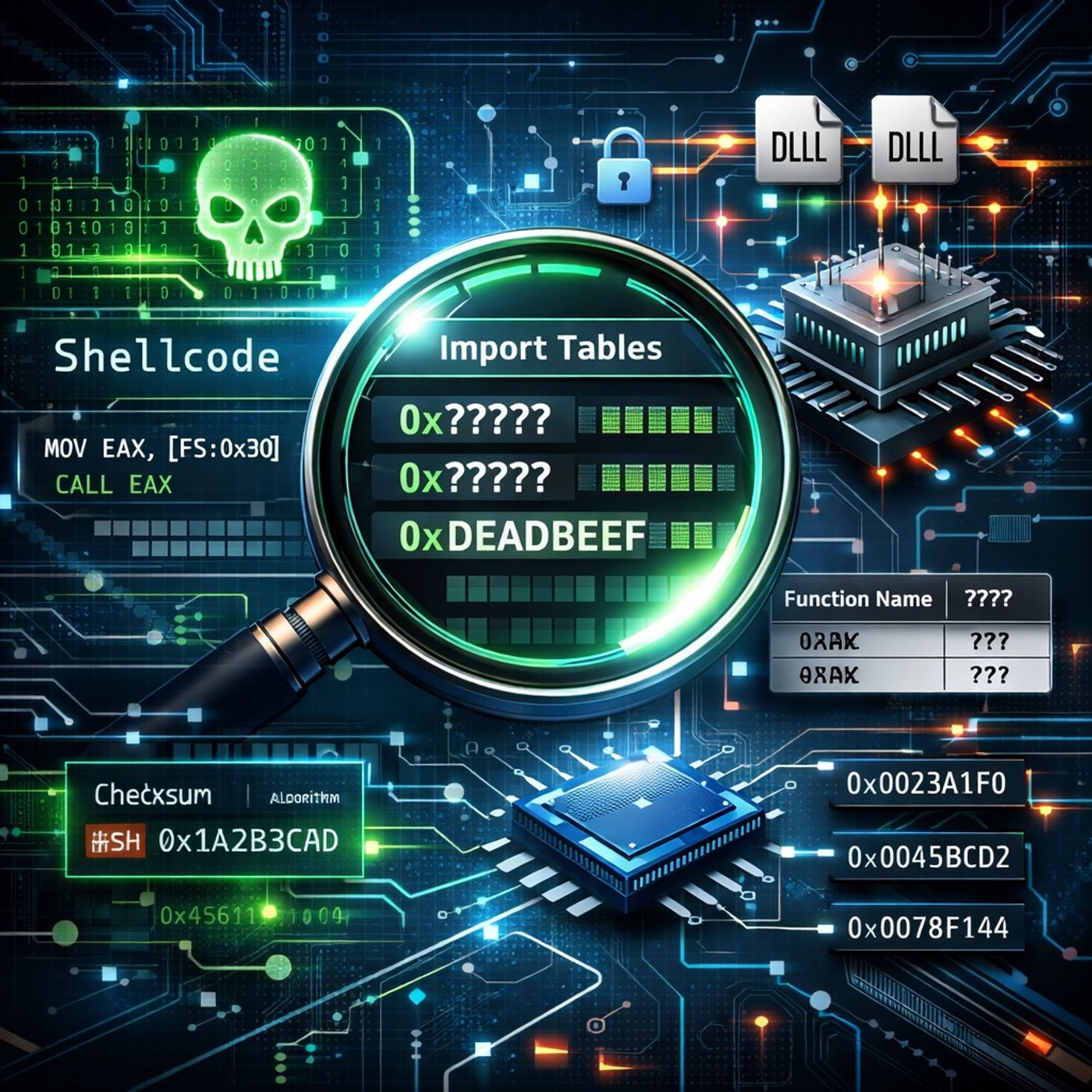
In this lesson, you’ll learn about:Why Malware Builds Its Own Import TablesHow bypassing static, dynamic, and runtime linking hides API usage from analysis tools.Why this technique is especially valuable for shellcode, which executes without a normal Windows loader.How custom API resolution breaks automated inspection and signature-based detection.Locating System Libraries via the PEBAccessing the Process Environment Block (PEB) through the FS register (offset 0x30).Navigating PEB_LDR_DATA to enumerate loaded modules.Walking linked lists such as InMemoryOrderModuleList to locate key DLLs.Extracting the image base (DLL base address) from LDR_DATA_TABLE_ENTRY.Manual Parsing of the PE FormatUsing the e_lfanew field (offset 0x3C) to locate the NT Headers.Navigating the PE Data Directory to find the Export Table.Understanding the role of:Address of FunctionsAddress of NamesAddress of Name OrdinalsChecksum-Based API ResolutionIterating through exported function names without storing them in cleartext.Computing a checksum for each name at runtime.Matching computed values against hard-coded checksums embedded in the malware.Resolving the correct function pointer using ordinals and function address tables.Indirect API InvocationStoring resolved function addresses in a custom array.Executing APIs via indirect calls (e.g., call eax) instead of named imports.Why this completely hides functionality from the binary’s static import table.You can listen and download our episodes for free on more than 10 different platforms:https://linktr.ee/cybercode_academy
Embed this episode
Ready to play
Course 20 - Malware Analysis: Identifying and Defeating Code Obfuscation | Episode 4: Dynamic API Resolution: Walking the PEB and Parsing
No transcript for this episode yet
Similar Episodes
No similar episodes found.