
EPISODE · May 13, 2025 · 10 MIN
Day 19: The Wolf Reads AI- "Quantifying the Rise and Fall of Complexity in Closed Systems: The Coffee Automaton"
from Deep Learning With The Wolf · host Diana Wolf Torres
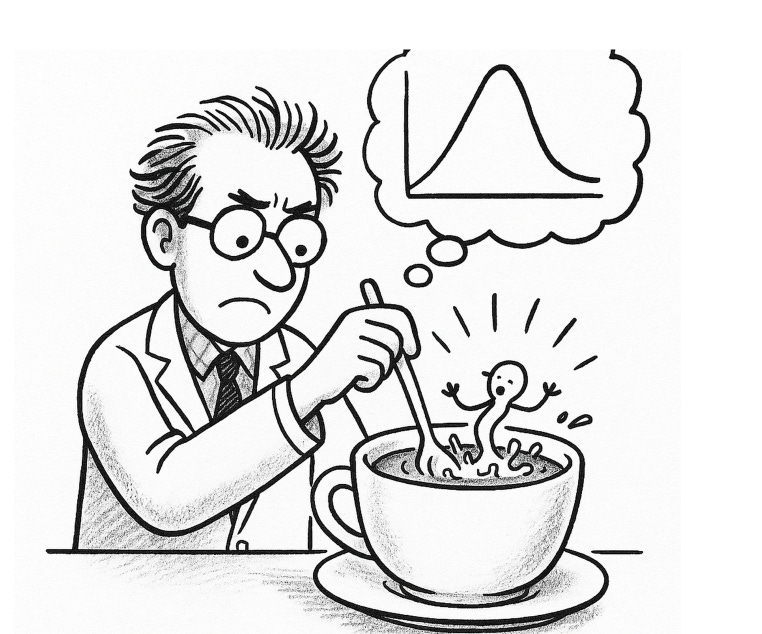
Title: “Quantifying the Rise and Fall of Complexity in Closed Systems: The Coffee Automaton”Authors: Scott Aaronson, Sean M. Carroll & Lauren Ouellette Date: May 27, 2014Link: https://arxiv.org/pdf/1405.6903What’s the big idea?Aaronson, Carroll & Ouellette model “interestingness” in a closed thermodynamic system by simulating cream diffusing into coffee via a 2D cellular automaton. They measure “apparent complexity” as the Kolmogorov complexity of a smoothed snapshot of the cup—showing that, unlike entropy (which only increases), complexity first rises then falls.Key Contributions* Apparent Complexity Measure: Maps each automaton state to a coarse-grained grayscale image, then quantifies its complexity by compression size.* Analytic Baseline: Proves non-interacting particles never produce high complexity.* Numerical Experiments (Original Claim): Reported a peak in complexity when particles interact, roughly when diffusion reaches the cup’s diameter.* Open Challenge: Posed proving this peak analytically.Post-Publication Revision (2015)Scott Aaronson later acknowledged that the originally reported complexity bump was a simulation artifact caused by border-pixel rounding errors. (Github.) Brent Werness showed that, with the original interaction rule, no true bump occurs—and one can even rigorously prove its absence. However, by adopting a new “shearing” rule (shifting entire regions of cream and coffee), the model does exhibit provable complexity growth. A revised version of the paper, with Werness and Varun Mohan as co-authors, details this corrected mechanism. (scottaaronson.blog/Why it mattersThis work remains a landmark for making “complexity” in closed systems mathematically tangible—and for exemplifying how scientific models improve through iterative correction. Its evolution underscores the importance of rigorous validation in computational science and points toward richer models of self-organization in physics, chemistry, and biology.Read the original paper here.Additional Resources For Inquisitive Minds:Aman’s AI Journal. Primers. Quantifying the Rise and Fall of Complexity in Closed Systems: the Coffee AutomatonPodcast Note:This podcast was percolated by Google NotebookLM’s. The two podcast hosts are AI-generated. Grab a delicious cup of coffee and enjoy the perky banter.Stay tuned for tomorrow’s mini-deep dive into Neural Turing Machines!#ComplexityTheory #Thermodynamics #WolfReadsAI #CoffeeAutomaton #KolmogorovComplexity #StatisticalPhysics This is a public episode. If you would like to discuss this with other subscribers or get access to bonus episodes, visit dianawolftorres.substack.com
Embed this episode
NOW PLAYING
Day 19: The Wolf Reads AI- "Quantifying the Rise and Fall of Complexity in Closed Systems: The Coffee Automaton"
No transcript for this episode yet
Similar Episodes
No similar episodes found.
Similar Podcasts
No similar podcasts found.