
EPISODE · May 15, 2026 · 11 MIN
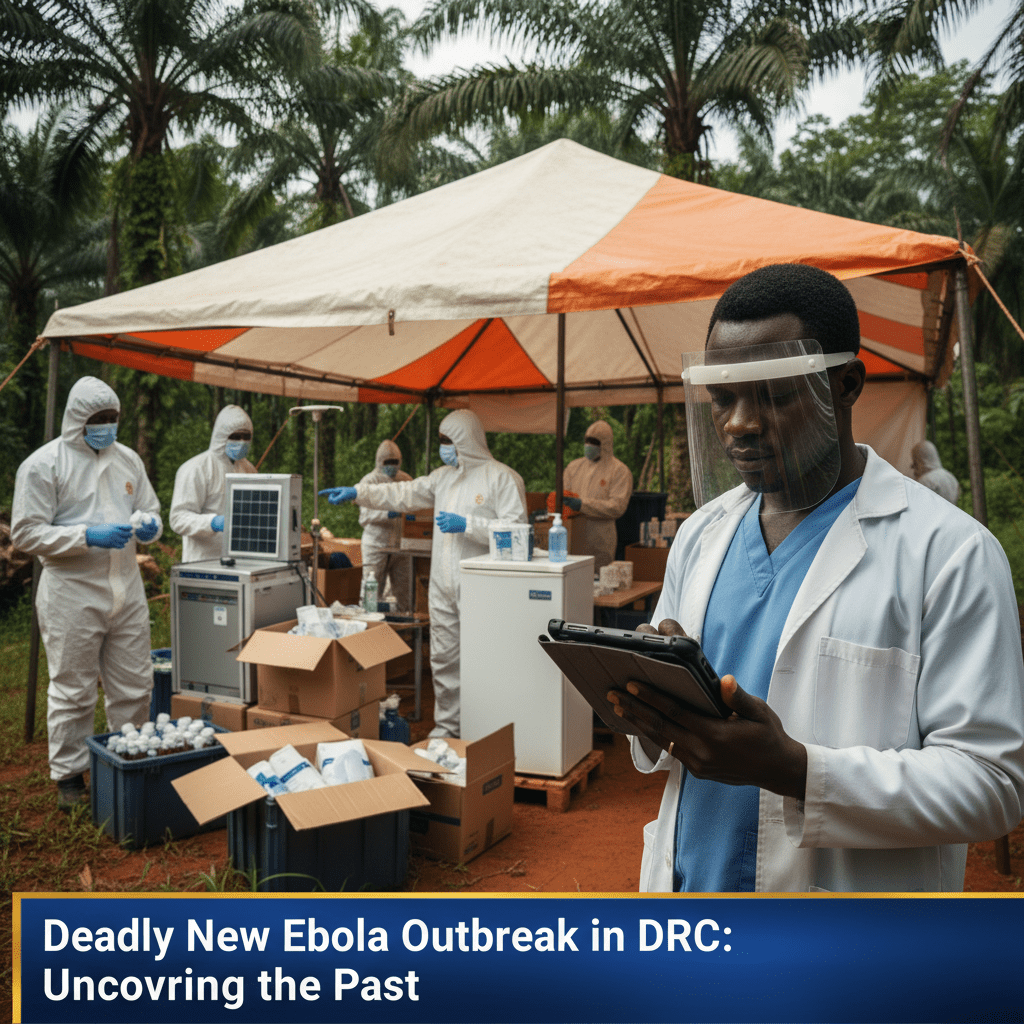
Deadly New Ebola Outbreak in DRC: Uncovering the Past
from African Elements Daily · host African Elements
Health officials report a new Ebola outbreak in the DRC's Ituri Province. Explore the history of the virus since 1976 and the rise of African health sovereignty. Deadly New Ebola Outbreak in DRC: Uncovering the Past By Darius Spearman (africanelements) Support African Elements at patreon.com/africanelements and hear recent news in a single playlist. Additionally, you can gain early access to ad-free video content. A Sudden Crisis in the Ituri Province On May 15, 2026, international health officials announced deeply troubling news. A new Ebola outbreak in the Democratic Republic of the Congo has claimed 65 lives. The Africa Centres for Disease Control and Prevention reports over 240 suspected cases. This crisis is currently unfolding in the remote Ituri Province. Local health workers are scrambling to contain the dangerous virus. The current outbreak serves as a severe warning to the global community. The world is watching the eastern part of the country with great concern. This situation is the latest chapter in a very long struggle. The disease has continuously haunted the central African region for fifty years (africacdc.org). This headline brings back painful memories of previous health disasters. The media often focuses heavily on the immediate tragedy. However, understanding the deep past is completely essential. The modern medical response looks very different today than it did decades ago. African nations are now firmly leading their own health initiatives. They are building entirely new structures for disease control. The ongoing fight against this lethal pathogen requires constant vigilance. It also demands a deep understanding of the local environment. Furthermore, the Africa CDC immediately convened emergency meetings with health authorities from Uganda and South Sudan. The ultimate goal is to prevent dangerous cross-border transmission (africacdc.org). The Discovery in the Village of Yambuku The documented history of this specific virus begins in 1976. The disease first appeared in the country then known as Zaire. The pathogen is named after the Ebola River. This river flows near the site of the first recognized outbreak. A schoolteacher named Mabalo Lokela was the first identified patient. He lived in the highly remote village of Yambuku. He went to a local mission hospital with a severe fever. Doctors initially mistook his symptoms for a severe case of malaria. His condition rapidly worsened, baffling the local medical staff (wikipedia.org). The 1976 outbreak remains one of the deadliest events on record. The mortality rate reached an astonishing 88 percent. A total of 280 people died out of 318 recorded cases. A young Congolese microbiologist named Jean-Jacques Muyembe-Tamfum investigated the growing crisis. He courageously collected fresh blood samples with his bare hands. He survived the terrifying ordeal and became a world-leading medical expert. Scientists from around the world eventually helped isolate the lethal virus. They received a single blood sample shipped in a simple thermos. Consequently, researchers from Antwerp and the American CDC arrived to help (theguardian.com). Historical Ebola Outbreak Fatality Rates 88% 1976 Zaire 66% 2018 Kivu 26% 2026 Bundibugyo Zoonotic Reservoirs and Hidden Ecological Threats Public health experts know the virus cannot be completely eradicated. The disease exists naturally within the local African environment. Animals act as zoonotic reservoirs for the dangerous pathogen. Fruit bats and insectivorous bats are the primary suspected carriers. The virus lives and reproduces safely inside these specific bats. The bats themselves do not get significantly sick from the infection. The disease then spills over into human populations. This usually happens through direct contact with infected animal fluids (cdc.gov). Environmental changes play a massive role in these deadly spillovers. Logging and deforestation push humans deeper into untouched wildlife habitats. Uncontrolled expansion increases the chances of contact with dangerous animals. The virus survives in nature entirely independently of human transmission. New outbreaks can occur completely unpredictably at any given time. A community might see zero cases for several quiet years. Then, a sudden spillover event sparks a brand new emergency. Management strategies now focus heavily on monitoring animal health. The One Health approach connects human health directly with animal welfare (mongabay.com). The Reality of Wild Meat Consumption The topic of wild animal consumption is historically very complicated. In the Congo Basin, wild meat is an essential source of protein. Wild-caught meat provides up to 80 percent of protein intake for rural communities. Livestock farming is geographically difficult in these dense tropical forests. Many households view wild meat as an entirely natural food source. They consider it significantly healthier than domesticated meat options. The resilience of these communities is remarkable, adapting through significant challenges time and time again (un.org). The actual health risk does not come from eating cooked meat. The true danger arises during the hunting and preparation process. Hunters handle the raw blood and saliva of newly killed animals. Banning this vital food source outright creates major social justice issues. Such strict bans severely threaten the food security of vulnerable populations. Providing alternative protein sources is a completely necessary public health step. African leaders are working tirelessly to find a balanced, respectful approach. This delicate balance must protect human lives while respecting cultural traditions. Communities desperately need viable ways to raise domestic animals (mongabay.com). Protein Intake in Congo Basin Communities 80% Wild Meat Wild Catch Domestic/Other The Unique Danger of the Bundibugyo Strain The current 2026 outbreak presents a very unique scientific challenge. Preliminary laboratory results strongly suggest the presence of the Bundibugyo strain. This specific viral strain was first formally identified in Uganda in 2007. The Zaire strain is historically the most common cause of major outbreaks. A highly effective and fully licensed vaccine already exists for the Zaire strain. Unfortunately, the rare Bundibugyo strain currently has no licensed vaccine available. Consequently, health officials find themselves completely without their primary medical weapon (news-medical.net). This frustrating vaccine gap highlights serious global research equity issues. The Zaire strain usually has a much higher fatality rate. Therefore, international pharmaceutical companies prioritized Zaire for their commercial investments. Global health funding historically follows the most visibly catastrophic emergencies. Scientists genuinely believe a Bundibugyo vaccine could be developed quite rapidly. They already possess the necessary viral vector technology from previous research. However, clinical trials require active human outbreaks to prove scientific effectiveness. The general rarity of Bundibugyo outbreaks severely hampers any human testing progress (kff.org). Contact Tracing in Conflict Zones Contact tracing is an absolutely essential strategy for stopping any outbreak. Health workers must meticulously identify everyone exposed to the virus. This vital task is nearly impossible in the active Ituri Province. The region is currently a highly volatile military conflict zone. Over 120 armed rebel groups operate in the eastern Democratic Republic of the Congo. These violent groups fight for control over valuable global minerals. Mining activity in Mongwalu massively accelerates the rapid viral spread. The struggle for resources is a familiar theme, echoing historical exploitation across the diaspora (mercycorps.org). Large-scale human displacement creates a truly perfect storm for disease. Terrified people flee violence and move unpredictably across the vast region. Health workers simply cannot follow contacts for the required 21-day period. Furthermore, a deep crisis of public trust complicates the entire medical response. Survey data shows very few local residents trust national health authorities. Health workers in white protective suits are sometimes mistaken for foreign agents. Consequently, there have been hundreds of violent attacks on local health facilities. This ongoing violence shows exactly how the history of Africa took a dramatic turn after foreign interference (dailysabah.com). From Isolation to Dignified Burials The global response strategy has evolved significantly over the last fifty years. Early outbreak protocols relied almost entirely on strict, isolating quarantines. Entire villages were completely cut off until the virus naturally disappeared. Today, professional health teams focus heavily on safe and dignified burials. The deadly viral load is absolutely highest when a victim dies. Traditional funeral rites often require closely touching or washing the deceased body. This physical contact was historically a major driver of viral transmission (cdc.gov). Initial safe burial protocols were deeply controversial and widely hated. Foreign health workers placed bodies in simple plastic bags and unmarked graves. This cold clinical approach caused severe spiritual distress for grieving local families. In local Congolese culture, a poor burial actively prevents the soul from finding peace. Modern protocols now deeply respect traditional cultural and religious practices. Families can observe the burial safely from a reasonable distance. They can sing, pray, and ensure religious customs are properly followed. This shift reflects a broader movement toward shedding colonial influences in health and science (speakupafrica.org). The Evolution of Medical Ethics and Consent Medical ethics in emergency outbreak responses have completely transformed. Early interventions in the 1970s followed a highly paternalistic Western model. Foreign doctors made absolutely all the decisions for passive African patients. Today, rigorous informed consent is an absolute requirement in every clinic. Patients must legally agree to participate in any experimental clinical trials. They finally have a respected voice in their own medical treatment. Bio-secure emergency care units now safely protect both patients and staff. These ethical debates mirror the ongoing fights over justice and freedom seen across the Black diaspora (oup.com). Data sovereignty is another massive ethical advancement for the continent. In the distant past, African blood samples were routinely shipped to Western labs. African institutions rarely received proper credit for their critical scientific contributions. Today, human genetic data remains the exclusive property of African research centers. Shared decision making is the brand new standard of medical care. Respected village elders and religious leaders are always consulted first. Health interventions are launched only with full, enthusiastic community backing (theclassicjournal.org). The Africa CDC and Sovereign Health Capacity The 2026 health response looks entirely different from the tragic 1976 event. The Africa Centres for Disease Control and Prevention is boldly leading the charge. This specific agency is an autonomous public health body. It successfully serves the 55 member states of the African Union. The United States CDC operates under the current administration of Donald Trump, focusing on American health. In contrast, the Africa CDC focuses exclusively on the diverse needs of African nations. The organization fiercely emphasizes a new public health order for the continent. The ultimate goal is achieving complete sovereign health capacity (cdc.gov). This new independence changes the entire dynamic of global health entirely. The Africa CDC coordinates directly with brilliant local scientists and doctors. The Institut National de Recherche Biomédicale in Kinshasa plays a major, foundational role. Together, African experts manage the complex logistics and set the research agendas. African governments are striving diligently to increase domestic health spending. They deeply want to move away from unreliable, fragmented donor funding. The vibrant continent is fiercely determined to secure its own healthy future (africacdc.org). A primary organizational goal is expanding local pharmaceutical and vaccine manufacturing. The agency firmly hopes to produce 60 percent of vaccines locally by the year 2040. Currently, less than one percent of vaccines are actively made in Africa. The establishment of the African Medicines Agency beautifully supports this massive vision. The continent can now safely regulate its own life-saving drugs. The tragedy of 65 recent deaths is truly heartbreaking and severe. Yet, the highly organized African response provides a powerful beacon of hope (africacdc.org). Africa CDC Vaccine Manufacturing Goal Current Status: 1% 2040 Target: 60% 60% 0% 25% 50% 75% 100% About the Author Darius Spearman is a professor of Black Studies at San Diego City College, where he has been teaching for over 20 years. He is the founder of African Elements, a media platform dedicated to providing educational resources on the history and culture of the African diaspora. Through his work, Spearman aims to empower and educate by bringing historical context to contemporary issues affecting the Black community.
NOW PLAYING
Deadly New Ebola Outbreak in DRC: Uncovering the Past
No transcript for this episode yet
Similar Episodes
No similar episodes found.