
EPISODE · Jun 16, 2026 · 20 MIN
Decoding the BOAT: GRB 221009A and the Hunt for High-Energy Neutrinos
from Multi-messenger astrophysics · host Astro-COLIBRI
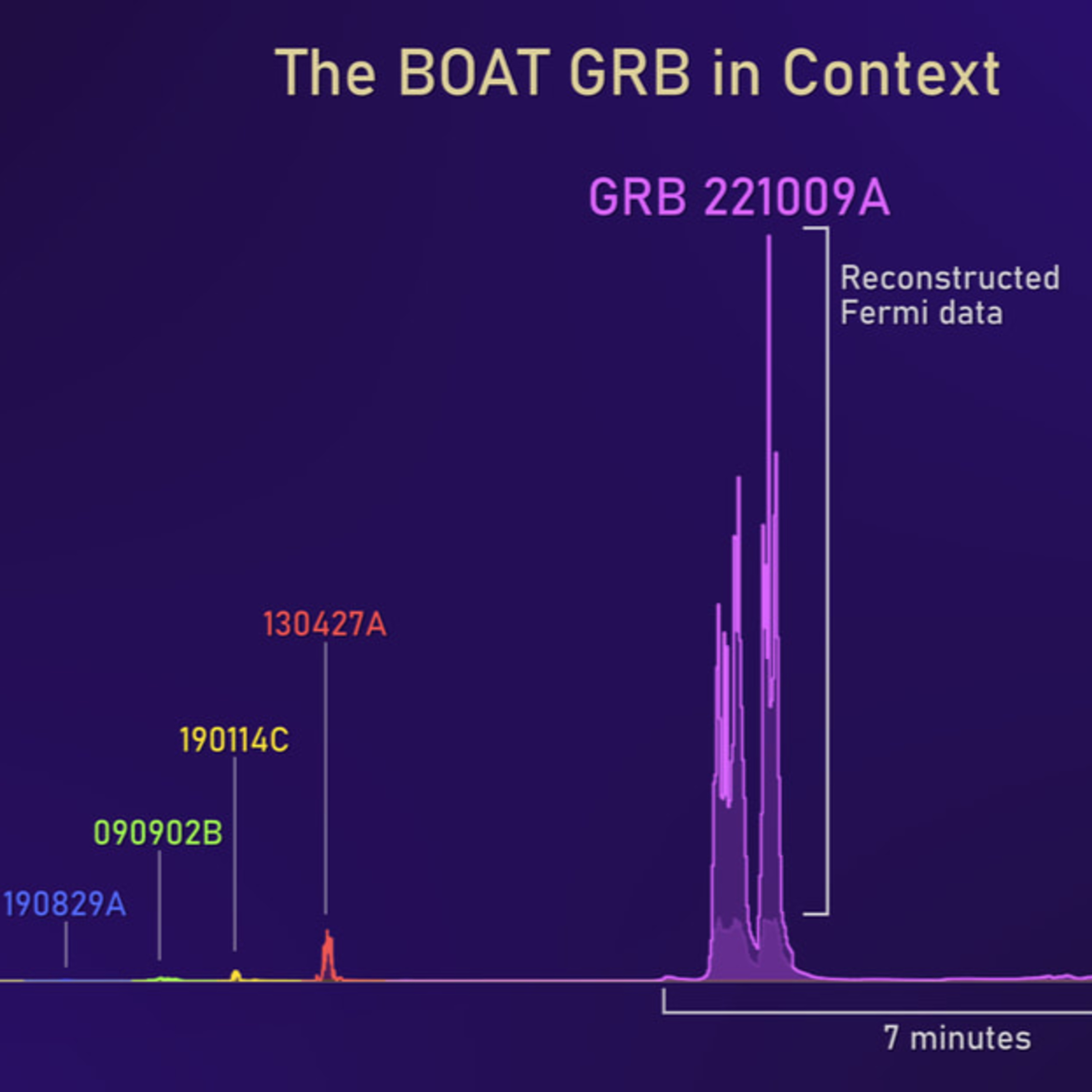
In this episode, we dive into the astrophysics behind GRB 221009A, an event widely known as the Brightest-Of-All-Time (BOAT) gamma-ray burst. Detected in October 2022, this extraordinary explosion shattered records by producing ultra-high-energy photons exceeding 10 TeV. We discuss a recent multi-messenger study that models the burst's very-high-energy (VHE) afterglow using a Gaussian structured jet expanding into an interstellar medium. We explore how this smooth, angular jet structure explains the extreme TeV output observed at a mildly off-axis viewing angle, cleanly resolving the "energy crisis" that standard uniform (top-hat) jet models face. Finally, we tackle the mystery of the missing neutrinos. Despite the immense energy of the BOAT, observatories like IceCube have not detected any coincident neutrinos. We break down the calculations for photo-hadronic ($p\gamma$) neutrino production and explain why the expected flux still falls below the sensitivity limits of even the next generation of detectors, like IceCube Gen2 and GRAND200k. Key Takeaways:The BOAT GRB: GRB 221009A was a remarkably luminous and relatively nearby event, offering an unprecedented opportunity to test emission models and ultra-high-energy cosmic ray acceleration.The Power of a Gaussian Jet: By using a Gaussian structured jet model, scientists can accurately reproduce the burst's gradual light curve steepening and immense brightness without requiring physically unrealistic energy budgets. A Mildly Off-Axis View: The study reveals that the optimal way to interpret the data is a mildly off-axis viewing geometry, which allows the observer to receive intense early-time emission from the jet's core.Neutrino Non-Detection Explained: Mathematical models of the photo-pion decay channel show that even under highly optimistic microphysical parameters, the predicted muon neutrino events remain below current and future detection limits, confirming that the null results from IceCube are consistent with the physics.Reference to the Article Discussed:Mondal, T., Razzaque, S., Joshi, J. C., Majumder, S., & Bose, D. (2026). Multi messenger study of GRB 221009A with VHE gamma-ray and neutrino Afterglow from a Gaussian structured jet. Journal of High Energy Astrophysics, 53, 100636.Acknowledements: Podcast prepared with Google/NotebookLM. Illustration credits: NASA's Goddard Space Flight Center and Adam Goldstein (USRA)
Embed this episode
Ready to play
Decoding the BOAT: GRB 221009A and the Hunt for High-Energy Neutrinos
No transcript for this episode yet
Similar Episodes
No similar episodes found.
Similar Podcasts
No similar podcasts found.