
EPISODE · Apr 14, 2026 · 20 MIN
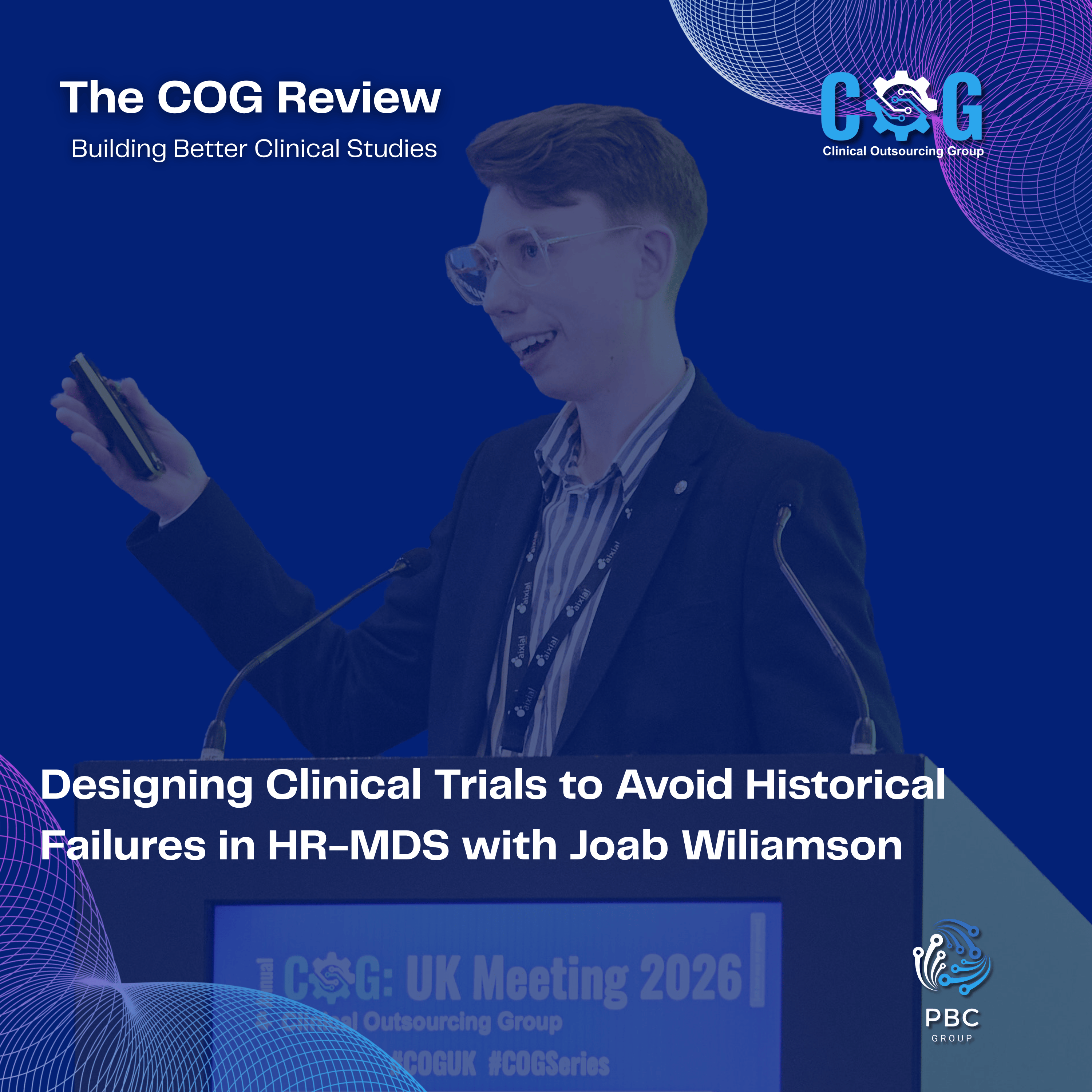
Designing Clinical Trials to Avoid Historical Failures in HR-MDS with Joab Wiliamson
from The COG Review: Building Better Clinical Studies
Gain practical strategies to de-risk clinical trial outsourcing and design more robust studies in high-risk myelodysplastic syndrome (HR-MDS), with lessons directly applicable to clinical study optimization and CRO selection.SpeakerJoab WilliamsonVP of Operations, Faron PharmaceuticalsLinkedIn: Joab WilliamsonSpecialty: Clinical trial operations, immunotherapy development, rare and high-risk oncology indicationsEpisode OverviewLive from COG UK, this episode features Joab Williamson, VP of Operations at Faron Pharmaceuticals, sharing an operational case study on trial design and outsourcing strategy for high-risk myelodysplastic syndrome (MDS). The session was moderated by Sverre Bengtsson with insights relevant to those involved in clinical study optimization, CRO selection, and risk mitigation in oncology trials.Drawing from a series of historical failures by leading sponsors in HR-MDS, including studies by Novartis, Takeda, and Gilead, Joab Williamson dissects why promising assets stumbled at the Phase 3 stage, and what clinical operations teams can do differently. Topics include the impact of post-trial treatment and global standard-of-care variability on overall survival endpoints, and why realistic effect sizing plus adaptive design are crucial for clinical outsourcing success.Key operational themes include designing protocols that anticipate real-world patient heterogeneity, aligning geography and eligibility criteria to de-risk outsourcing initiatives, and embedding a pre-mortem approach during early protocol development. For clinical research professionals focused on clinical trial outsourcing, vendor management, and CRO partnerships, the discussion offers actionable frameworks for reducing failure risk and optimizing trial delivery.Key Moments00:02:05 – Joab Williamson outlines Faron’s clinical-stage focus and unique challenges in HR-MDS trial execution00:04:17 – Review of repeated industry failures by large sponsors, and how small biotechs can lead by learning from these in outsourcing contexts00:05:10 – Why post-trial treatment switching flattens survival signals and requires careful protocol design for accurate CRO performance metrics00:08:09 – The operational risk of “all-comer” Phase 3 studies and how poor eligibility criteria complicate CRO selection and site management00:09:06 – Managing global trial execution challenges: how regional standard-of-care differences impact clinical outsourcing outcomes00:10:07 – Adaptive trial designs for incremental gains: why better statistical planning can rescue studies often lost to underpowered sample sizes00:11:25 – The critical role of eligibility criteria in optimizing clinical study results and operational feasibility00:13:02 – Being realistic about effect size and aligning Phase 3 expectations with Phase 1/2 outcomes to mitigate outsourcing and CRO delivery risk00:14:16 – Leveraging biomarker stratification and operational controls to increase audit-readiness and consistency across outsourced studies00:18:03 – Practical steps for embedding a pre-mortem analysis into early outsourcing and protocol design phasesTop 3 TakeawaysPrioritize Realistic Effect Sizing: Don’t overestimate Phase 3 outcomes based on early data, size trials and set outsourcing expectations using conservative, data-driven assumptions and iterative analysis.Embed Pre-Mortem Reviews in Outsourcing Workflows: Systematically review past failures to guide protocol and vendor selection, reducing repeat errors and optimizing clinical study outcomes with new or existing CROs.Control Patient and Geographic Variables: Tighten eligibility criteria and align region/site selection with Phase 1/2 success to avoid operational pitfalls and ensure consistent execution across clinical outsourcing partners.Links & ResourcesThe PBC Group – COG Event Series: Agendas, blog, and further clinical operations contentFaron PharmaceuticalsPeer-Reviewed Analysis (Faron with Yale): Published findings on clinical trial design in HR-MDSQuotes“Look at every single past failure in your indication. When you collect them, you see clear patterns, both in sponsor strategy and in trial design decisions that also directly impact CRO selection and outsourcing outcomes.”- Joab Williamson“A full label isn’t as valuable as a successful trial. Trying to do everything in one study often introduces risk and dilutes clinical operations best practices.”- Joab Williamson“A resizing event in the middle of a Phase 3 allows you to build for success, especially when you’re uncertain of treatment effect or resourcing with an external partner.”- Joab Williamson“There’s a graveyard in high-risk MDS. But if you’re operationally rigorous and realistic in the assumptions you send out to your CROs, it is possible to win.”- Joab Williamson“Designing trials for predictable, incremental gains, with protocol features such as adaptive design and hierarchy of endpoints, delivers both clinical and outsourcing resilience.” - Joab Williamson-----------Further content and agendas: hhttps://thepbcgroup.com-----------Further content and agendas: hhttps://thepbcgroup.comCopyright 2026 The PBC Group
NOW PLAYING
Designing Clinical Trials to Avoid Historical Failures in HR-MDS with Joab Wiliamson
No transcript for this episode yet
Similar Episodes
Mar 26, 2026 ·1m
Mar 19, 2026 ·34m
Feb 18, 2026 ·11m
Feb 11, 2026 ·45m