
EPISODE · Feb 13, 2026 · 16 MIN
🧬 Dipids: The DNA Origami Breakthrough That Builds Cell-Sized Robots
from The Deep Dive Lab: Unraveling Materials Science · host Son Hoang
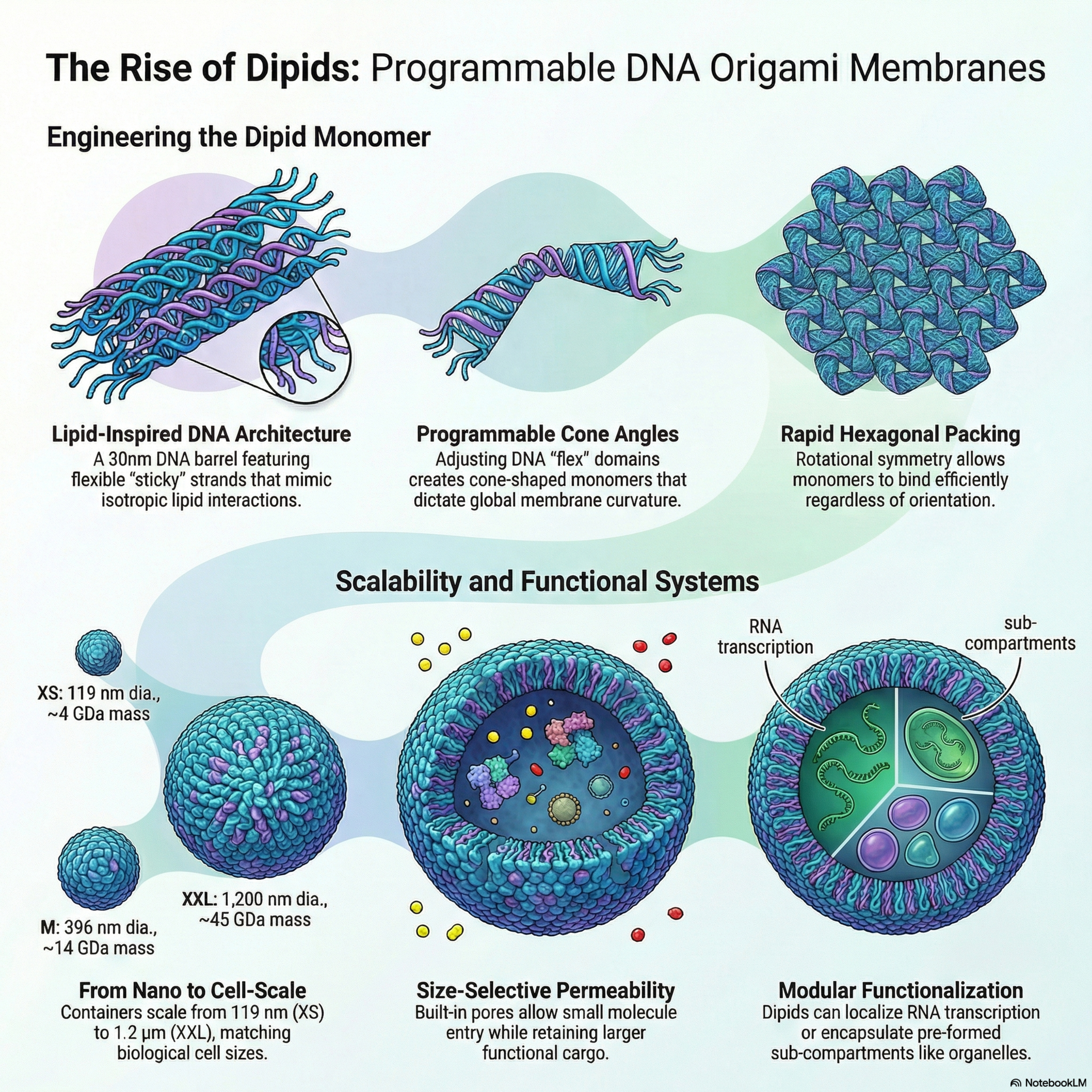
Life is defined by its borders. Without membranes, the chemistry of a cell would dissolve into chaos. For decades, synthetic biologists faced a brutal trade-off: build rigid, virus-scale DNA cages with atomic precision—or large, messy lipid vesicles with no programmability.A landmark 2025 study from the Technical University of Munich, published in Nature Materials, shatters that barrier. By merging DNA origami precision with lipid-like fluidity, researchers created “Dipids”—DNA-lipid hybrid membranes capable of self-assembling into containers ranging from virus scale (119 nm) to bacterial scale (1.2 μm).These isotropic “sticky discs” bypass rigid Caspar–Klug viral geometry, introducing structural compliance through flexible oligo-dT domains. The result? A programmable DNA fabric that is as soft as a biological membrane yet as addressable as a microchip.Even more astonishing: scaling from small to XXL requires only minor design tweaks—costing roughly $160 in new strands. With built-in porosity, Dipid membranes act as nanofactories, demonstrated by in-vitro transcription experiments where T7 polymerase freely entered to activate fluorescent RNA inside the container.We are witnessing the birth of cell-scale soft robotics—where molecular computation, motors, and membrane topography converge.📖 Source paper: Self-assembled cell-scale containers made from DNA origami membranes. Nature Materials (2025).#DNAOrigami #SyntheticBiology #Nanotechnology #SoftRobotics #CellEngineering #BottomUpBiology #NatureMaterials #FutureOfLife #deepdivelab
Embed this episode
NOW PLAYING
🧬 Dipids: The DNA Origami Breakthrough That Builds Cell-Sized Robots
No transcript for this episode yet
Similar Episodes
No similar episodes found.
Similar Podcasts
No similar podcasts found.