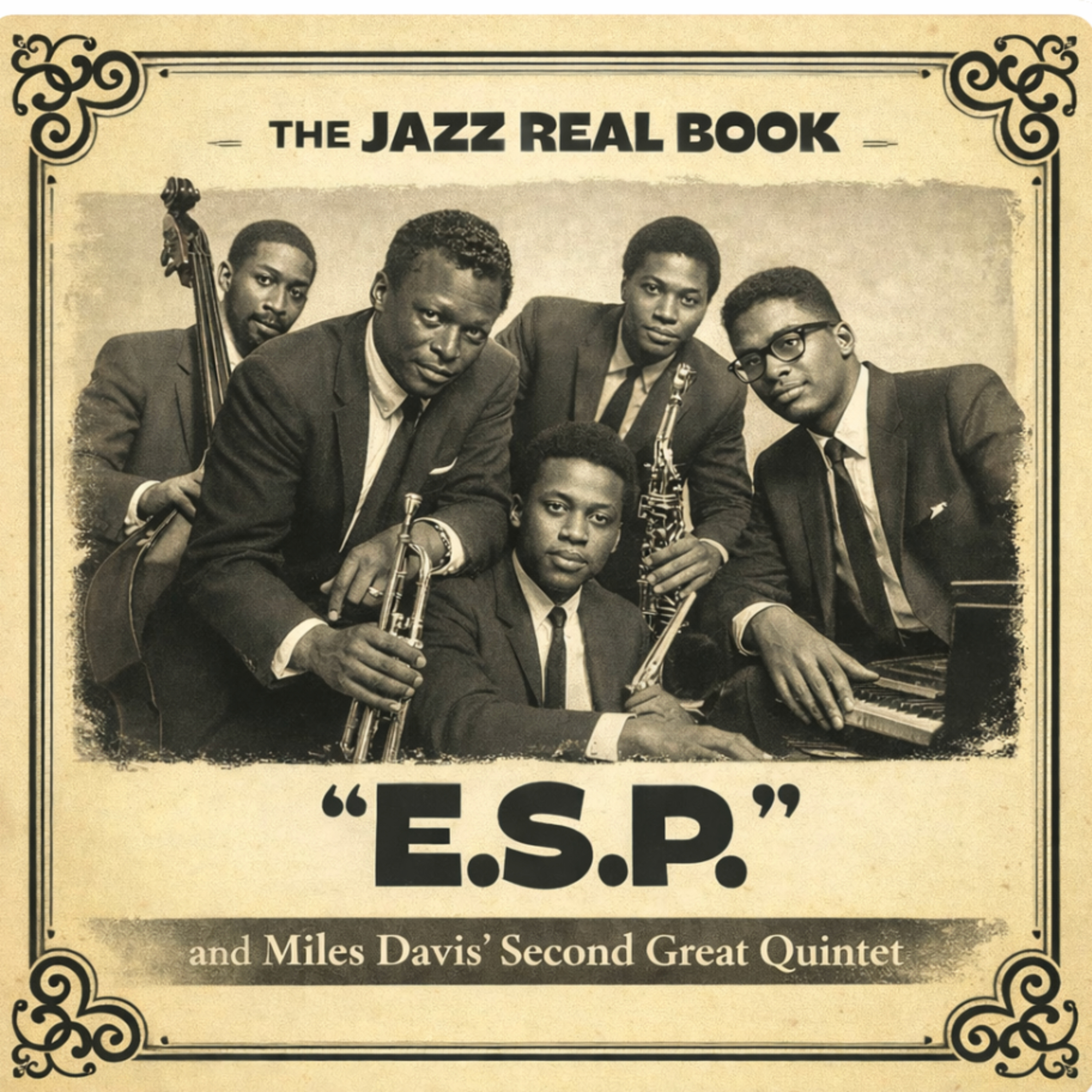
E.S.P. and Miles Davis’ Second Great Quintet episode artwork

EPISODE · Feb 8, 2026 · 20 MIN

E.S.P. and Miles Davis’ Second Great Quintet

from The Jazz Real Book · host Jay Sweet

“E.S.P.” and Miles Davis’ Second Great Quintet (110)Standards Rating 5, Difficulty Rating 7 “E.S.P.” stands as a defining statement of Miles Davis’ Second Great Quintet, featuring Wayne Shorter, Herbie Hancock, Ron Carter, and Tony Williams. Written by Shorter, the tune captures the group’s concept of “time, no changes,” where pulse remains steady but harmony feels fluid and constantly shifting. Its 16-bar A and A’ sections, filled with syncopation and chord tensions (#11s, 9ths, altered dominants), create ambiguity rather than predictable resolution. The half-step root motion and unresolved cadences reflect the band’s conversational style—each member shaping form in real time. Williams’ elastic drumming and Hancock’s harmonically suggestive comping free the soloists from strict harmonic boundaries. On the original 1965 recording, the quintet achieves remarkable cohesion, balancing structure and risk. “E.S.P.” exemplifies how this ensemble reshaped post-bop into a more interactive, modern language.Miles Davis Joey DeFrancesco The Jazz Real Book Playlist Vol. 2

“E.S.P.” and Miles Davis’ Second Great Quintet (110)Standards Rating 5, Difficulty Rating 7 “E.S.P.” stands as a defining statement of Miles Davis’ Second Great Quintet, featuring Wayne Shorter, Herbie Hancock, Ron Carter, and Tony Williams. Written by Shorter, the tune captures the group’s concept of “time, no changes,” where pulse remains steady but harmony feels fluid and constantly shifting. Its 16-bar A and A’ sections, filled with syncopation and chord tensions (#11s, 9ths, altered dominants), create ambiguity rather than predictable resolution. The half-step root motion and unresolved cadences reflect the band’s conversational style—each member shaping form in real time. Williams’ elastic drumming and Hancock’s harmonically suggestive comping free the soloists from strict harmonic boundaries. On the original 1965 recording, the quintet achieves remarkable cohesion, balancing structure and risk. “E.S.P.” exemplifies how this ensemble reshaped post-bop into a more interactive, modern language.Miles Davis Joey DeFrancesco The Jazz Real Book Playlist Vol. 2

NOW PLAYING

E.S.P. and Miles Davis’ Second Great Quintet

0:00 20:26

No transcript for this episode yet

We transcribe on demand. Request one and we'll notify you when it's ready — usually under 10 minutes.

Frequently Asked Questions

How long is this episode of The Jazz Real Book?

This episode is 20 minutes long.

When was this The Jazz Real Book episode published?

This episode was published on February 8, 2026.

What is this episode about?

“E.S.P.” and Miles Davis’ Second Great Quintet (110)Standards Rating 5, Difficulty Rating 7 “E.S.P.” stands as a defining statement of Miles Davis’ Second Great Quintet, featuring Wayne Shorter, Herbie Hancock, Ron Carter, and Tony Williams. Written...

Can I download this The Jazz Real Book episode?

Yes, you can download this episode by clicking the download button on the episode player, or subscribe to the podcast in your preferred podcast app for automatic downloads.
URL copied to clipboard!