
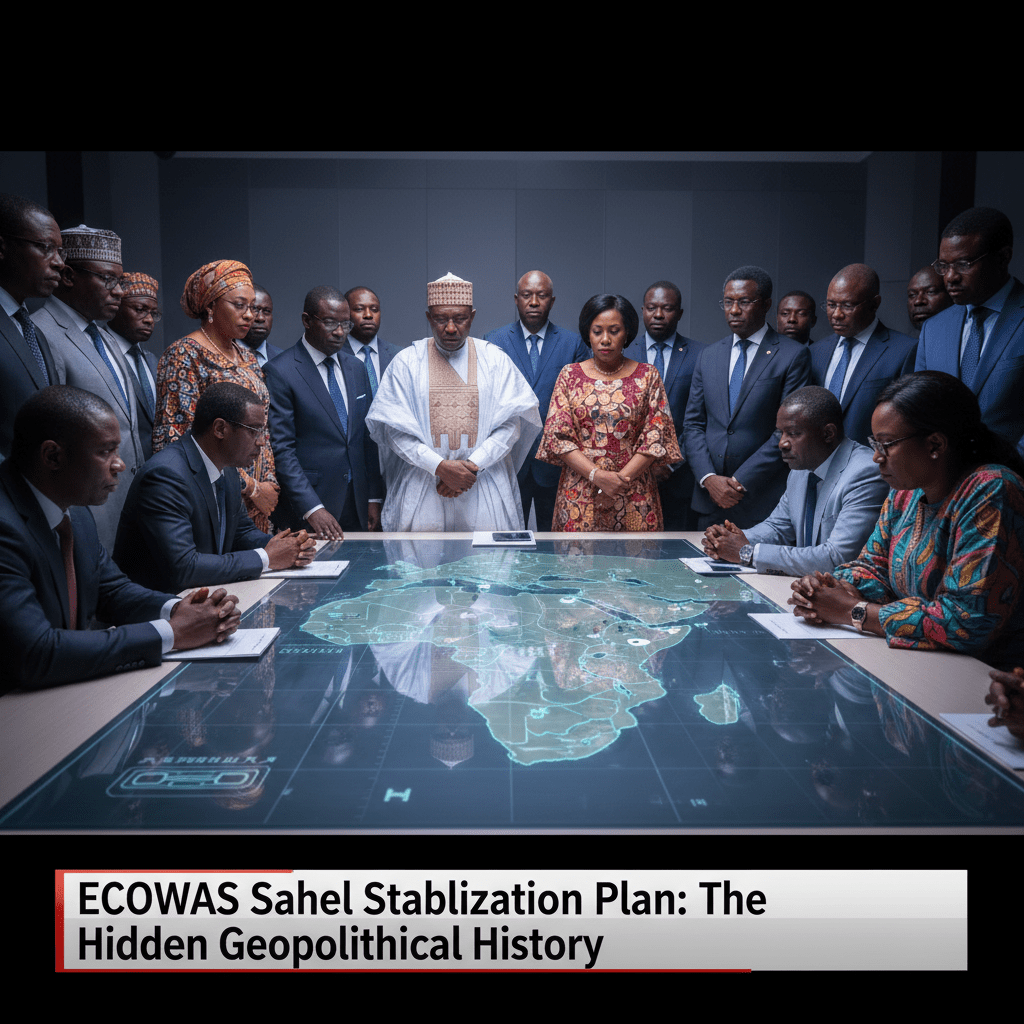
EPISODE · May 18, 2026 · 12 MIN
ECOWAS Sahel Stabilization Plan: The Hidden Geopolitical History
from African Elements Daily · host African Elements
Explore the ECOWAS Sahel Stabilization Plan's strategy to counter extremism, achieve autonomy, and address the shifting geopolitics of West Africa. ECOWAS Sahel Stabilization Plan: The Hidden Geopolitical History By Darius Spearman (africanelements) Support African Elements at patreon.com/africanelements and hear recent news in a single playlist. Additionally, you can gain early access to ad-free video content. A Crisis Reaches a Boiling Point Early Monday morning, the Economic Community of West African States released a preliminary framework for a unified, cross-border security response. This announcement followed intense emergency meetings over the weekend. The ECOWAS Sahel Stabilization Plan aims to counter recent destabilization across the region. The Sahel is a vast semi-arid transition zone stretching roughly 2,400 miles from the Atlantic Ocean to the Red Sea, effectively separating the Sahara Desert from the fertile savannas to the south (wikipedia.org). Historically, this region served as a cultural and economic crossroads for diverse ethnic groups, but today it faces an unprecedented emergency. Over the past decade, extremist violence has shattered the region. This relentless conflict has displaced 4.2 million people, with 3.7 million being internally displaced within their own borders. Furthermore, militant Islamist violence caused over 23,000 fatalities in 2023 alone, representing a 20 percent increase from the previous year (crisisgroup.org, unrefugees.org). Extremist groups now influence or control approximately 40 percent of the territory in Burkina Faso. Because of these alarming statistics, regional leaders felt compelled to draft a new survival strategy. The resulting framework represents an urgent attempt to secure a territory that deeply affects the stability of the entire African continent. Human Toll of the Sahel Crisis Militant Violence Fatalities (2023): 23,000 People Displaced (2026): 4.2 Million The Birth of West African Unity To fully grasp the magnitude of the current Stabilization Plan, one must examine the historical evolution of West African collective security. Leaders established ECOWAS in 1975 through the Treaty of Lagos. Initially, the founders designed the organization primarily as an economic bloc to promote regional integration. The movement drew deep inspiration from the Pan-African ideals of the 1950s and the decolonization process, aiming to foster regional self-determination during the heights of the Cold War (wikipedia.org). The organization symbolized a powerful vision for a unified continent. However, the organization's mission shifted dramatically at the end of the 1980s. When the Liberian Civil War broke out in 1989, ECOWAS realized that economic integration was impossible without regional peace. This realization led to the creation of the ECOWAS Monitoring Group, widely known as ECOMOG, in 1990. ECOMOG served as the first regional intervention force of its kind in the world. Following subsequent interventions in Sierra Leone and Guinea-Bissau, the bloc codified its security role in the 1999 Protocol Relating to the Mechanism for Conflict Prevention. This crucial protocol officially created the ECOWAS Standby Force, intended as a rapid-deployment unit to counter terrorism and prevent illegal political takeovers (wikipedia.org). The Catalyst in Mali The roots of the modern Sahelian breakdown trace directly back to 2012. A military coup in Mali, followed by a massive Tuareg and jihadist rebellion, exposed severe weaknesses in the regional security architecture. Despite its previous successes, ECOWAS struggled to deploy its Standby Force effectively during this emergency. Ultimately, the region had to rely on French military intervention, known as Operation Serval, to halt the militant advance (crisisgroup.org). This intervention halted the immediate threat but planted seeds of long-term resentment. This reliance on foreign powers set the stage for profound political shifts. Between 2020 and 2023, the region experienced a historic wave of military takeovers in Mali, Burkina Faso, and Niger. Analysts refer to this geographic concentration of illegal power seizures as the "Coup Belt." The African Union and ECOWAS officially classify these events as Unconstitutional Changes of Government (au.int). The military juntas justified their actions by pointing to the failure of both ECOWAS and Western allies to stop the ongoing jihadist insurgencies. These leaders argued that severe, extra-legal measures were necessary to protect their citizens from continuous violence. The Rise of the Alliance of Sahel States The political landscape fractured even further when Mali, Burkina Faso, and Niger officially withdrew from ECOWAS in early 2025. The three nations formed a rival confederation called the Alliance of Sahel States (AES). This new bloc views its withdrawal as an act of decolonization and anti-imperialism. The Alliance explicitly rejects Western-aligned frameworks and French influence in favor of national sovereignty. These three nations represent roughly 17 percent of the regional population and 7.7 percent of its total gross domestic product (gisreportsonline.com). The Alliance of Sahel States successfully expelled Western military forces from their territories. For example, France officially ended its decade-long military presence in these countries between 2022 and 2023. Additionally, in 2024, the United States was forced to withdraw from a strategic 110 million dollar drone base in Agadez, Niger (defensescoop.com). Currently, the Donald Trump administration must navigate this rapidly changing geopolitical environment as Western powers pivot toward more stable coastal nations like Kenya and Côte d’Ivoire. The Alliance leaders heavily utilize anti-Western sentiment, framing ECOWAS as a puppet of Western interests. Regional Split: ECOWAS vs. AES Population Distribution ECOWAS 83% AES 17% Economic Share (GDP) ECOWAS 92.3% AES 7.7% Escaping the Dependency Trap A major focus of the 2026 Stabilization Framework is achieving true strategic autonomy. Strategic autonomy refers to the ability of African nations to set their own foreign policy and security priorities without depending on conditional foreign aid. Historically, reliance on Western funding created a severe "dependency trap." This trap occurs when foreign aid forces recipient countries to accept political conditions that align with the strategic interests of the donor nation rather than local needs. Critics view this dynamic as a missionary arm of neoliberalism that stifles local initiative and sovereignty (lse.ac.uk). The region clearly recognizes that shedding colonial influences is essential for long-term survival. To avoid this trap, the new ECOWAS plan emphasizes aggressive self-financing. Leaders are pushing for a 0.5 percent community levy on imported goods to fund the new counterterrorism initiatives independently. While this levy aims to secure financial independence, it also carries serious economic risks. Critics note that this tax creates a price burden for everyday consumers. In a region where the cost of a nutritious diet is already 110 percent higher than the daily minimum wage, adding taxes to essential imports could worsen the ongoing hunger crisis (foodsecurityportal.org). Leaders must carefully balance the desire for military independence with the economic realities of their citizens. The Kinetic Edge of the Framework The military component of the ECOWAS Sahel Stabilization Plan signals a monumental shift in regional strategy. After years of diplomatic fatigue, the May 2026 resolution moves away from quiet diplomacy and fully embraces kinetic enforcement. In military terminology, "kinetic" refers to active warfare involving lethal force and traditional combat operations, as opposed to soft measures like economic sanctions (dtic.mil). This change reflects a regional consensus that soft power alone cannot defeat well-armed extremist networks. A core component of the new plan is the operationalization of a 1,650-soldier counterterrorism brigade. This elite unit is designed to serve as the kinetic edge of the Stabilization Plan. Member states such as Nigeria, Ghana, and Senegal have pledged troops and domestic funding to ensure the unit is ready for rapid deployment (premiumtimesng.com). The framework targets an ambitious annual budget of 2.5 billion dollars for regional security. This financial commitment represents a massive increase from previous underfunded initiatives. By empowering this new strike force, ECOWAS intends to deter further unconstitutional political changes while simultaneously battling extremist insurgents. Target Security Budget Annual Funding Goal for the 2026 Sahel Stabilization Plan $2.5B A Focus on the People Despite the strong military focus, the new framework acknowledges that ECOWAS currently sits at its most fragile point since 1975. Officially titled the "Compact for the Future of Regional Integration," the plan deliberately attempts to transition the bloc from an organization of states to an organization of peoples. This citizen-centered approach is a direct response to the widespread perception that ECOWAS only serves wealthy, elite interests. That elite-driven perception previously fueled public support for military coups across the Sahel (africanlegalstudies.blog). To rebuild essential public trust, the framework prioritizes social inclusion and gender representation within its ranks. The African Union and ECOWAS have established a 30 percent baseline quota for women in peace processes and military decision-making. The new framework pushes further, setting an aspirational target of 40 percent female representation in leadership roles. Enforcement of these goals occurs through the Women, Peace, and Security agenda. This agenda mandates the inclusion of gender officers in peace support operations to ensure that women exercise transformative influence rather than serving merely symbolic or auxiliary roles (inclusivepeace.org). The Diaspora Connection The ongoing instability in the Sahel holds profound implications for the global African Diaspora. The crisis has triggered massive migration flows toward North Africa and Western countries as refugees flee climate shocks and persistent violence. Unfortunately, this instability facilitates human trafficking networks that target vulnerable African migrants, compounding an already severe humanitarian crisis (unrefugees.org). For many, the situation connects directly to the broader fight for economic justice as Black populations demand fair treatment and resource control globally. For many social justice advocates within the Diaspora, the Sahelian struggle serves as a powerful mirror to their own battles against systemic oppression. The aggressive push for sovereignty in West Africa represents a bold confrontation with imperialism that inspires anti-colonial movements around the world (blackagendareport.com). Observers draw parallels to the fight over justice and freedom seen in historical Black Power movements. The ability of the region to survive this fracture highlights the enduring strength and resilience of African people. Ultimately, the ECOWAS Sahel Stabilization Plan is a desperate yet necessary attempt to prevent the fragmentation of West Africa and reclaim a stable destiny for over 400 million citizens. About the Author Darius Spearman is a professor of Black Studies at San Diego City College, where he has been teaching for over 20 years. He is the founder of African Elements, a media platform dedicated to providing educational resources on the history and culture of the African diaspora. Through his work, Spearman aims to empower and educate by bringing historical context to contemporary issues affecting the Black community.
NOW PLAYING
ECOWAS Sahel Stabilization Plan: The Hidden Geopolitical History
No transcript for this episode yet
Similar Episodes
No similar episodes found.