
EPISODE · May 18, 2026 · 15 MIN
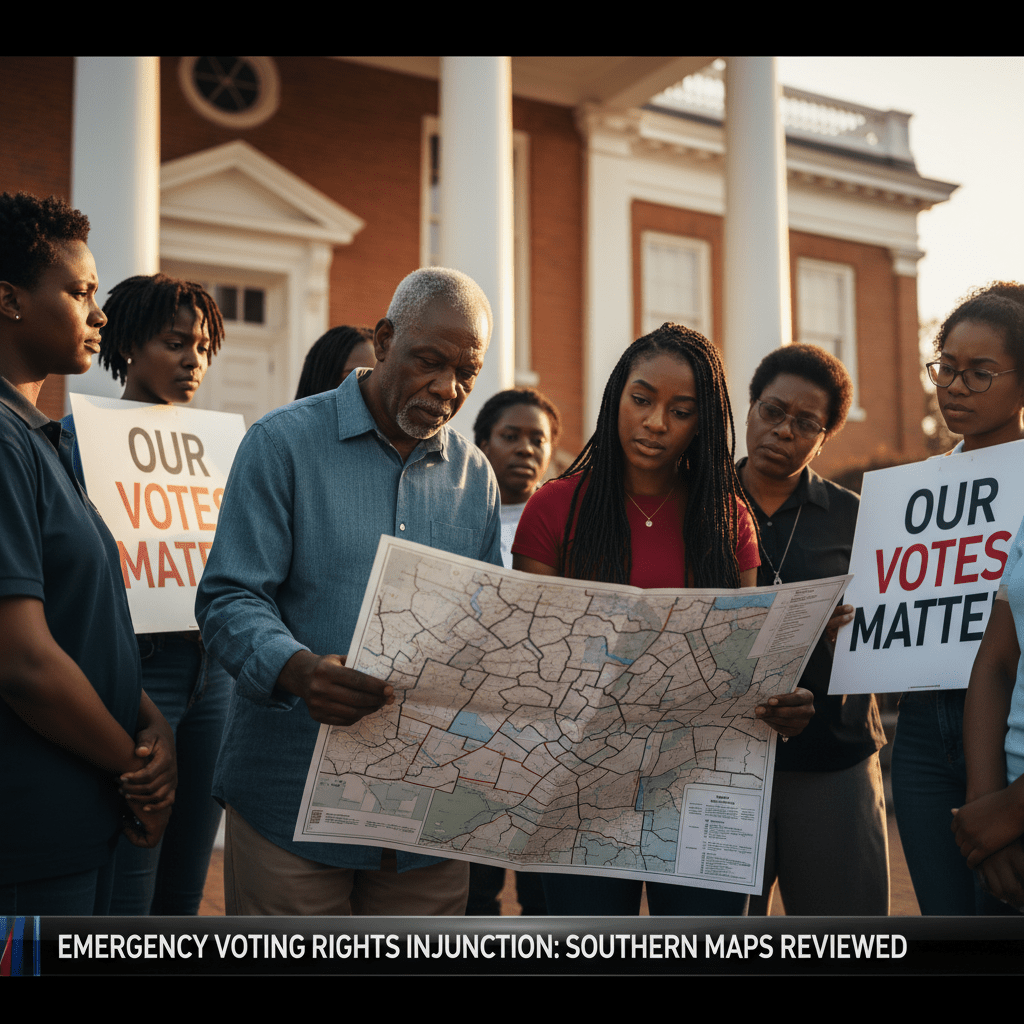
Emergency Voting Rights Injunction: Southern Maps Reviewed
from African Elements Daily · host African Elements
Deep dive into Emergency Voting Rights Injunction Expedited: A federal appeals court announced late Sunday night that it will expedite the review of the joint injunction filed by civil rights advocates against recently implemented redistricting maps in three Southern states ahead of the upcoming primaries.. Emergency Voting Rights Injunction: Southern Maps Reviewed By Darius Spearman (africanelements) Support African Elements at patreon.com/africanelements and hear recent news in a single playlist. Additionally, you can gain early access to ad-free video content. The Sudden Shift In Southern Elections A federal appeals court announced a late Sunday night decision that shocked political observers. The court will expedite the review of a joint injunction regarding congressional maps. Civil rights advocates filed this injunction against newly implemented redistricting maps. These controversial maps currently impact three Southern states. These specific states are Alabama, Louisiana, and Tennessee. This legal move happens just days before upcoming primary elections. The stakes for this decision are incredibly high. The final decision could shift power in the United States Congress. Therefore, voters wait nervously for a final resolution. (courthousenews.com) The current political climate remains intensely competitive. President Donald Trump is currently in office. Both major political parties are actively battling for every legislative seat. However, this legal battle represents a much deeper struggle. It is fundamentally a fight for fair and equal representation. The newly drawn maps severely limit Black voting power in the South. Advocates strongly argue these changes are intentionally discriminatory. They point directly to the aggressive timing of the map changes. Lawmakers implemented them during an active election cycle. Consequently, massive chaos has erupted among election officials and ordinary voters. (democracydocket.com) A Struggle Rooted In Reconstruction The present political battles reflect a very long historical struggle. The fight for fair political representation began immediately after the Civil War. At that time, the nation ratified the 15th Amendment in 1870. This crucial amendment strictly prohibited denying voting rights based on race. This created a brief but powerful era of biracial democracy. Black men were elected to offices across the Southern states. They successfully served in local, state, and even federal positions. It seemed like a bright new dawn for racial equality. (eji.org) However, this remarkable progress faced immediate and violent backlash. White politicians soon implemented new laws to regain total control. They specifically designed these laws to bypass the 15th Amendment. By the late nineteenth century, Jim Crow tactics ruled the Southern landscape. Lawmakers introduced expensive poll taxes and impossible literacy tests. They also used racial gerrymandering to dilute minority voting strength. By 1940, these oppressive tactics were highly effective. Only three percent of voting-age Black residents in the South were registered to vote. This systematic disenfranchisement lasted for several painful decades. (eji.org) Southern Black Voter Registration Growth 1940 3% 1964 27% Post-VRA 50% How Maps Divide And Conquer Communities Understanding the current legal injunction requires examining specific legislative tactics. Lawmakers historically used strategies known as packing and cracking to control elections. Packing involves deliberately concentrating minority voters into one single district. This strategy ensures these voters win that specific seat. However, it completely removes their political influence from all surrounding districts. As a result, their overall representation remains artificially restricted. (stevevladeck.com) Cracking operates as the exact opposite political strategy. This tactic involves intentionally spreading minority voters across several different districts. Because they are divided, they never form a large enough group anywhere. They become unable to elect their preferred candidate in any district. These manipulative strategies were heavily utilized during the Civil Rights era. States could no longer legally deny ballots directly to Black citizens. Instead, they manipulated the boundary maps to ensure minority votes lacked real weight. The joint injunction currently under review targets these exact same tactics. Advocates claim these discriminatory strategies are actively returning to Southern politics today. (ballsandstrikes.org) The Voting Rights Act Provided Protection The passage of the 1965 Voting Rights Act changed the political landscape entirely. Many historians consider it the capstone of the entire Civil Rights Movement. The law provided necessary federal oversight for local and state elections. Section 5 of the act was especially crucial for Southern states. It required states with histories of severe discrimination to obtain federal approval. They had to preclear any changes to their voting laws. This included moving a single polling place or redrawing congressional maps. (slu.edu) This preclearance system acted as a powerful preventative shield. It effectively stopped discriminatory laws before they were ever implemented. Furthermore, Section 2 of the act allowed federal lawsuits against unfair maps. It strictly prohibited any map that diluted minority voting power. The societal impact of this legislation was immediate and massive. In Georgia, Black voter registration rose significantly from twenty-seven percent in 1964. Within a few short years, it reached nearly half of all voting-age Black residents. The federal law finally forced stubborn states to respect the ballot box. (slu.edu) The Collapse Of Federal Oversight The strong protection provided by the Voting Rights Act did not last forever. A major legal shift occurred during the summer of 2013. The Supreme Court decided the landmark case of Shelby County versus Holder. This controversial ruling effectively ended the federal preclearance requirement. The court completely struck down the formula used to determine which states needed approval. Southern states could suddenly change their voting laws without prior federal review. (democracydocket.com) The negative consequences of this Supreme Court decision were incredibly swift. Southern states rapidly closed nearly 1,200 polling places in minority neighborhoods. They also purged millions of eligible voters from the official registration rolls. Civil rights advocates argued this was a clear return to older disenfranchisement tactics. Furthermore, it allowed state legislatures to implement new district maps without federal oversight. This sudden loss of preclearance directly led to the current legal chaos. Lawmakers can now change maps mid-election without asking anyone for permission. (democracydocket.com) Polling Places Closed Post-2013 1,200 Federal Oversight Removed by Shelby County v. Holder A New Legal Standard Changes Everything The recent push for an expedited review stems from another major court case. In late April 2026, the Supreme Court ruled on Louisiana versus Callais. This 6-3 decision significantly weakened Section 2 of the Voting Rights Act. The court decided that Louisiana used race unconstitutionally in its map design. The state had previously created a second majority-Black district. The conservative majority called this action an unconstitutional racial gerrymander. (courthousenews.com) This monumental ruling reversed a legal precedent set only three years prior. It shifted the standard from showing discriminatory effects to requiring proof of intentional discrimination. Plaintiffs must now provide clear evidence that lawmakers actively intended to discriminate. This requirement is notoriously difficult to prove in a modern court of law. Furthermore, the court allowed states to freely use a partisan gerrymandering defense. If a state claims it drew maps purely for political goals, it may be shielded entirely. It becomes legally protected from claims of racial discrimination. This ruling opened the floodgates for states to quickly redraw their congressional maps. (courthousenews.com) Maps Redrawn During Active Elections Following the Callais ruling, three specific states took immediate and drastic action. Alabama officials quickly filed emergency motions to revert to an older, contested map. This revised map contains only one single majority-Black district. A lower federal court had previously ordered the state to create two. Louisiana took even more disruptive steps regarding its electoral process. Governor Jeff Landry officially declared a statewide state of emergency. He subsequently suspended the state congressional primaries originally set for May. (dailypress.net, courthousenews.com) This unprecedented suspension allowed the state legislature time to pass entirely new maps. These new maps deliberately eliminate one of the two majority-Black seats in Louisiana. Meanwhile, Tennessee lawmakers called a rapid and highly controversial special session. They completely redrew the congressional map surrounding the major city of Memphis. The state formally split the cohesive, majority-Black city into three separate districts. They diluted its voting power by combining city voters with rural, Republican-leaning areas. These sudden, sweeping changes caused immediate panic among civil rights organizations nationwide. (courthousenews.com) The High Cost Of Diluted Representation The sudden redistricting changes carry severe consequences for Black communities across the South. In Tennessee, the Memphis district was historically a cohesive and powerful voting bloc. Now, the newly implemented map fragments the community entirely. Black voters will make up less than thirty percent of the electorate in these new areas. They will immensely struggle to elect candidates of their choice in these districts. This directly impacts how the system of federalism serves these specific communities. (ballotpedia.org) Proponents of fair maps consistently argue that descriptive representation matters deeply. Seeing community members in political office strongly encourages voter turnout. It also ensures that highly specific community policy issues receive necessary attention. These critical issues include criminal justice reform and economic justice. When districts are split apart, these crucial voices are effectively silenced. The current map changes are viewed as a massive betrayal of democratic principles. Political analysts estimate these new maps could net Republicans up to five additional congressional seats. This shift could significantly alter the balance of power in Congress for a decade. (theguardian.com) The "Cracking" of Memphis (TN-09) Majority District <30% Black <30% Black <30% Black A cohesive voting bloc is shattered into three separate districts, diluting its political power. Discarded Ballots And Widespread Voter Confusion The late changes have also caused direct, measurable harm to everyday voters. In Louisiana, early voting had already begun before the primary was officially suspended. Over 42,000 early absentee ballots had already been cast by citizens. Because the congressional election was canceled, these ballots were effectively invalidated immediately. They will never be counted toward the heavily contested congressional races. Governor Landry confirmed on national television that these specific ballots were discarded entirely. (ksat.com) Voters whose ballots were discarded must now vote again in rescheduled elections. Civil rights groups angrily call this a historic act of mass disenfranchisement. It forces voters to navigate a constantly changing and confusing electoral system. The Secretary of State noted that votes for other political offices might still proceed. However, the mass invalidation of congressional votes creates immense logistical confusion. This chaotic situation perfectly highlights the danger of changing rules mid-election. It severely damages public trust in the integrity of the democratic process. (blackvotersmatterfund.org) The Judicial Doctrine Called The Purcell Principle The appeals court decided to expedite the review for a very specific legal reason. It heavily involves a judicial concept known as the Purcell Principle. This important doctrine usually stops federal courts from changing election rules late. The primary goal is to prevent mass voter confusion near election day. Courts typically avoid interfering on the literal eve of an election. (democracydocket.com) However, civil rights advocates fiercely argue a completely different perspective regarding this principle. They claim the states themselves blatantly violated the spirit of this doctrine. The states willingly redrew maps and suspended elections during an active voting cycle. The appellate courts are finally recognizing this highly unusual disruption. Waiting for a standard appeal process would take several crucial months. It would force the 2026 midterms to use potentially unlawful and discriminatory maps. The expedited review strongly attempts to resolve the resulting chaos quickly. It desperately aims to restore stability before voters head to the primary polls. (stevevladeck.com) What This Means For The Future The impending court decision carries immense, nation-altering weight for the entire country. The 2026 midterms are incredibly critical for both major political parties. The expedited judicial review could determine the final shape of Southern congressional maps. If the injunction successfully holds, states may be forced to draw fairer districts. If the courts eventually side with the states, the diluted maps will permanently remain. (nationalaffairs.com) This ongoing legal battle highlights the severe vulnerability of modern voting rights. Decades after the Voting Rights Act, the fundamental struggles remain shockingly similar. Black communities continue to fight tirelessly for equal political influence and representation. The outcome of this specific case will set a powerful national precedent. It will clearly signal how federal courts handle sudden, state-led election changes. Voters across the American South are watching the proceedings very closely. The final ruling will undoubtedly shape the future of American democracy for generations. (theguardian.com) About the Author Darius Spearman is a professor of Black Studies at San Diego City College, where he has been teaching for over 20 years. He is the founder of African Elements, a media platform dedicated to providing educational resources on the history and culture of the African diaspora. Through his work, Spearman aims to empower and educate by bringing historical context to contemporary issues affecting the Black community.
NOW PLAYING
Emergency Voting Rights Injunction: Southern Maps Reviewed
No transcript for this episode yet
Similar Episodes
No similar episodes found.