
EPISODE · May 4, 2026 · 6 MIN
Engineering Heme at Scale: The Bacillus subtilis Chassis
from Biomanufacturing & Fermentation Technology · host prasad ernala
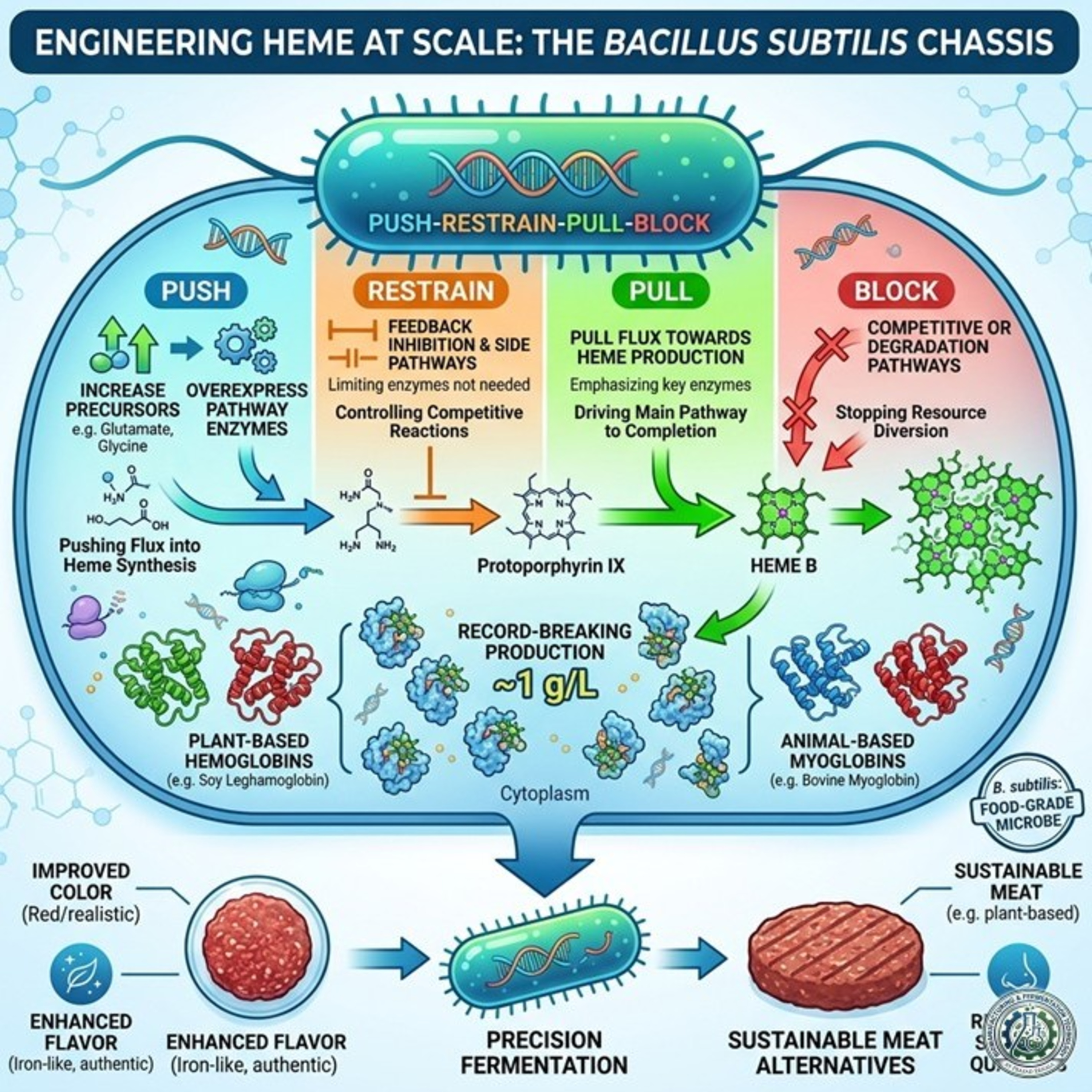
In this episode we discuss the results of Researchers who have successfully engineered the bacteria Bacillus subtilis to serve as a highly efficient production host for active hemoglobins and myoglobins. By utilizing a sophisticated "push–restrain–pull–block" strategy, scientists optimized the internal metabolic pathways to significantly increase the supply of heme, a critical cofactor for these proteins. This systematic overhaul resulted in record-breaking production levels for plant-based and animal-based proteins, achieving concentrations of approximately one gram per liter. The choice of this specific microbe is strategically important because it is considered food-grade, making it an ideal candidate for manufacturing ingredients for meat alternatives. Ultimately, this work demonstrates how precision fermentation can be used to improve the color, flavor, and sensory qualities of sustainable food products through advanced metabolic engineering.#Science#Bioprocess #ScaleUp and #TechTransfer,#Industrial #Microbiology,#MetabolicEngineering and #SystemsBiology,#Bioprocessing,#MicrobialFermentation,#Bio-manufacturing,#Industrial #Biotechnology,#Fermentation Engineering,#ProcessDevelopment,#Microbiology,#Biochemistry,#Biochemical Engineering, #Applied #MicrobialPhysiology, #Microbial #ProcessEngineering, #Upstream #BioprocessDevelopment, #Downstream Processing and #Purification,#CellCulture and #MicrobialSystems Engineering, #Bioreaction #Enzymes, #Biocatalyst #scientific #Scientist #Research
What this episode covers
In this episode we discuss the results of Researchers who have successfully engineered the bacteria Bacillus subtilis to serve as a highly efficient production host for active hemoglobins and myoglobins. By utilizing a sophisticated "push–restrain–pull–block" strategy, scientists optimized the internal metabolic pathways to significantly increase the supply of heme, a critical cofactor for these proteins. This systematic overhaul resulted in record-breaking production levels for plant-based and animal-based proteins, achieving concentrations of approximately one gram per liter. The choice of this specific microbe is strategically important because it is considered food-grade, making it an ideal candidate for manufacturing ingredients for meat alternatives. Ultimately, this work demonstrates how precision fermentation can be used to improve the color, flavor, and sensory qualities of sustainable food products through advanced metabolic engineering.#Science#Bioprocess #ScaleUp and #TechTransfer,#Industrial #Microbiology,#MetabolicEngineering and #SystemsBiology,#Bioprocessing,#MicrobialFermentation,#Bio-manufacturing,#Industrial #Biotechnology,#Fermentation Engineering,#ProcessDevelopment,#Microbiology,#Biochemistry,#Biochemical Engineering, #Applied #MicrobialPhysiology, #Microbial #ProcessEngineering, #Upstream #BioprocessDevelopment, #Downstream Processing and #Purification,#CellCulture and #MicrobialSystems Engineering, #Bioreaction #Enzymes, #Biocatalyst #scientific #Scientist #Research
NOW PLAYING
Engineering Heme at Scale: The Bacillus subtilis Chassis
No transcript for this episode yet
Similar Episodes
Apr 21, 2026 ·13m
Apr 19, 2026 ·16m
Apr 17, 2026 ·13m
Apr 13, 2026 ·11m
Apr 11, 2026 ·16m