
EPISODE · May 11, 2026 · 16 MIN
Engineering Putrescine Beyond Toxicity: Rewiring E. coli into a High-Performance Bio-Diamine Factory
from Biomanufacturing & Fermentation Technology · host prasad ernala
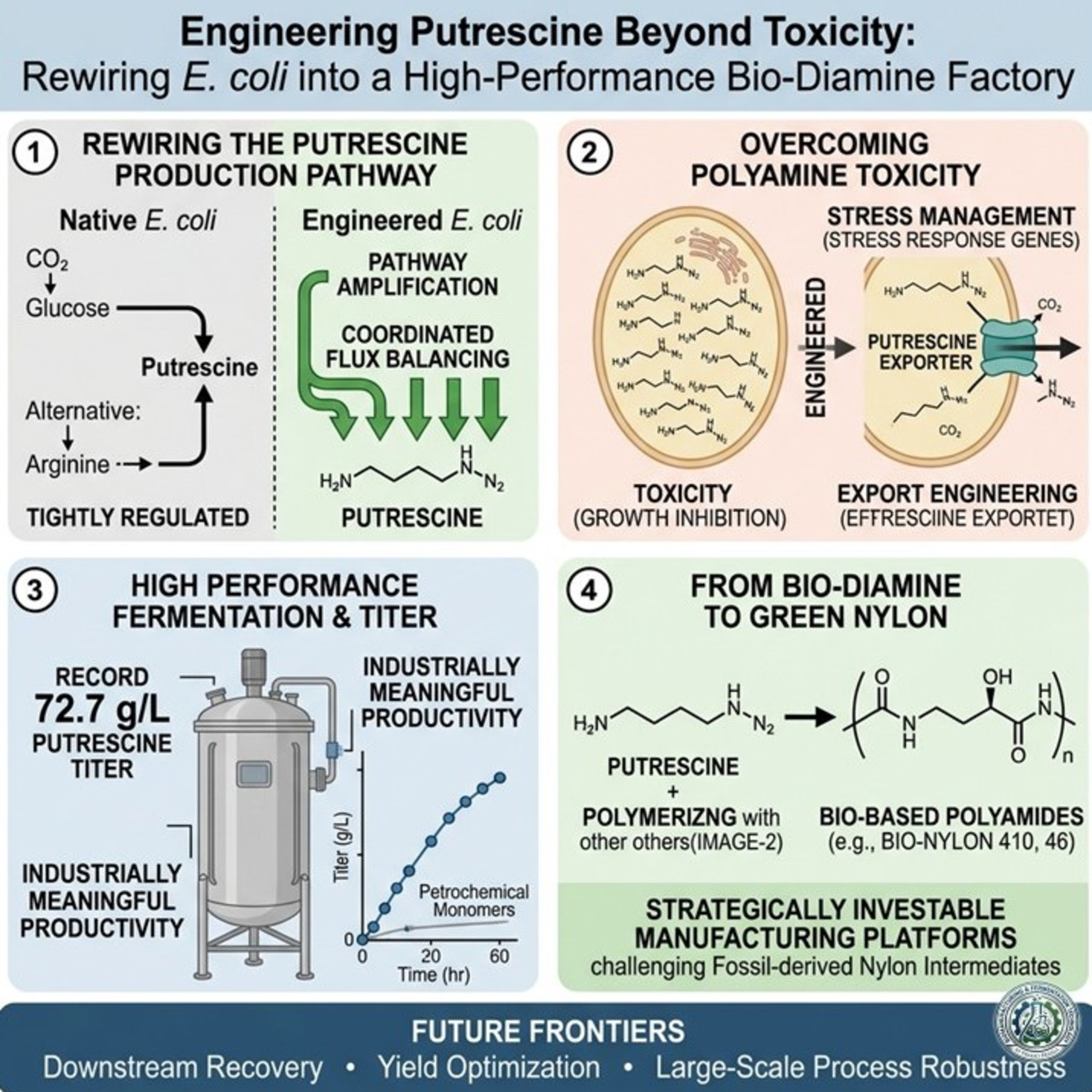
The latest advances in microbial putrescine biosynthesis signal a major transition in industrial metabolic engineering, where diamines are emerging as credible bio-based alternatives to petrochemical monomers in polyamide and specialty chemical manufacturing. Through systems-level metabolic rewiring of Escherichia coli, researchers achieved a record 72.7 g/L putrescine titer from glucose with industrially meaningful productivity, demonstrating that polyamine toxicity is no longer a fixed biological limitation but an engineerable parameter. Beyond pathway amplification, the work highlights the importance of coordinated flux balancing, stress management, and export engineering in transforming a tightly regulated metabolite into a scalable fermentation product. More importantly, this study reframes microbial diamines from academic curiosities into strategically investable manufacturing platforms capable of challenging fossil-derived nylon intermediates, while exposing the next critical frontier: downstream recovery, yield optimization, and large-scale process robustness for commercial deployment.#Science#Bioprocess #ScaleUp and #TechTransfer,#Industrial #Microbiology,#MetabolicEngineering and #SystemsBiology,#Bioprocessing,#MicrobialFermentation,#Bio-manufacturing,#Industrial #Biotechnology,#Fermentation Engineering,#ProcessDevelopment,#Microbiology,#Biochemistry,#Biochemical Engineering, #Applied #MicrobialPhysiology, #Microbial #ProcessEngineering, #Upstream #BioprocessDevelopment, #Downstream Processing and #Purification,#CellCulture and #MicrobialSystems Engineering, #Bioreaction #Enzymes, #Biocatalyst #scientific #Scientist #Research
What this episode covers
The latest advances in microbial putrescine biosynthesis signal a major transition in industrial metabolic engineering, where diamines are emerging as credible bio-based alternatives to petrochemical monomers in polyamide and specialty chemical manufacturing. Through systems-level metabolic rewiring of Escherichia coli, researchers achieved a record 72.7 g/L putrescine titer from glucose with industrially meaningful productivity, demonstrating that polyamine toxicity is no longer a fixed biological limitation but an engineerable parameter. Beyond pathway amplification, the work highlights the importance of coordinated flux balancing, stress management, and export engineering in transforming a tightly regulated metabolite into a scalable fermentation product. More importantly, this study reframes microbial diamines from academic curiosities into strategically investable manufacturing platforms capable of challenging fossil-derived nylon intermediates, while exposing the next critical frontier: downstream recovery, yield optimization, and large-scale process robustness for commercial deployment.#Science#Bioprocess #ScaleUp and #TechTransfer,#Industrial #Microbiology,#MetabolicEngineering and #SystemsBiology,#Bioprocessing,#MicrobialFermentation,#Bio-manufacturing,#Industrial #Biotechnology,#Fermentation Engineering,#ProcessDevelopment,#Microbiology,#Biochemistry,#Biochemical Engineering, #Applied #MicrobialPhysiology, #Microbial #ProcessEngineering, #Upstream #BioprocessDevelopment, #Downstream Processing and #Purification,#CellCulture and #MicrobialSystems Engineering, #Bioreaction #Enzymes, #Biocatalyst #scientific #Scientist #Research
NOW PLAYING
Engineering Putrescine Beyond Toxicity: Rewiring E. coli into a High-Performance Bio-Diamine Factory
No transcript for this episode yet
Similar Episodes
Apr 21, 2026 ·13m
Apr 19, 2026 ·16m
Apr 17, 2026 ·13m
Apr 13, 2026 ·11m
Apr 11, 2026 ·16m