
EPISODE · Sep 12, 2008 · 8H
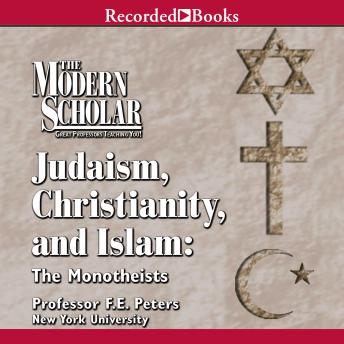
Judaism, Christianity and Islam: The Monotheists | Frank Peters
from Listen to Premium Digital Audiobooks in High Quality · host Frank Peters
Please visit https://thebookvoice.com/podcasts/1/audiobook/329600 to listen full audiobooks. Title: Judaism, Christianity and Islam: The Monotheists Author: Frank Peters Narrator: Frank Peters Format: Unabridged Audiobook Length: 8 hours 0 minutes Release date: September 12, 2008 Ratings: Ratings of Book: 3 of Total 2 Genres: Christianity Publisher's Summary: In everything that follows, 'Bible' always means the Hebrew or Jewish Bible. The Christian Scriptures will always be called 'New Testament' or 'Gospels.' Judaism, Christianity and Islam should be thought of as three faith communities rather than as three 'religions.' They are communities of believers, each with its own ideology, history (its ideology is often embedded in its history), its traditions, and, of course, its members, the great number of Jews, Christians and Muslims past and present. We cannot take much account of the members here, but they are the ones who are responsible for a good part of the ideology, history, and traditions. A distinction is sometimes made between history and sacred history. For all three groups, God is always somehow in charge of what happens to humans, but when God is thought to be more or less directly in charge, that is sacred history. The Bible, for example, is sacred history; what happened to the Jews afterwards is just plain history, where God appears to be (closely) observing events rather than directing them. But not in everyone's eyes: there are still any number of Jews, Christians and Muslims who regard whatever happens, or will happen, as God's doing, not man's. If the Arabic term is a little unfamiliar, 'Islam' means 'submission' (to God, of course), and a 'Muslim' is 'one who has submitted.' The words are Arabic but not all Muslims are Arabs by a long shot, and great many Turks and Iranians and millions and millions of Indians and Indonesians will be upset if you insist that they are. Nor are all Arabs Muslims. Many Palestinian Arabs are Christians, for example. Christians too can be anything ethnic under the sun, and what the Jews are will emerge throughout this course. Finally, it's easier to study these communities if the student attempts to maintain objectivity about each of the 'others.'
What this episode covers
Please visit https://thebookvoice.com/podcasts/1/audiobook/329600 to listen full audiobooks. Title: Judaism, Christianity and Islam: The Monotheists Author: Frank Peters Narrator: Frank Peters Format: Unabridged Audiobook Length: 8 hours 0 minutes Release date: September 12, 2008 Ratings: Ratings of Book: 3 of Total 2 Genres: Christianity Publisher's Summary: In everything that follows, 'Bible' always means the Hebrew or Jewish Bible. The Christian Scriptures will always be called 'New Testament' or 'Gospels.' Judaism, Christianity and Islam should be thought of as three faith communities rather than as three 'religions.' They are communities of believers, each with its own ideology, history (its ideology is often embedded in its history), its traditions, and, of course, its members, the great number of Jews, Christians and Muslims past and present. We cannot take much account of the members here, but they are the ones who are responsible for a good part of the ideology, history, and traditions. A distinction is sometimes made between history and sacred history. For all three groups, God is always somehow in charge of what happens to humans, but when God is thought to be more or less directly in charge, that is sacred history. The Bible, for example, is sacred history; what happened to the Jews afterwards is just plain history, where God appears to be (closely) observing events rather than directing them. But not in everyone's eyes: there are still any number of Jews, Christians and Muslims who regard whatever happens, or will happen, as God's doing, not man's. If the Arabic term is a little unfamiliar, 'Islam' means 'submission' (to God, of course), and a 'Muslim' is 'one who has submitted.' The words are Arabic but not all Muslims are Arabs by a long shot, and great many Turks and Iranians and millions and millions of Indians and Indonesians will be upset if you insist that they are. Nor are all Arabs Muslims. Many Palestinian Arabs are Christians, for example. Christians too can be anything ethnic under the sun, and what the Jews are will emerge throughout this course. Finally, it's easier to study these communities if the student attempts to maintain objectivity about each of the 'others.'
NOW PLAYING
Judaism, Christianity and Islam: The Monotheists | Frank Peters
No transcript for this episode yet
Similar Episodes
Mar 26, 2026 ·1m
Mar 19, 2026 ·34m
Feb 18, 2026 ·11m
Feb 11, 2026 ·45m