
EPISODE · Jan 19, 2021 · 27 MIN
EP45: Age-Friendly Health Systems: History and Overview
from This Is Getting Old: Moving Towards an Age-Friendly World Podcast with Dr. MELISSA BATCHELOR · host Melissa Batchelor PhD, FAAN
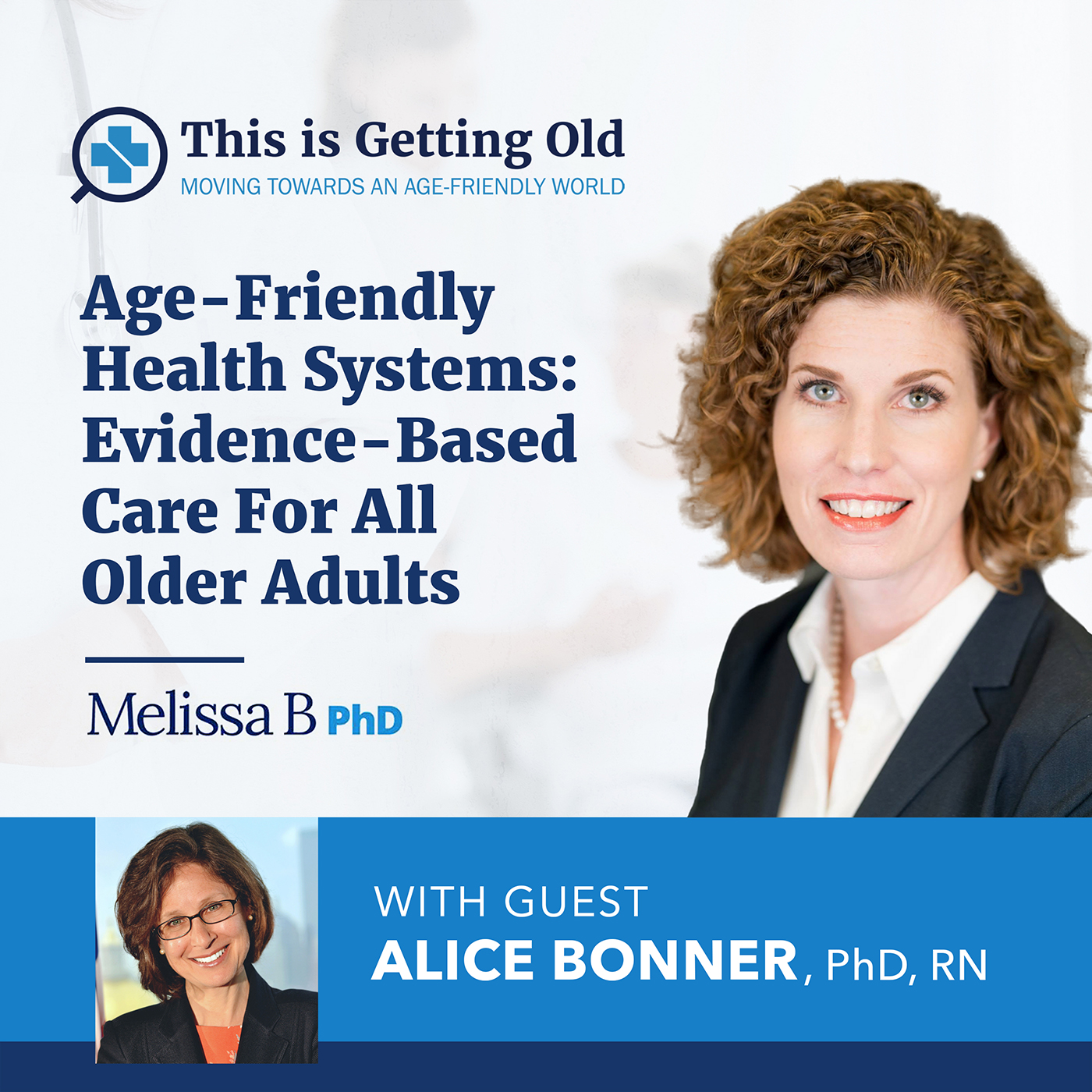
Age-Friendly Health Systems: History and Overview "Age-friendly Health Systems create a system of care where there's good communication, good leadership, and information systems that track across (care settings)."— Alice Bonner, PhD, RN With nine years to go before the last Baby Boomers reach age 65, our nation is on a short timeline to develop the infrastructure needed to provide quality care for older adults in our hospitals and health care systems. With that vision in mind, a system of "age-friendly environments" is emerging from the collaborative efforts between the John A. Hartford Foundation and the Institute for Healthcare Improvement (IHI) in partnership with the American Hospital Association (AHA) and the Catholic Health Association of the United States (CHA). The first podcast interview for This is Getting Old: Moving Towards an Age-Friendly World was with Dr. Terry Fulmer who has led development of the Age-Friendly Health Systems initiative (Episode 3). Building on that interview, in this episode, Dr. Alice Bonner shares the history and an overview of the Age-Friendly Health Systems. The goal of the age-friendly health system is to guide development of an infastructure required for hospitals and health systems to deliver evidence-based care for all - not just for older adults. Discover how the system empowers all health care settings to implement the 4M's Framework to facilitate care for older adults. Part One of 'Age-Friendly Health Systems: Evidence-Based Care for All Older Adults' Age-Friendly Health Systems: A History And Overview The Age-Friendly Health Systems: Evidence-Based Care for All Older Adults offers healthcare systems opportunities to help older adults residing within them. The model further emphasizes that societies must strive to counter age-based stigma, referred to as ageism, towards elderlies. This is to encourage independence for older people and to implement strategies that promote healthy aging. The idea came about from several organizations and individuals who look at the current health system, the current system of communities and public health, and how healthcare facilities are run. They brought together expert clinicians, researchers, and people who spent their lives working with older adults. They started doing a big review of the literature and combed through several references. They've found that there are 90 elements of care guided explicitly toward older people's best care. They did lots of brainstorming, had meetings, and repeatedly went over the literature until they got down from 90 elements to 13 elements. Then everybody said, "13 things are just too many things to ask nurses and doctors and social workers to do". So they got together in a room and didn't come out until they had called it down to four elements, and those four elements all start with the letter M. What Matters? Medications, Mobility, and Mentation. "Age-friendly health systems allow people to customize; it promotes leadership; it requires leadership. And not just a medical director, but nursing leadership, social work, leadership, pharmacy leadership. It's about the interprofessional team."- Alice Bonner, PhD, RN Age-Friendly Care – 4Ms Framework The 4M's are the core practices that clinicians believed to make a difference in administering care. Alice emphasized that health systems should implement these 4Ms accurately. According to her, "By addressing these 4Ms, we're talking about assessing people and then acting on those assessments. It isn't enough to do an assessment and put a piece of paper in the chart. What you want to do is say, "Okay, how can we act on this?" The Age-Friendly Care Systems 4Ms frameworks evolve on the following concepts: What Matters Know and align care with each older adult's specific health outcome goals and care preferences, including end-of-life care and across settings of care. Medication If medication is necessary, use age-friendly medication that does not interfere with What Matters to the older adult, mobility, or mentation across the setting of care. Mentation Prevent, identify, treat, and manage dementia, depression, and delirium across care settings. Mobility Ensure that older adults move safely every day to maintain function and do What Matters. Part Two of ''Age-Friendly Health Systems: Evidence-Based Care for All Older Adults' The Principles Behind Age-Friendly Health System Alice further stressed that most people are not thinking about ageism and includes stereotyped beliefs that discriminate against older adults. It's not widely recognized, until it happens to you or someone you love. Age-friendly systems look at how workers at health systems speak, the language they use, the references they make, and how they handle ageism and get rid of it. The Frameworks Institute has several resources and reports to help you learn more about how to effectively counter ageism. That is the primary reason why the forerunners of the 4Ms framework of the age-friendly systems anchored the system on the following principles. The 4Ms are set to be integrated into care for every adult ages 65 and older during every inpatient stay for over a year in a primary care setting. Age-Friendly Health Systems and the 4Ms are a framework to organize the efficient, reliable delivery of effective care with older adults. The framework is intended to be an infrastructure that builds on the care you provide today. Age-Friendly Health Systems are designed to close the gap between the evidence-based care that we know works and the reliable practice of that care with every older adult in every interaction. "We started with five health systems. We're now at over a thousand health systems across the country, which is pretty miraculous for a three or four-year project. And the goal is to make it not just a project but to make it sustainable in the way we deliver care everywhere, all the time, every day." — Alice Bonner, PhD, RN Why Should Health Systems Implement The 4Ms Framework? As of December 2020, over 1,000 hospitals, outpatient practices, retail-clinics, and post-acute long-term care communities have been recognized as working to become Age-Friendly Health Systems. Having described a detailed 4Ms approach in their setting, 178 of these have been identified as Committed to Care Excellence as exemplar sites working toward the 4Ms reliable practice. What Are Participants Saying? There's always measurement involved in being recognized as an age-friendly health system. You or your organization can participate by signing up and joining an active community. Here are what some of the participants are saying about 4M's Framework of the Age-friendly System. "My hospital joined the movement and was recognized as an Age-Friendly Health System Participant after sharing with IHI how we are putting the 4Ms into practice. I'm going to encourage my doctor's office to join, too. " "IHI recognized us as leaders in the movement, and as an Age-Friendly Health System Committed to Care Excellence when we shared three months of data on the number of older adults, we cared for with the 4Ms." About Melissa Batchelor, PhD, RN, FNP, FAAN: I earned my Bachelor of Science in Nursing ('96'96) and Master of Science in Nursing ('00'00) as a Family Nurse Practitioner (FNP) from the University of North Carolina Wilmington (UNCW) School of Nursing (SON). I genuinely enjoy working with the complex medical needs of older adults. I worked full-time for five years as FNP in geriatric primary care across many long-term care settings (skilled nursing homes, assisted living, home, and office visits), then transitioned into academic nursing in 2005, joining the faculty at UNCW SON as a lecturer. I obtained my PhD in Nursing and a post master's Certificate in Nursing Education from the Medical University of South Carolina College of Nursing ('11'11) and then joined the Duke University School of Nursing faculty as an Assistant Professor. My family moved to northern Virginia in 2015 and led to me joining the faculty at George Washington University (GW) School of Nursing in 2018 as a (tenured) Associate Professor. I am also the Director of the GW Center for Aging, Health, and Humanities. Find out more about her work at https://melissabphd.com/.
Embed this episode
NOW PLAYING
EP45: Age-Friendly Health Systems: History and Overview
No transcript for this episode yet
Similar Episodes
No similar episodes found.
Similar Podcasts
No similar podcasts found.