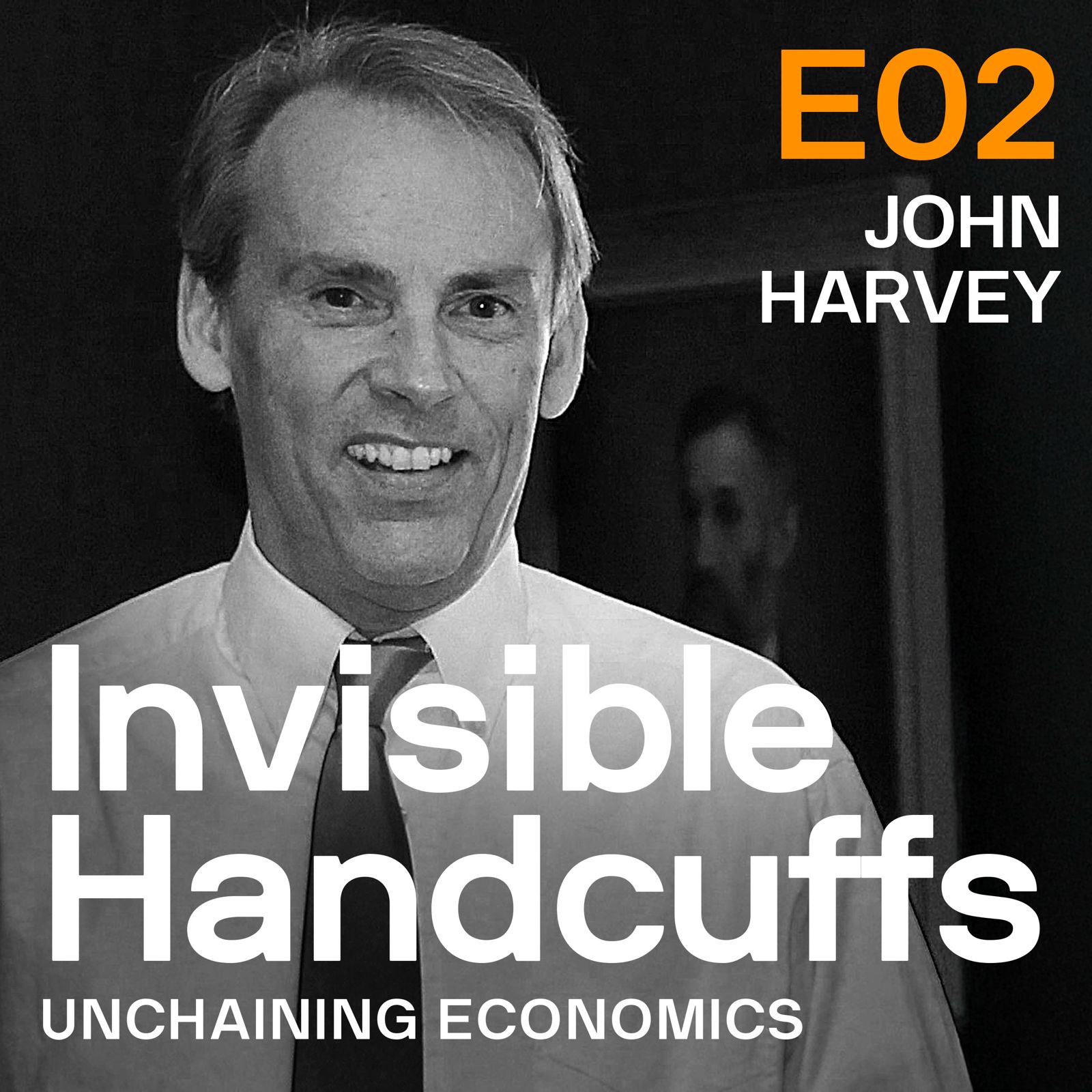
Episode 02: Why economists need multiple perspectives with John T Harvey episode artwork

EPISODE · May 29, 2026 · 1H 20M

Episode 02: Why economists need multiple perspectives with John T Harvey

from Invisible Handcuffs: Unchaining Economics · host Katy Shields

This podcast is all about freeing ourselves from the chains of economic orthodoxy: the set of ideas that drive most decisions in governments, institutions around the world and thus are also underpin our crises. But where do these ideas come from, and why do they persist? What might alternative schools have to offer? And if such alternative perspectives could offer solutions, why are they not more widely taught? That is the topic of this week’s discussion with Professor John T Harvey of Texas Christian University. Unlike most economics student John was fortunate enough to have been exposed to a range of thought schools in his own economics education, which, as he explains, made him want to be an economics professor. He then went on to write a textbook on the various economic thoughts schools, mainly, as he discovered none existed. In this episode we discuss some key schools and how they compare to the 'neoclassical' school, from Marxisim to (post-)Keynesianism, Institutional, Feminist and Ecological Economics. John makes the point that education, especially in social sciences, should be all about questioning, critiquing, and exploring alternative points of view. Yet in economics, particularly as it is taught in high schools and at undergrad today, there is no such debate. Students are presented with mathematical models and abstract formulae as if they are natural laws and 'assumptions', like individualism and profit-maximisation, are treated as universal even though they may not reflect the values or cultures of much of the human population. John and I discuss some of the outcomes: disengagement, self-selection bias and an economics which is among the least diverse of any discipline. We also get into the history of why this is - why, despite growing critiques, neoclassicism persists; the confluence of historical factors and the ways in which various incentive systems, like journal and university rankings, uphold it today. We end by discussing what can be done, from ensuring that heterodox economists keep fighting to 'keep ideas alive', to the role of student movements, to what we can achieve by engaging directly engaging with decision-makers and the broader public. Find out more about John's book here: https://www.e-elgar.com/shop/gbp/contending-perspectives-in-economics-9781789900484.html?srsltid=AfmBOoqCNYwAcSxGx6lwVMmKD6J9fnSmIqB4WmOZ52H_9LVB1czks618

This podcast is all about freeing ourselves from the chains of economic orthodoxy: the set of ideas that drive most decisions in governments, institutions around the world and thus are also underpin our crises. But where do these ideas come from, and why do they persist? What might alternative schools have to offer? And if such alternative perspectives could offer solutions, why are they not more widely taught? That is the topic of this week’s discussion with Professor John T Harvey of Texas Christian University. Unlike most economics student John was fortunate enough to have been exposed to a range of thought schools in his own economics education, which, as he explains, made him want to be an economics professor. He then went on to write a textbook on the various economic thoughts schools, mainly, as he discovered none existed. In this episode we discuss some key schools and how they compare to the 'neoclassical' school, from Marxisim to (post-)Keynesianism, Institutional, Feminist and Ecological Economics. John makes the point that education, especially in social sciences, should be all about questioning, critiquing, and exploring alternative points of view. Yet in economics, particularly as it is taught in high schools and at undergrad today, there is no such debate. Students are presented with mathematical models and abstract formulae as if they are natural laws and 'assumptions', like individualism and profit-maximisation, are treated as universal even though they may not reflect the values or cultures of much of the human population. John and I discuss some of the outcomes: disengagement, self-selection bias and an economics which is among the least diverse of any discipline. We also get into the history of why this is - why, despite growing critiques, neoclassicism persists; the confluence of historical factors and the ways in which various incentive systems, like journal and university rankings, uphold it today. We end by discussing what can be done, from ensuring that heterodox economists keep fighting to 'keep ideas alive', to the role of student movements, to what we can achieve by engaging directly engaging with decision-makers and the broader public. Find out more about John's book here: https://www.e-elgar.com/shop/gbp/contending-perspectives-in-economics-9781789900484.html?srsltid=AfmBOoqCNYwAcSxGx6lwVMmKD6J9fnSmIqB4WmOZ52H_9LVB1czks618

NOW PLAYING

Episode 02: Why economists need multiple perspectives with John T Harvey

0:00 1:20:54

No transcript for this episode yet

We transcribe on demand. Request one and we'll notify you when it's ready — usually under 10 minutes.

Stansberry Radio - Edgy Source for Investing, Finance & Economics Porter Stansberry: Interviews w/ Alex Jones, Jim Rogers, Rick Rule, Doug Casey, T. Boone Pickens, Harry Dent, & James Altucher Porter Stansberry is the outspoken founder of Stansberry Research - now one of the largest and most recognized investment research firms in the world.Stansberry Radio puts you in tune to hear Porter’s commentary on the latest financial and economic news. Listen to Porter interview renowned experts. WW2 - the Key Questions, answered by Laurence Rees. Laurence Rees A former Head of BBC TV History programmes, Laurence has specialized in writing books and making television documentaries about World War Two, the Nazis and Stalinism for thirty years. He won a BAFTA and a Peabody for his TV series 'The Nazis: A Warning from History' and a British Book Award for his book on Auschwitz, which is also the world's best selling book on this notorious camp. His book 'the Holocaust: A New History' was described by the Times as 'exemplary' and by the Daily Telegraph as 'the best single volume account of the atrocity ever written'. Educated at Oxford University, for several years he was a visiting senior fellow at the London School of Economics, London University. He holds honorary doctorates from the University of Sheffield and the Open University. Professor Robert Service, of Oxford University, described Rees as 'one of the world's experts on the Second World War'. Sir Max Hastings wrote in the Sunday Times, in a review of Laurence Rees' 'World War Two: Behi Summer 2011 | Public lectures and events | Video London School of Economics and Political Science Video files from LSE's summer 2011 programme of public lectures and events, for more recordings and pdf documents see the corresponding audio collection.

Frequently Asked Questions

How long is this episode of Invisible Handcuffs: Unchaining Economics?

This episode is 1 hour and 20 minutes long.

When was this Invisible Handcuffs: Unchaining Economics episode published?

This episode was published on May 29, 2026.

What is this episode about?

This podcast is all about freeing ourselves from the chains of economic orthodoxy: the set of ideas that drive most decisions in governments, institutions around the world and thus are also underpin our crises. But where do these ideas come from,...

Can I download this Invisible Handcuffs: Unchaining Economics episode?

Yes, you can download this episode by clicking the download button on the episode player, or subscribe to the podcast in your preferred podcast app for automatic downloads.
URL copied to clipboard!