
EPISODE · Apr 24, 2026 · 1H 20M
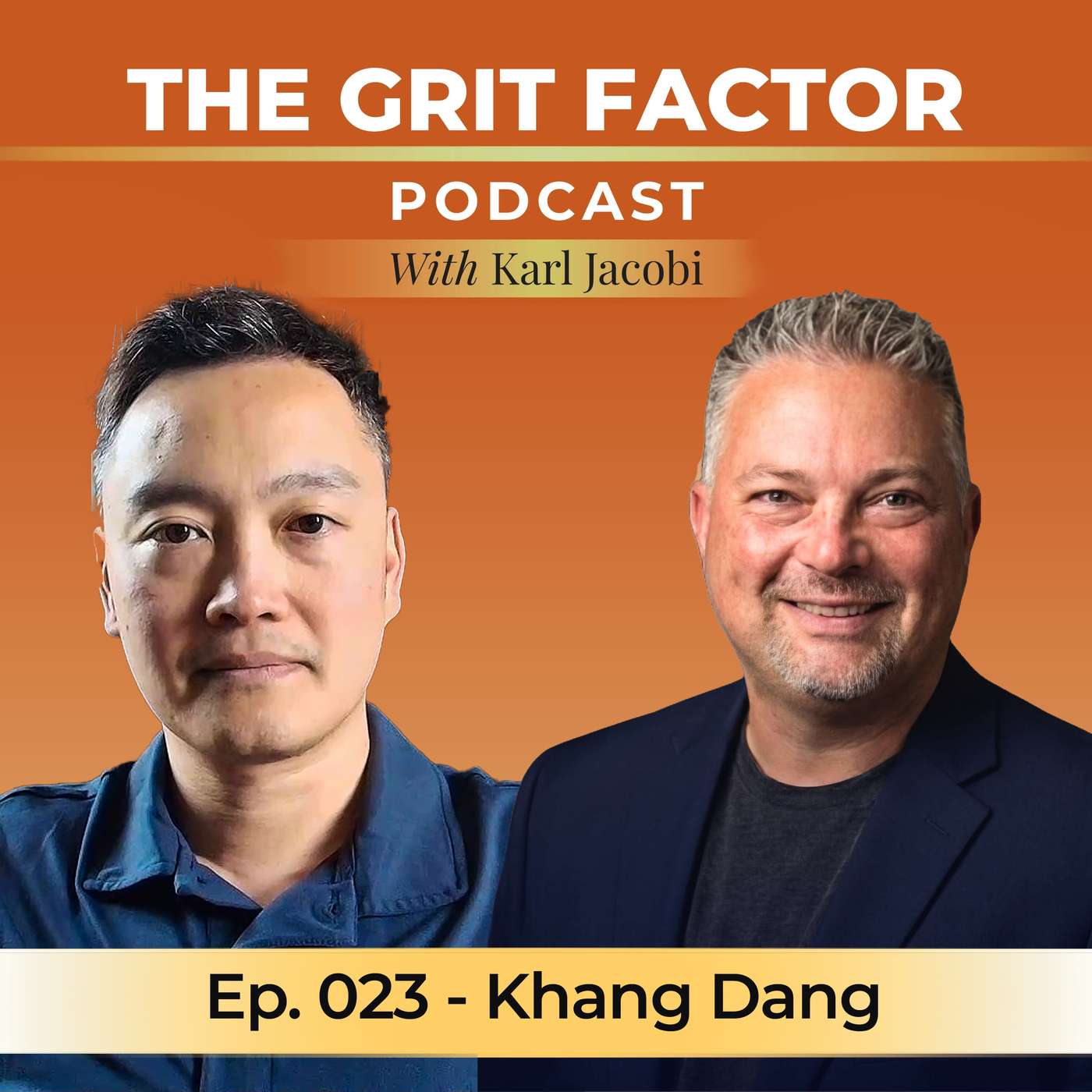
Episode 023: Nine Figures, Ferraris, and a Son He Would Trade It All to See Again with Khang Dang
from The Grit Factor Podcast w/ Karl Jacobi · host Karl Jacobi
Episode SummaryKhang Dang sold blueberry blow pops for a quarter in fourth grade, got shut down by his math teacher, and kept going. He spent his college years arbitraging eBay inventory while his peers chased grades. He climbed the corporate ladder as a database administrator, jumped eleven jobs in twelve interviews across eight years, hit six figures by year four, and still hated every corporate meeting he ever sat in. He left a one hundred and fifty thousand dollar salary to co-found a specialty pharmacy with his wife's cousin. Three years later the business was doing one hundred and thirty million dollars in revenue and Khang was buying Ferraris. He had built the dream. And he was dying inside.He had built a corporate world of his own. Button shirts. Meetings about meetings. One hundred and fifty employees. A one point two million dollar annual insurance bill. Every marker of success. None of the freedom that made him fall in love with business as a candy-dealing fourth grader. When the Affordable Care Act began squeezing specialty pharmacy margins, the business cratered back toward thirty million. Three years of grinding brought it partially back. Then Khang sold his shares, took six months to let his body and mind recover from a decade of abuse, stumbled onto Jim Cochrane's Amazon podcast, and started reselling widgets online. His family thought he had lost his mind. He had actually just found his way back to himself.The Amazon business grew to three million dollars a year. He built software for it. He took a two-week vacation without checking a single thing. And then in 2023, his son Brian died. From running around laughing to a slight cold to gone within a day, from something so rare the doctors called it essentially getting struck by lightning. Everything Khang had spent twenty years building, the nine-figure exit, the Amazon empire, the Ferraris, became meaningless overnight. The only question that mattered was: where is my son?That question drove Khang into the deepest investigation of his faith he had ever undertaken. He read the evidence. He made his decision. And he is now more certain than he has ever been about anything in his life. This episode is for anyone who has been using success as a substitute for what actually matters, and for anyone who has lost something they cannot replace.In This Episode, You'll Discover:How Khang started selling blueberry blow pops at a twenty-five cent markup in fourth grade, turned it into three to four hundred dollars over six months, got shut down by his math teacher, and how that moment made him more committed to entrepreneurship than everHow he jumped eleven jobs in twelve interviews over eight years as a database administrator by teaching himself advanced skills before companies expected him to have them, and why job-hopping was his fastest path to salary growthWhat scaling a specialty pharmacy from zero to one hundred and thirty million dollars in three years actually felt like from the inside, and why the Ferraris and the success could not hide the fact that he had rebuilt the very corporate prison he escapedThe two near-bankruptcies, the first when insurance companies squeezed specialty pharmacy margins and he had to lay off seventy percent of staff in two weeks, and the second when Amazon suspended his account for six months over branded bundlingWhat his son Brian was like, why everyone who met him once fell in love with him, and why Khang describes losing him as getting hit by lightning, something so rare it virtually does not happenHow the grief drove Khang to investigate the evidence for Christianity rather than just coping with it, the two books that answered his two core questions, and why he says he is now ninety-nine point nine nine percent certain of his conclusionWhy Khang refuses to use the word manifest, what it means to him that God gives and takes away independently of your determination, and how that understanding changed the way he approaches business, health, and familyThe gun-to-your-head rep framework Khang uses in the gym when he thinks he is done, and why he believes most people never actually work as hard as they think they doKey Takeaways:You Can Build Everything You Wanted and Still Be Miserable. Khang had Ferraris, a nine-figure exit, one hundred and fifty employees, and a soul that was withering. He had rebuilt the exact corporate world he escaped. The lesson is not that success is bad. It is that success disconnected from the reason you got into the game in the first place is just a prison with better furniture.The Why Has to Be Bigger Than the What. Khang did not come back to faith because it was convenient. He came back because his son was gone and the only question that mattered was whether Brian was still alive somewhere. When the why is big enough, everything else, the evidence, the work, the consistency, follows. This principle applies to business, health, and every other area of life.You Cannot Manifest Your Destiny. Stop Saying It. Khang went from one hundred and thirty million to thirty million without changing his work ethic, his intelligence, or his determination. Things outside his control moved against him. He could influence outcomes, not guarantee them. The humility that comes from genuinely believing this changes how you lead, how you respond to setbacks, and how you treat the people around you.How Bad Do You Want It? This is Khang's operating question for everything. Not as a motivational phrase but as a daily practical filter. Every time you feel like stopping, every time the caloric deficit is hard or the sales call is uncomfortable or the rep is too heavy, ask the question. If you want it badly enough, you will find more in the tank. The gun-to-your-head rep test proves it every time.Come Up With the Goal, Break Down the Steps, Do the Work. Nobody gets in their car and drives to Miami by picking a random direction. Khang attributes every sustainable win to this sequence: define the goal specifically, break it into simple executable steps, follow them without deviation. Intensity without direction is just noise.Faith Is Not Coping. Coping Is When You Do Not Have Evidence. Khang made a deliberate choice to investigate rather than just believe. He read the books, examined the arguments, weighed the evidence. After about a year of serious research he says he is more certain of the resurrection than he is of most things he operates on in business. That is not coping. That is a conclusion.Lose the Fat Before You Add the Muscle. Shiny object syndrome is the entrepreneur's version of starting a new diet while still finishing the current bad one. Khang is actively removing it: pick one thing, excel at it, prove it works, then move to the next. The platform building, the new feature, the adjacent opportunity all sound good. The discipline is in finishing the current thing first.All Good Things Come From Above. Khang's first directive. Not as a passive surrender but as a reframe on control. You do your work, you bring your best, you follow the steps. But the outcome is not yours to own. The man who built nine figures in revenue and lost his son to a lightning-strike illness has more credibility to say this than most. He is not bitter about it. He is clearer about it than he has ever been.Timestamps:[00:00] Karl introduces Khang Dang: Vietnamese immigrant, James Madison University grad, database admin to nine-figure pharmacy exit to seven-figure Amazon seller to software...
Embed this episode
NOW PLAYING
Episode 023: Nine Figures, Ferraris, and a Son He Would Trade It All to See Again with Khang Dang
No transcript for this episode yet
Similar Episodes
No similar episodes found.
Similar Podcasts
No similar podcasts found.