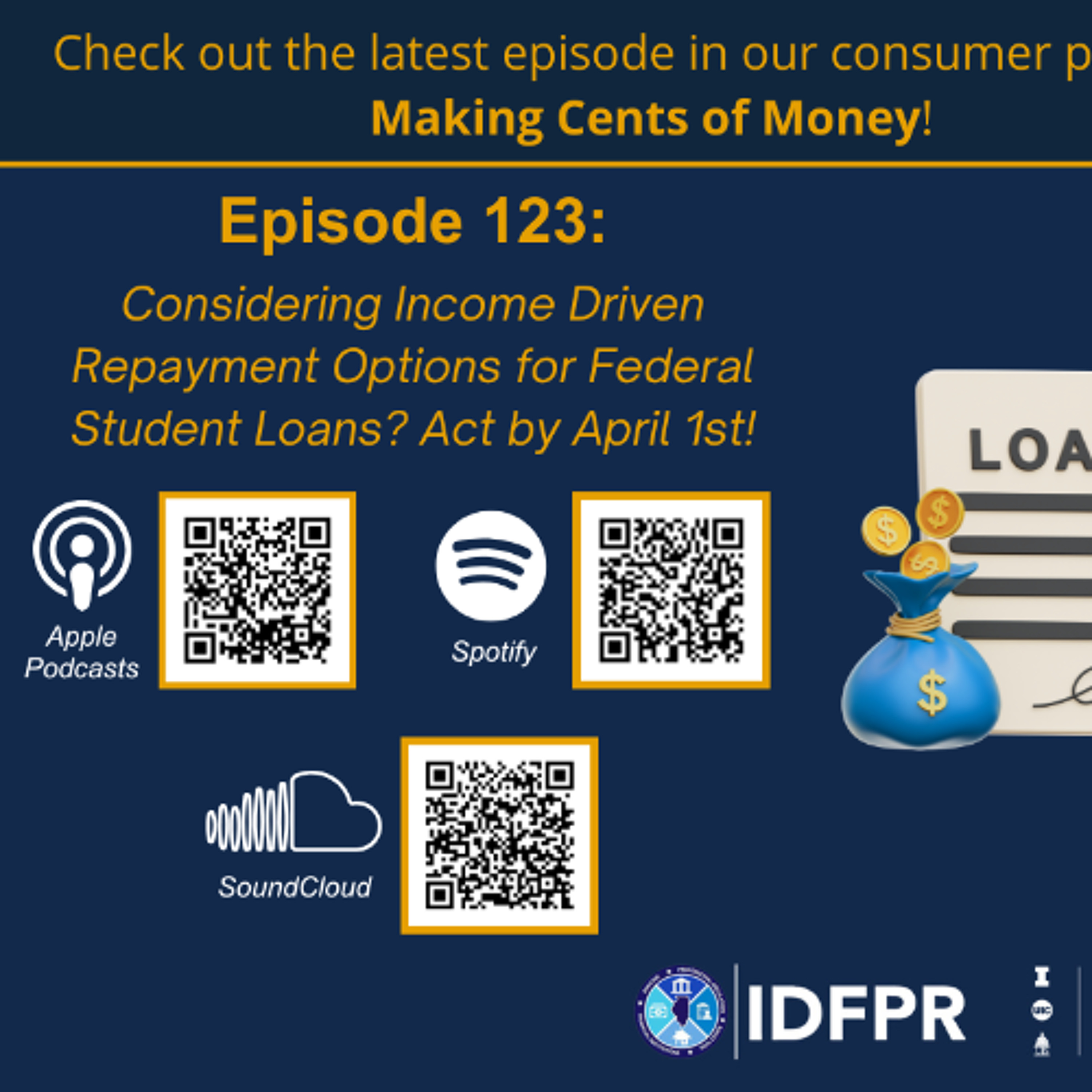
Episode 123: Considering Income Driven Repayment Options for Federal Student Loans? Act by April 1, 2026! episode artwork

EPISODE · Mar 3, 2026 · 9 MIN

Episode 123: Considering Income Driven Repayment Options for Federal Student Loans? Act by April 1, 2026!

from Making Cents of Money · host Making Cents of Money

If income-driven repayment flexibility matters to you, don't wait until summer 2026. Any federal loans disbursed on or after July 1, 2026, lose access to IBR, ICR, and PAYE. Because consolidation can take months to process, treat April 1, 2026 as your planning deadline. FREQUENTLY ASKED QUESTIONS What is changing with income-driven repayment? The One Big Beautiful Bill Act (OBBBA), signed July 4, 2025, restructures federal student loan repayment starting July 1, 2026. Loans disbursed on or after that date are limited to a new Standard Repayment Plan or the Repayment Assistance Plan (RAP). Legacy plans — IBR, ICR, and PAYE — will not be available for those loans. Are IBR, ICR, and PAYE going away entirely? Not immediately. Borrowers with loans disbursed before July 1, 2026, who take on no new loans after that date, can still enroll in or remain on IBR, ICR, or PAYE. That said, per NASFAA's bill analysis, borrowers on ICR or PAYE must move to IBR, a standard plan, or RAP by July 1, 2028 — otherwise they are automatically placed in RAP. IBR remains available for existing borrowers on an ongoing basis. Why does consolidation matter? Borrowers with FFEL loans, Perkins loans, or mixed federal portfolios often must consolidate into a Direct Consolidation Loan to access income-driven repayment at all. Under the OBBBA, that loan must be disbursed — not just applied for — by June 30, 2026. A consolidation disbursed on or after July 1, 2026 loses access to IBR, ICR, and PAYE, even for borrowers previously enrolled in those plans. Parent PLUS borrowers have an additional requirement: a consolidation loan used to pay off a Parent PLUS loan must enter repayment under ICR before July 1, 2026 to preserve later IBR eligibility. Why April 1? April 1 is not in the law — it's a practical safety deadline. Federal Student Aid encourages borrowers who need to consolidate to apply at least three months before July 1, 2026 to ensure disbursement clears by June 30. Three months back from July 1 is April 1. What counts as "disbursed"? Disbursement means the consolidation loan has been fully processed, the underlying loans paid off, and a new Direct Consolidation Loan officially issued. Submitting an application or receiving approval does not count if the actual disbursement occurs on or after July 1, 2026. Should everyone consolidate before April 1? No — consolidation is not automatically the right move. Consider the impact on interest capitalization, existing borrower benefits, and forgiveness timelines before acting. The goal isn't "everyone consolidate." It's everyone check. Log in to StudentAid.gov, review your loan types, and determine whether action is needed before the window closes. REFERENCES NASFAA (2026, January). Federal student aid changes from the One Big Beautiful Bill Act. https://www.nasfaa.org/uploads/documents/Federal_Student_Aid_Change_OB3.pdf U.S. Department of Education, Federal Student Aid. Big updates: Changes to federal student loan repayment. https://studentaid.gov/announcements-events/big-updates U.S. Congress (2025). H.R. 1 — One Big Beautiful Bill Act (119th Congress). https://www.congress.gov/bill/119th-congress/house-bill/1/text

If income-driven repayment flexibility matters to you, don't wait until summer 2026. Any federal loans disbursed on or after July 1, 2026, lose access to IBR, ICR, and PAYE. Because consolidation can take months to process, treat April 1, 2026 as your planning deadline. FREQUENTLY ASKED QUESTIONS What is changing with income-driven repayment? The One Big Beautiful Bill Act (OBBBA), signed July 4, 2025, restructures federal student loan repayment starting July 1, 2026. Loans disbursed on or after that date are limited to a new Standard Repayment Plan or the Repayment Assistance Plan (RAP). Legacy plans — IBR, ICR, and PAYE — will not be available for those loans. Are IBR, ICR, and PAYE going away entirely? Not immediately. Borrowers with loans disbursed before July 1, 2026, who take on no new loans after that date, can still enroll in or remain on IBR, ICR, or PAYE. That said, per NASFAA's bill analysis, borrowers on ICR or PAYE must move to IBR, a standard plan, or RAP by July 1, 2028 — otherwise they are automatically placed in RAP. IBR remains available for existing borrowers on an ongoing basis. Why does consolidation matter? Borrowers with FFEL loans, Perkins loans, or mixed federal portfolios often must consolidate into a Direct Consolidation Loan to access income-driven repayment at all. Under the OBBBA, that loan must be disbursed — not just applied for — by June 30, 2026. A consolidation disbursed on or after July 1, 2026 loses access to IBR, ICR, and PAYE, even for borrowers previously enrolled in those plans. Parent PLUS borrowers have an additional requirement: a consolidation loan used to pay off a Parent PLUS loan must enter repayment under ICR before July 1, 2026 to preserve later IBR eligibility. Why April 1? April 1 is not in the law — it's a practical safety deadline. Federal Student Aid encourages borrowers who need to consolidate to apply at least three months before July 1, 2026 to ensure disbursement clears by June 30. Three months back from July 1 is April 1. What counts as "disbursed"? Disbursement means the consolidation loan has been fully processed, the underlying loans paid off, and a new Direct Consolidation Loan officially issued. Submitting an application or receiving approval does not count if the actual disbursement occurs on or after July 1, 2026. Should everyone consolidate before April 1? No — consolidation is not automatically the right move. Consider the impact on interest capitalization, existing borrower benefits, and forgiveness timelines before acting. The goal isn't "everyone consolidate." It's everyone check. Log in to StudentAid.gov, review your loan types, and determine whether action is needed before the window closes. REFERENCES NASFAA (2026, January). Federal student aid changes from the One Big Beautiful Bill Act. https://www.nasfaa.org/uploads/documents/Federal_Student_Aid_Change_OB3.pdf U.S. Department of Education, Federal Student Aid. Big updates: Changes to federal student loan repayment. https://studentaid.gov/announcements-events/big-updates U.S. Congress (2025). H.R. 1 — One Big Beautiful Bill Act (119th Congress). https://www.congress.gov/bill/119th-congress/house-bill/1/text

NOW PLAYING

Episode 123: Considering Income Driven Repayment Options for Federal Student Loans? Act by April 1, 2026!

0:00 9:39

No transcript for this episode yet

We transcribe on demand. Request one and we'll notify you when it's ready — usually under 10 minutes.

Ask A Spaceman Archives - 365 Days of Astronomy Ask A Spaceman Archives - 365 Days of Astronomy Podcasting Astronomy Every Day of the Year いろはにマネーの「ながら学習」 IrohaniMoney この番組では、インターン生2人が、金融、経済、投資関連の気になる情報を分かりやすくお伝えしていきます。インターン生の会話を「ながら聴き」する感覚で一緒に勉強していきましょう!ご意見箱フォーム:https://forms.gle/TTGaVP2TJksNMKJo7ぜひお便りや感想をお待ちしています!公式X:https://x.com/irohanimoney番組のハッシュタグは「#いろはにながら」です。番組への感想をお待ちしています!いろはにマネー:https://www.bridge-salon.jp/money/姉妹サイト:https://kabu.bridge-salon.jp/姉妹サイト:https://bridge-salon.jp/(株)インベストメントブリッジ運営 Eat to Live Jenna Fuhrman, Dr. Fuhrman Our health is our most precious gift and smart nutrition can change your life. Each month, join Dr. Fuhrman and his daughter, Jenna Fuhrman as they discuss important topics in the world of nutrition. Eat to Live will change the way you eat and think about food. French Your Way Jessica: Native French teacher founder of French Your Way Boost your French listening skills and test your comprehension with this one of a kind series of podcasts. Get the chance to listen to a real conversation between native speakers talking at normal speed AND customise your learning experience through carefully designed sets of questions (2 levels of difficulty) available for download at www.frenchvoicespodcast.com. All interviews also come with the transcript. French teacher Jessica interviews native speakers of French from around the world who share a bit of their life and passion. Where else would you meet in one same place a French yoga teacher based in Melbourne, a soap manufacturer from Provence, or a couple cycling around the world?

Frequently Asked Questions

How long is this episode of Making Cents of Money?

This episode is 9 minutes long.

When was this Making Cents of Money episode published?

This episode was published on March 3, 2026.

What is this episode about?

If income-driven repayment flexibility matters to you, don't wait until summer 2026. Any federal loans disbursed on or after July 1, 2026, lose access to IBR, ICR, and PAYE. Because consolidation can take months to process, treat April 1, 2026 as...

Can I download this Making Cents of Money episode?

Yes, you can download this episode by clicking the download button on the episode player, or subscribe to the podcast in your preferred podcast app for automatic downloads.
URL copied to clipboard!