
EPISODE · Jun 2, 2025 · 1H 24M
Episode 25: Libra (1)
from Don DeLillo Should Win the Nobel Prize · host Jeffrey Severs & Michael Streit
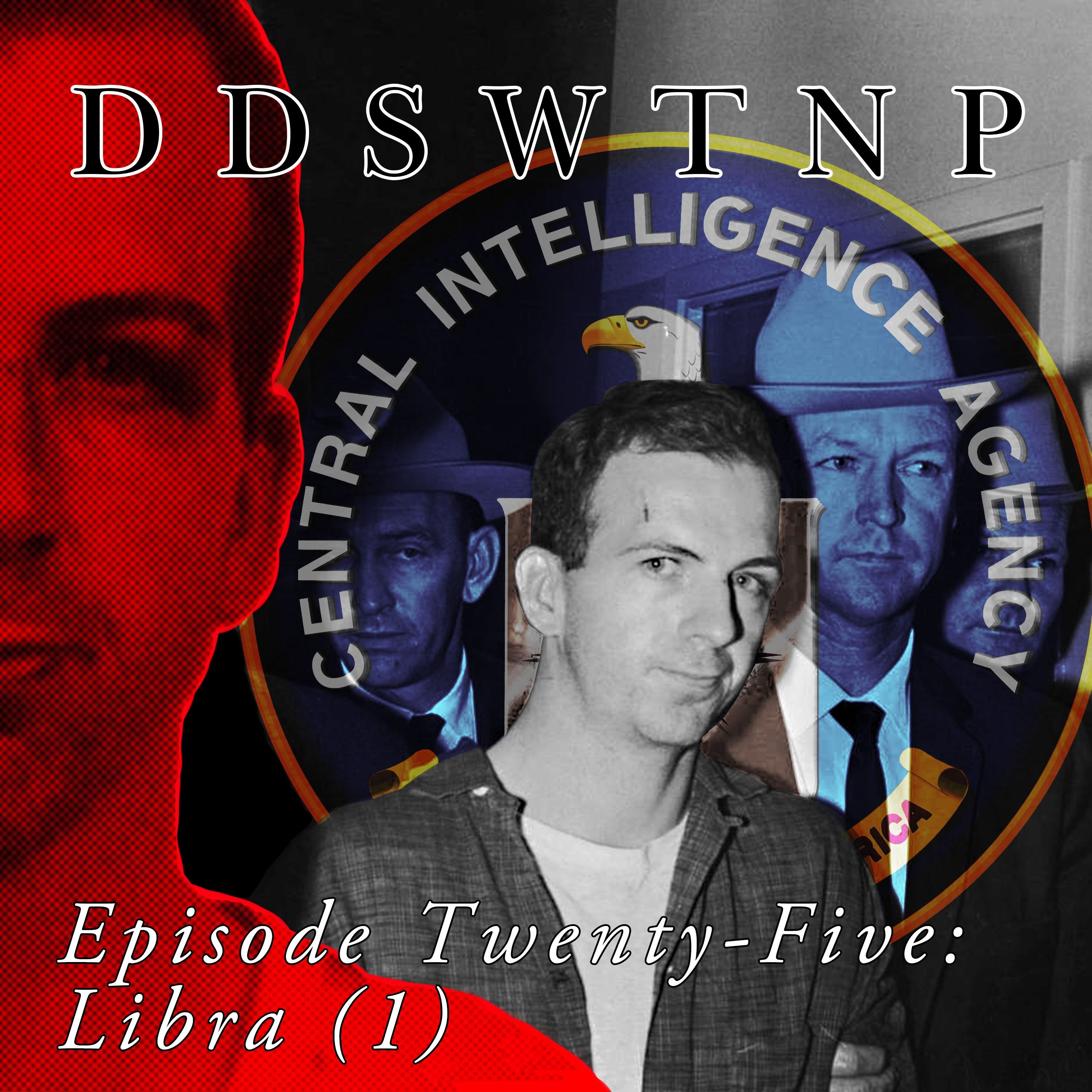
Who killed JFK? What forces made the mind and actions of Lee Oswald? And what does it mean to be an agent of history or something called fate? DDSWTNP probe these and other big questions in multiple new episodes on Libra released over the coming month. June may be the time of Gemini, another sign of doubles in the Zodiac, but for us it’s a month for the balance scale, tipping one way or the other, with some Librans like Lee not balanced at all but (as David Ferrie puts it) “somewhat unsteady and impulsive . . . Poised to make the dangerous leap.” In Episode 25: Libra (1), we discuss where DeLillo began in the 1970s in his build-up to Libra, as far back as Americana and other early novels’ mentions of JFK, Oswald, the CIA, and the overwhelming Warren Report. We examine what makes DeLillo’s Oswald a great but frustrating character and a portal for new dimensions in the author’s examination of language, naming, and self-making. We ask what’s behind the clear shifts in style, tone, and humor DeLillo makes for this historical novel, as well as the power of his place/date chapter structure, the influence of existentialist fiction, and some alternate titles he considered. And we begin working our way through all the figures and ideas surrounding Oswald, from Marxist beliefs and CIA practices of “unknowing” to Cold War obsessions with the Bay of Pigs, life in the U.S.S.R., and a losing war in Vietnam that DeLillo and readers know is coming but his characters importantly don’t. Stay tuned in our Libra episodes to come for investigation of the Murray-like wit of David Ferrie, how DeLillo regards the lone gunman theory, the mysterious edits made to his “Author’s Note,” the theological musings of Nicholas Branch, and much more. Texts and historical figures mentioned in Episode 25: Ann Arensberg, “Seven Seconds” (1988), in Thomas DePietro, ed., Conversations with Don DeLillo, University of Mississippi Press, 2005, 40-46. Don DeLillo, “American Blood: A Journey Through the Labyrinth of Dallas and JFK.” Rolling Stone, December 8, 1983. Rpt. in Osteen, Mark, ed., Novels of the 1980s: The Names, White Noise, Libra. Library of America, 2022. 1045-1061. ---. “Preface, 2022.” In Osteen, ed., Novels of the 1980s: The Names, White Noise, Libra. Library of America, 2022. 633-634. Don DeLillo Papers, Harry Ransom Center, University of Texas at Austin. “Don DeLillo: The Word, the Image, and the Gun.” BBC Documentary, September 27, 1991. https://www.youtube.com/watch?v=0DTePKA1wgc DeLillo: “I was hoping it was Scorpio, because I liked that word. But his birth sign turned out to be Libra, the scales. I settled for that.” David Marchese, “We All Live in Don DeLillo’s World. He’s Confused By It Too” (2020)https://www.nytimes.com/interactive/2020/10/12/magazine/don-delillo-interview.html Everette Howard Hunt: https://en.wikipedia.org/wiki/E._Howard_Hunt Correction: the character Aleksei Kirilenko, Oswald’s Soviet handler in the novel (and source for one of many Lee aliases, Alek?), is DeLillo’s creation, not historical! Branch later reveals Kirilenko’s real name is Sergei Broda (301). No claim about DeLillo’s basis for Kirilenko/Broda, but here is information on yet another shadowy figure, defecting KGB agent Yuri Nosenko, who claimed to have been in charge of Oswald’s case file in the Soviet Union: https://en.wikipedia.org/wiki/Yuri_Nosenko
Embed this episode
What this episode covers
Who killed JFK? What forces made the mind and actions of Lee Oswald? And what does it mean to be an agent of history or something called fate? DDSWTNP probe these and other big questions in multiple new episodes on Libra released over the coming month. June may be the time of Gemini, another sign of doubles in the Zodiac, but for us it’s a month for the balance scale, tipping one way or the other, with some Librans like Lee not balanced at all but (as David Ferrie puts it) “somewhat unsteady and impulsive . . . Poised to make the dangerous leap.” In Episode 25: Libra (1), we discuss where DeLillo began in the 1970s in his build-up to Libra, as far back as Americana and other early novels’ mentions of JFK, Oswald, the CIA, and the overwhelming Warren Report. We examine what makes DeLillo’s Oswald a great but frustrating character and a portal for new dimensions in the author’s examination of language, naming, and self-making. We ask what’s behind the clear shifts in style, tone, and humor DeLillo makes for this historical novel, as well as the power of his place/date chapter structure, the influence of existentialist fiction, and some alternate titles he considered. And we begin working our way through all the figures and ideas surrounding Oswald, from Marxist beliefs and CIA practices of “unknowing” to Cold War obsessions with the Bay of Pigs, life in the U.S.S.R., and a losing war in Vietnam that DeLillo and readers know is coming but his characters importantly don’t. Stay tuned in our Libra episodes to come for investigation of the Murray-like wit of David Ferrie, how DeLillo regards the lone gunman theory, the mysterious edits made to his “Author’s Note,” the theological musings of Nicholas Branch, and much more.
Ready to play
Episode 25: Libra (1)
No transcript for this episode yet
Similar Episodes
Similar Podcasts
No similar podcasts found.