
EPISODE · Aug 7, 2025 · 2H 29M
Episode 28: Librarama
from Don DeLillo Should Win the Nobel Prize · host Jeffrey Severs & Michael Streit
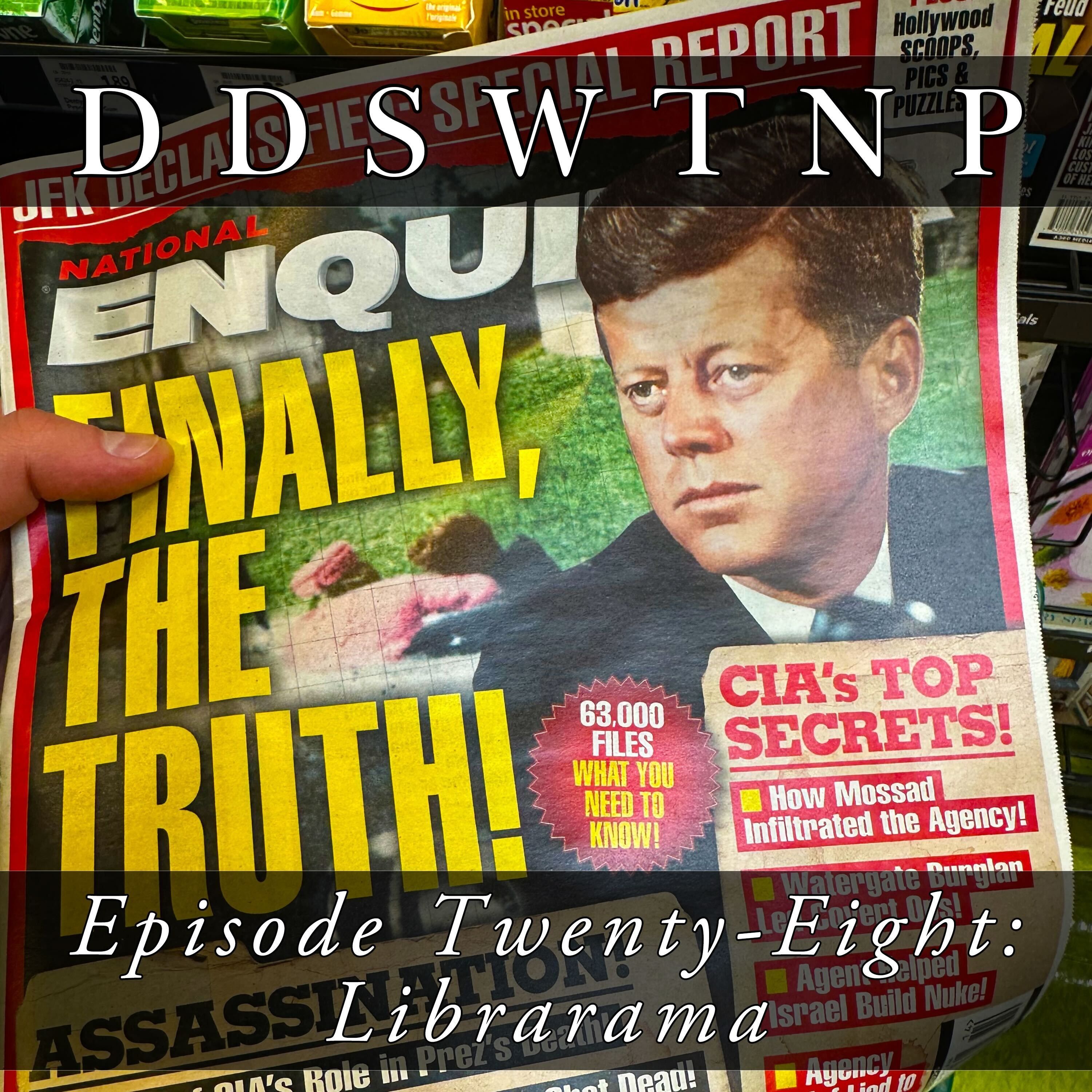
We’re still not done with Libra – or Libra is not done with us! In Episode 28, DDSWTNP pick up threads left hanging after our three-part treatment of DeLillo’s JFK novel. While tackling a wide variety of subjects, this episode homes in on Anthony DeCurtis’s 1988 interview with DeLillo for Rolling Stone (and later re-published in expanded form), “An Outsider in This Society.” We’re led to discuss DeLillo’s canny interview articulations in general, his method of writing by day and reading more history by night, and his reply to the suggestion that on the basis of Libra some readers regarded him as “a member of the paranoid left”: “I don’t have a program.” Along the way we also draw in vivid evidence of how DeLillo subtly reworked the voice of Marguerite Oswald from testimony in the Warren Report, what fellow Oswald novelist Norman Mailer had to say about Libra, and all that is illuminated by an exchange of letters to the New York Times between DeLillo and one of the Warren Report investigators. We also try here to understand as fully as possible the nuances of DeLillo’s ideas about historical fiction that emerge in the incredible DeCurtis interview: what DeLillo means when he says Libra is “a piece of work which is obviously fiction,” touts novels’ ability to “redeem” readers’ “despair,” and makes the powerful claim that “fiction rescues history from its confusions.” We quote enough that listeners will get plenty of insight even without having read the DeCurtis interview in full, and we look forward to applying many of the lessons about history learned here to future works like Underworld. “Some stories never end,” as DeLillo writes to begin “Assassination Aura,” and that’s true of this episode’s cover image, which uses a National Enquirer cover from March 2025 about new releases of JFK files. The interlude clip near the beginning is from Oswald’s August 1963 interviews on WDSU-TV in New Orleans. Finally, as we note in the episode, thanks to Joel in Toronto for an Instagram comment (we’re @delillopodcast) that inspired our return to the DeCurtis interview. Texts mentioned and discussed in this episode: Aristotle, Poetics. Trans. S.H. Butcher. https://www.gutenberg.org/files/1974/1974-h/1974-h.htm Roland Barthes, “The Death of the Author.” Trans. Richard Howard. https://writing.upenn.edu/~taransky/Barthes.pdf David W. Belin, “‘Libra’ and History.” Letter to the editor, New York Times, September 4, 1988. https://www.nytimes.com/1988/09/04/books/l-libra-and-history-487988.html Mark Binelli, “Intensity of a Plot [interview with Don DeLillo].” Guernica, July 17, 2007. https://www.guernicamag.com/intensity_of_a_plot/ Marc Caputo, “CIA admits shadowy officer monitored Oswald before JFK assassination, new records reveal.” Axios, July 5, 2025.https://www.axios.com/2025/07/05/cia-agent-oswald-kennedy-assassination Hal Crowther, “Clinging to the Rock: A Novelist’s Choices in the New Mediocracy.” In Introducing Don DeLillo, ed. Frank Lentricchia, Duke UP, 1991, 83-98. Anthony DeCurtis, “‘An Outsider in This Society’: An Interview with Don DeLillo.” South Atlantic Quarterly (1990) 89 (2): 281-304. (Expanded version of Rolling Stone interview published November 17, 1988 (see https://www.rollingstone.com/culture/culture-news/qa-don-delillo-69452/). Also published in this expanded form in Introducing Don DeLillo, ed. Frank Lentricchia, Duke UP, 1991, 43-66; and in Conversations with Don DeLillo, ed. Thomas DePietro, Jackson: U of Mississippi P, 2005, 52-74. See as well https://perival.com/delillo/ddinterviews.html.) Don DeLillo, “Jack Ruby’s Timing.” Letter to the editor [reply to David W. Belin], New York Times, October 2, 1988. https://www.nytimes.com/1988/10/02/books/l-jack-ruby-s-timing-312488.html Paul Edwards, “Libra at Steppenwolf: John Malkovich Adapts Don DeLillo.” Text and Performance Quarterly (1995) 15:3, 206-228. Gerald Howard, “The American Strangeness: An Interview with Don DeLillo.” Hungry Mind Review, 1997. (“Mailer calls him Doctor Joyce. You and I know that he’s a priest.”)http://web.archive.org/web/19990129081431/www.bookwire.com/hmr/hmrinterviews.article$2563 Douglas Keesey, Don DeLillo. New York: Twayne Publishers, 1993. On DeLillo’s creation of Marguerite Oswald, see pp. 194-96. Thomas LeClair, “An Interview with Don DeLillo,” Contemporary Literature 23.1 (1982): 19-31. (Republished in DePietro, ed., Conversations.) Norman Mailer, Letter to Don DeLillo, August 25, 1988. In Selected Letters of Norman Mailer. Ed. J. Michael Lennon. New York: Random House, 2014. 1092. David Remnick, “Exile on Main Street [interview with Don DeLillo].” New Yorker, September 7, 1997. https://www.newyorker.com/magazine/1997/09/15/exile-on-main-street-don-delillo-profile-remnick Jean Stafford, A Mother in History. New York: Farrar Straus & Giroux, 1966. David Streitfeld, “Don DeLillo’s Gloomy Muse.” Washington Post, May 13, 1992. https://www.washingtonpost.com/archive/lifestyle/1992/05/14/don-delillos-gloomy-muse/5187a6b7-f1f4-4199-9c05-f0b78cc77777/ George F. Will, “Shallow Look at the Mind of an Assassin [review of Libra].” Washington Post, September 22, 1988 (Libra as “an act of literary vandalism and bad citizenship”). Errata: It was Voltaire – not Pascal or Rousseau – who said, “If God did not exist it would be necessary to invent him.” And Underworld’s 1990s scenes begin in 1992, not 1991.
Embed this episode
What this episode covers
We’re still not done with Libra – or Libra is not done with us! In Episode 28, DDSWTNP pick up threads left hanging after our three-part treatment of DeLillo’s JFK novel. While tackling a wide variety of subjects, this episode homes in on Anthony DeCurtis’s 1988 interview with DeLillo for Rolling Stone (and later re-published in expanded form), “An Outsider in This Society.” We’re led to discuss DeLillo’s canny interview articulations in general, his method of writing by day and reading more history by night, and his reply to the suggestion that on the basis of Libra some readers regarded him as “a member of the paranoid left”: “I don’t have a program.” Along the way we also draw in vivid evidence of how DeLillo subtly reworked the voice of Marguerite Oswald from testimony in the Warren Report, what fellow Oswald novelist Norman Mailer had to say about Libra, and all that is illuminated by an exchange of letters to the New York Times between DeLillo and one of the Warren Report investigators. We also try here to understand as fully as possible the nuances of DeLillo’s ideas about historical fiction that emerge in the incredible DeCurtis interview: what DeLillo means when he says Libra is “a piece of work which is obviously fiction,” touts novels’ ability to “redeem” readers’ “despair,” and makes the powerful claim that “fiction rescues history from its confusions.” We quote enough that listeners will get plenty of insight even without having read the DeCurtis interview in full, and we look forward to applying many of the lessons about history learned here to future works like Underworld. “Some stories never end,” as DeLillo writes to begin “Assassination Aura,” and that’s true of this episode’s cover image, which uses a National Enquirer cover from March 2025 about new releases of JFK files. The interlude clip near the beginning is from Oswald’s August 1963 interviews on WDSU-TV in New Orleans. Finally, as we note in the episode, thanks to Joel in Toronto for an Instagram comment (we’re @delillopodcast) that inspired our return to the DeCurtis interview.
Ready to play
Episode 28: Librarama
No transcript for this episode yet
Similar Episodes
Feb 11, 2026 ·45m
Similar Podcasts
No similar podcasts found.