
EPISODE · Feb 2, 2026 · 2H 59M
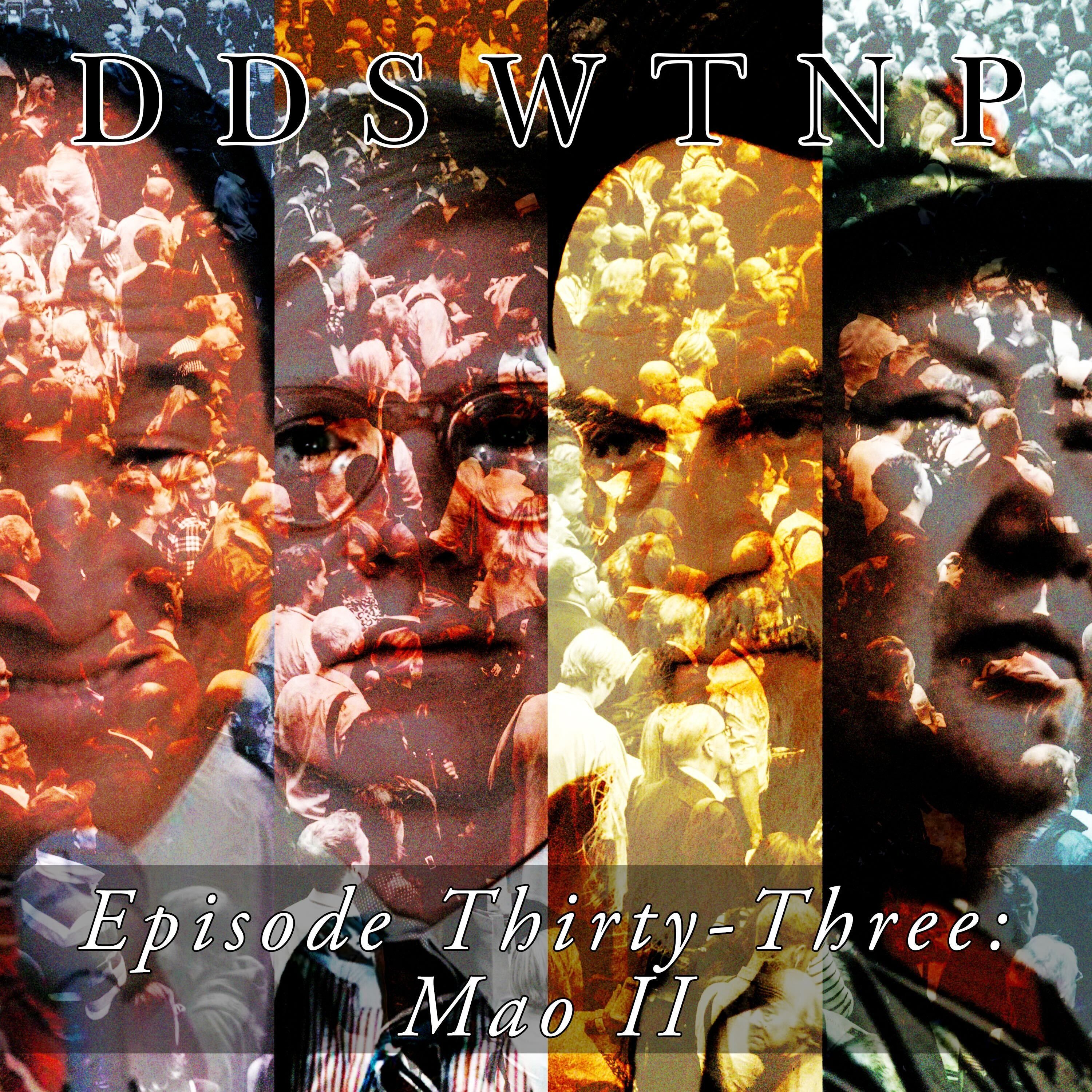
Episode 33: Mao II
from Don DeLillo Should Win the Nobel Prize · host Jeffrey Severs & Michael Streit
“Here they come, marching into American sunlight.” In Episode 33, DDSWTNP follow Mao II from this opening line into a chilling view of a mass Moonie wedding at Yankee Stadium, and on into the story of reclusive novelist Bill Gray, whose work, maybe, has a chance of deprogramming the mind and language of Karen Janney, one of the participants in that wedding – but maybe not, given the totalizing dominance by images that this novel documents. Our conversation delves into the several rich dialogues Mao II is known for, especially that about (quoting Bill) the “curious knot that binds novelists and terrorists,” the differing attempts by writers and bomb-makers to “alter the inner life of the culture” and “make raids on human consciousness” that DeLillo juxtaposes in this novel, which follows the writer from his cloying “bunker” to London, Athens, and (almost) Lebanon, while also taking in scenes from Iran, China, and the homeless encampments of lower Manhattan. Throughout we discuss the many followers of and sequels to Mao and Maoism DeLillo analyzes, all the ways his characters foolishly seek, outside the values of deep reading and the novel, scenes of “total vision” and messianic “total being,” the “lightning-lit” language of information and the terrorist’s mastery of “the language of being noticed.” We examine in detail as well the effects of Andy Warhol’s work as DeLillo sees it; what it means that readers never learn much at all about the content of Bill’s famous novels; the commonalities he has with Rushdie, Salinger, Pynchon, and DeLillo himself; and why terrorist go-between George Haddad loves word processors so much. We also have a lot to say about the ailing, injured body and spirit of Bill Gray, as well as the simplicity of spoons and what they might teach us about objects and art. Mao II is a book that, as we say in the episode, sums up much of the DeLillo that came before it, lays the groundwork for the masterpiece to come, and contains so many of what have come to seem over the years since 1991 (and over the run of our episodes) the foundational DeLillo ideas and questions, especially ones about politics, violence, and images. Hope you’ll have a listen and, if moved, tell us what you think! Texts referred to in this episode: David Cowart, Don DeLillo: The Physics of Language. Athens: U. of Georgia P., 2002. “Mao II is a sort of rest-and-motion book, to invent a category. The first half of the book could have been called ‘The Book,’ Bill Gray talking about his book, piling up manuscript pages, living in a house that operates as a kind of filing cabinet for his work and all the other work it engenders. And the second half of the book could have been called ‘The World.’ Here, Bill escapes his book and enters the world. It turns out to be the world of political violence . . . I was nearly finished with the first half of the book before I realized how the second half ought to be shaped. I was writing blind . . .” –“Don DeLillo: The Art of Fiction CXXXV,” The Paris Review 128 (1993): 274-306. Interview by Adam Begley. “I called him Bill Gray just as a provisional name,” DeLillo says. “I used to say to friends, 'I want to change my name to Bill Gray and disappear.’ I've been saying it for 10 years. But he began to fit himself into the name, and I decided to leave it.” –Vince Passaro, “Dangerous Don DeLillo,” New York Times Magazine, May 19, 1991 (https://www.nytimes.com/1991/05/19/magazine/dangerous-don-delillo.html) Mark Osteen, American Magic and Dread: Don DeLillo’s Dialogue with Culture. Philadelphia: U. of Pennsylvania P., 2000. Sources of interlude clips from Warhol and Moon: https://www.youtube.com/watch?v=9vCKc7r8U8Ehttps://www.youtube.com/watch?v=GiCYKJc_VwI
Embed this episode
What this episode covers
“Here they come, marching into American sunlight.” In Episode 33, DDSWTNP follow Mao II from this opening line into a chilling view of a mass Moonie wedding at Yankee Stadium, and on into the story of reclusive novelist Bill Gray, whose work, maybe, has a chance of deprogramming the mind and language of Karen Janney, one of the participants in that wedding – but maybe not, given the totalizing dominance by images that this novel documents. Our conversation delves into the several rich dialogues Mao II is known for, especially that about (quoting Bill) the “curious knot that binds novelists and terrorists,” the differing attempts by writers and bomb-makers to “alter the inner life of the culture” and “make raids on human consciousness” that DeLillo juxtaposes in this novel, which follows the writer from his cloying “bunker” to London, Athens, and (almost) Lebanon, while also taking in scenes from Iran, China, and the homeless encampments of lower Manhattan. Throughout we discuss the many followers of and sequels to Mao and Maoism DeLillo analyzes, all the ways his characters foolishly seek, outside the values of deep reading and the novel, scenes of “total vision” and messianic “total being,” the “lightning-lit” language of information and the terrorist’s mastery of “the language of being noticed.” We examine in detail as well the effects of Andy Warhol’s work as DeLillo sees it; what it means that readers never learn much at all about the content of Bill’s famous novels; the commonalities he has with Rushdie, Salinger, Pynchon, and DeLillo himself; and why terrorist go-between George Haddad loves word processors so much. We also have a lot to say about the ailing, injured body and spirit of Bill Gray, as well as the simplicity of spoons and what they might teach us about objects and art. Mao II is a book that, as we say in the episode, sums up much of the DeLillo that came before it, lays the groundwork for the masterpiece to come, and contains so many of what have come to seem over the years since 1991 (and over the run of our episodes) the foundational DeLillo ideas and questions, especially ones about politics, violence, and images. Hope you’ll have a listen and, if moved, tell us what you think!
Ready to play
Episode 33: Mao II
No transcript for this episode yet
Similar Episodes
No similar episodes found.
Similar Podcasts
No similar podcasts found.