
EPISODE · Dec 29, 2025 · 4 MIN
Episode 342 - Cosmic Conundrums
from Kevin McFarlane's podcast · host Kevin McFarlane
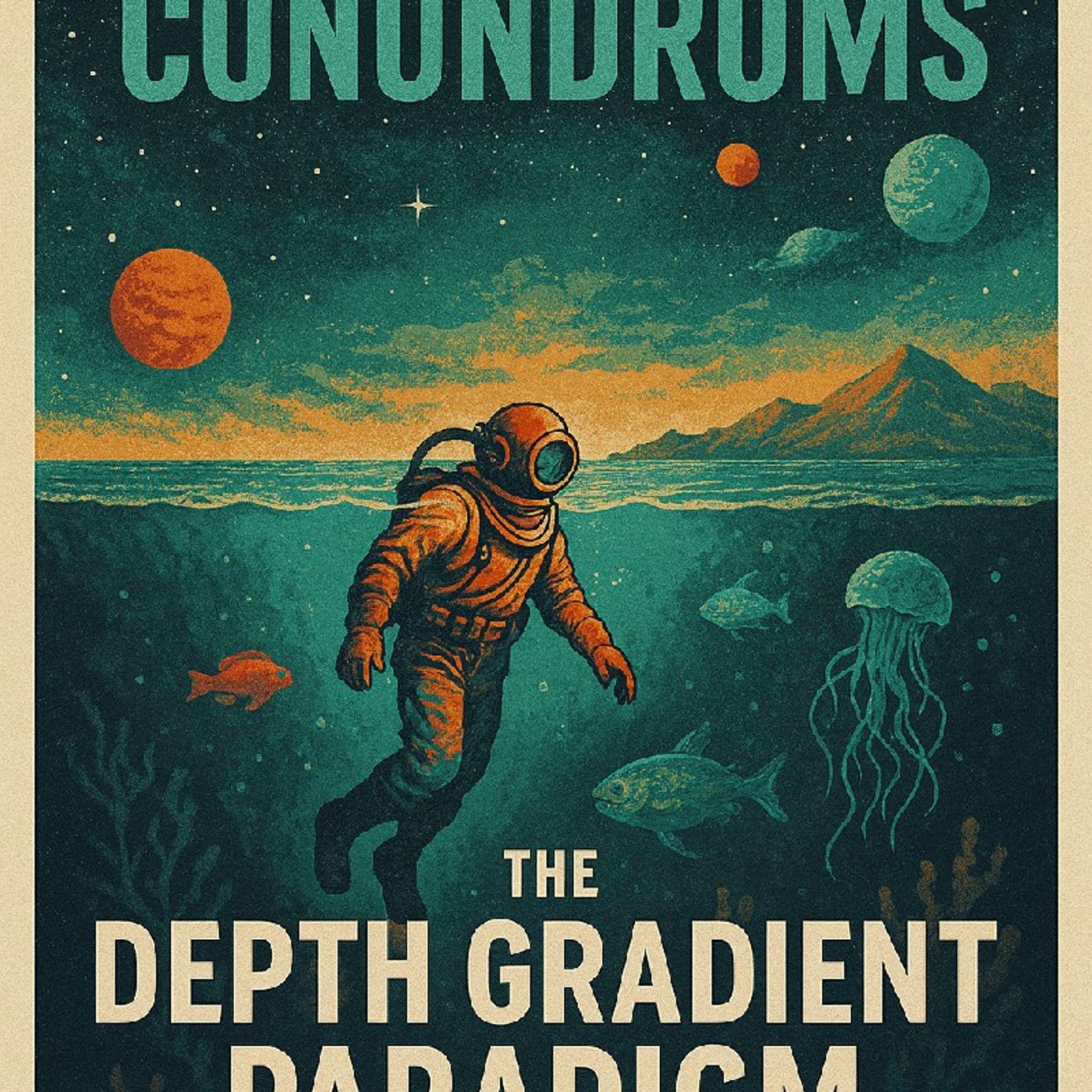
The human perceptual bubble traditionally conceives of the universe as a container within which events unfold along a linear, one-dimensional temporal axis. This substantival view, inherited from Newtonian mechanics, treats time as an absolute background—an "absolute, true, and mathematical time" that flows uniformly without reference to external phenomena. However, contemporary research across physics, cosmology, and biology increasingly suggests that this chronological sequence is an emergent illusion. In its place, a more fundamental architecture is revealed: the Depth Gradient. This paradigm posits that the universe does not operate according to the passage of time, but rather according to local "depths"—energetic, structural, and informational slopes that determine the rate of physical processes, signal propagation, and biological rhythms. In this framework, time does not "bend" or "dilate" in the relativistic sense; instead, the underlying rates of change fluctuate in response to the density of the specific gradient—be it curvature, connection, or energetic intensity.
Embed this episode
NOW PLAYING
Episode 342 - Cosmic Conundrums
No transcript for this episode yet
Similar Episodes
No similar episodes found.
Similar Podcasts
No similar podcasts found.