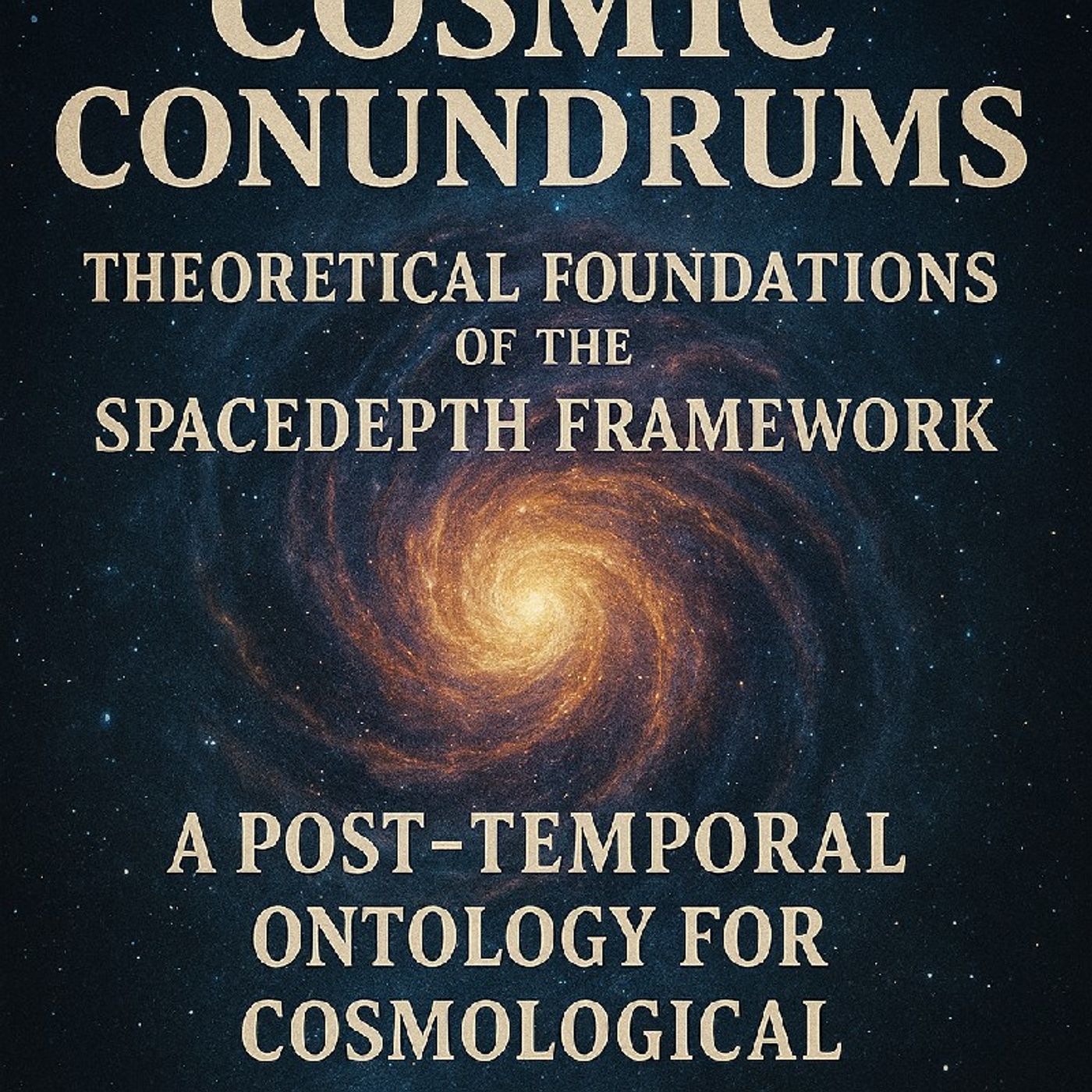
Episode 580 - Cosmic Conundrums episode artwork

EPISODE · Feb 27, 2026 · 5 MIN

Episode 580 - Cosmic Conundrums

from Kevin McFarlane's podcast · host Kevin McFarlane

The historical trajectory of theoretical physics has been characterized by a persistent attempt to reconcile the geometric elegance of general relativity with the probabilistic intricacies of quantum mechanics. For decades, these two pillars of modern science have remained largely incompatible, particularly regarding their disparate treatments of time and the fundamental nature of the vacuum. However, the emergence of the "spacedepth" model, as articulated in contemporary theoretical discourse and foundational exploratory documents, represents a radical departure from the classical interpretation of the universe as a fixed four-dimensional container. The spacedepth model proposes that spacetime is not a fundamental substrate but an emergent phenomenon generated by the dense "knitting" of quantum entanglement. In this framework, reality is not a backdrop in which events occur; rather, entanglement creates the very fabric of the spacetime manifold, defining its geometry and its causal structure through networks of informational connectivity. This paradigm shift necessitates a rigorous deconstruction of the "time problem," identifying traditional chronological time as a humancentric measurement that is fundamentally ill-suited for describing universal processes. Furthermore, the model reinterprets dark matter not as a missing particle species but as a "depth" dimension—a structural component of the manifold that dictates gravitational time dilation and shapes the dynamics of celestial systems through temporal gradients.

The historical trajectory of theoretical physics has been characterized by a persistent attempt to reconcile the geometric elegance of general relativity with the probabilistic intricacies of quantum mechanics. For decades, these two pillars of modern science have remained largely incompatible, particularly regarding their disparate treatments of time and the fundamental nature of the vacuum. However, the emergence of the "spacedepth" model, as articulated in contemporary theoretical discourse and foundational exploratory documents, represents a radical departure from the classical interpretation of the universe as a fixed four-dimensional container. The spacedepth model proposes that spacetime is not a fundamental substrate but an emergent phenomenon generated by the dense "knitting" of quantum entanglement. In this framework, reality is not a backdrop in which events occur; rather, entanglement creates the very fabric of the spacetime manifold, defining its geometry and its causal structure through networks of informational connectivity. This paradigm shift necessitates a rigorous deconstruction of the "time problem," identifying traditional chronological time as a humancentric measurement that is fundamentally ill-suited for describing universal processes. Furthermore, the model reinterprets dark matter not as a missing particle species but as a "depth" dimension—a structural component of the manifold that dictates gravitational time dilation and shapes the dynamics of celestial systems through temporal gradients.

NOW PLAYING

Episode 580 - Cosmic Conundrums

0:00 5:05

No transcript for this episode yet

We transcribe on demand. Request one and we'll notify you when it's ready — usually under 10 minutes.

No similar episodes found.

No similar podcasts found.

Frequently Asked Questions

How long is this episode of Kevin McFarlane's podcast?

This episode is 5 minutes long.

When was this Kevin McFarlane's podcast episode published?

This episode was published on February 27, 2026.

What is this episode about?

The historical trajectory of theoretical physics has been characterized by a persistent attempt to reconcile the geometric elegance of general relativity with the probabilistic intricacies of quantum mechanics. For decades, these two pillars of...

Can I download this Kevin McFarlane's podcast episode?

Yes, you can download this episode by clicking the download button on the episode player, or subscribe to the podcast in your preferred podcast app for automatic downloads.
URL copied to clipboard!