
EPISODE · Feb 7, 2026 · 1 MIN
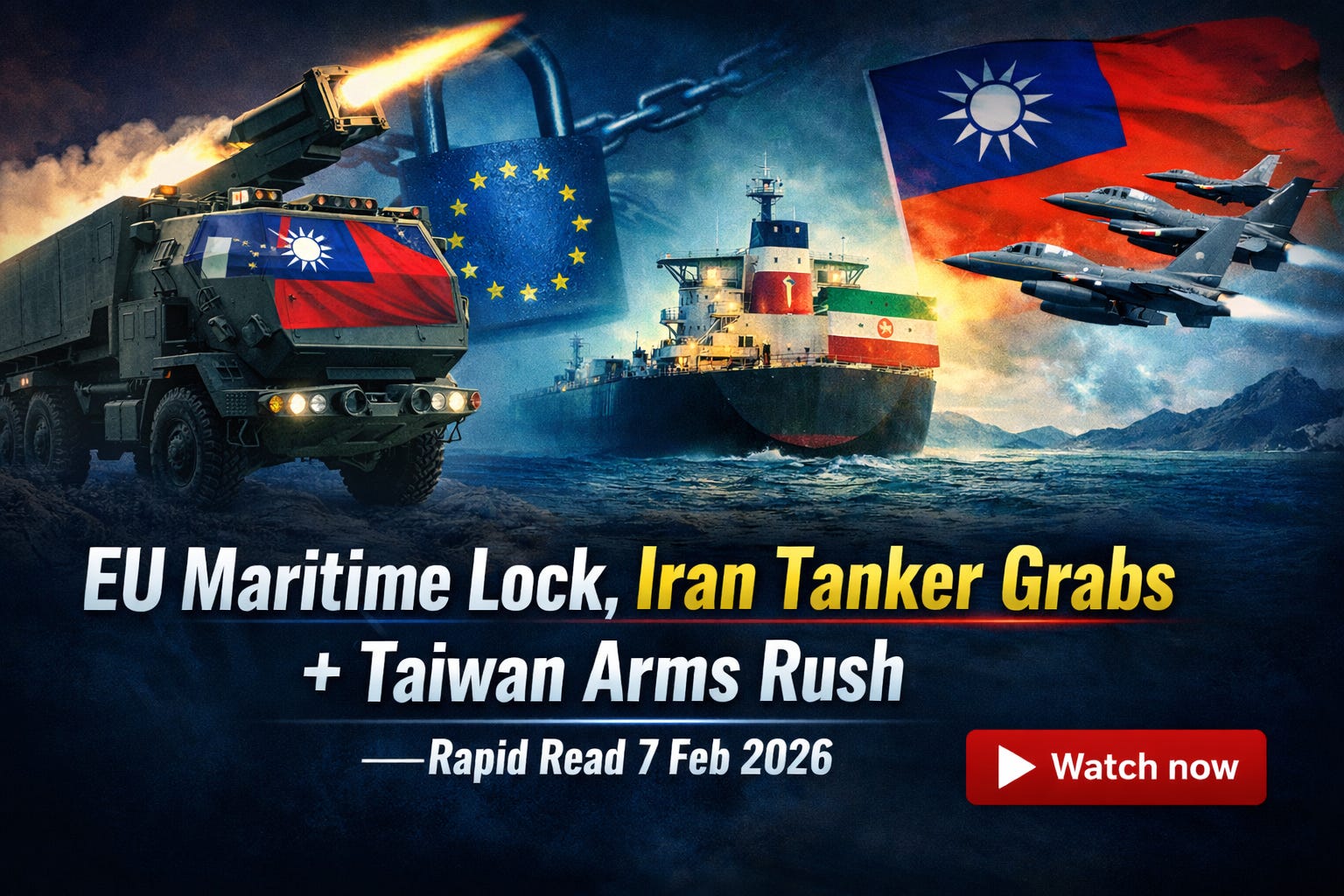
EU Maritime Lock, Iran Tanker Grabs + Taiwan Arms Rush —Rapid Read 7 Feb 2026
from Geopolitics Unplugged · host GeopoliticsUnplugged
GeopoliticsUnplugged Substack is a reader-supported publication. To receive new posts and support my work, consider becoming a free or paid subscriber.Shock LineTariffs lock oil flows into security-aligned channels.What Changed (Last 24 Hours)* EU proposed full ban on Russian maritime services, replacing price cap.* Iran seized two tankers in Persian Gulf, accusing smuggling.* Reliance (India) acquired 2 million barrels Venezuelan crude, resuming purchases.* US expedited Taiwan arms deliveries, including HIMARS launchers.* Canada scrapped EV sales mandate, allocated billions for incentives.* Russia expanded labor recruitment to India and Sri Lanka.Why This Matters (The System)Security-First Energy Regime.We are watching a layout between:Control vs open access.Bilateral pacts vs multilateral flows.Force vs negotiation.This is not normalization.It is constraining adversary directionality.Hard anchor: 24 MMtpa capacity addition filed for Corpus Christi LNG.What Breaks Next (Forward Risk)* If EU ban approves, Urals discounts deepen 10-15%, losing Indian buyers.* If Iran sustains seizures, Hormuz ship speeds cap at 17 knots, inflating insurance.* If Taiwan arms deploy, China invasion optionality narrows pre-2027 timelines.* If Canadian incentives persist, EV import slots lock below 10% market share.* If Thai vote rejects reform, alliance cohesion erodes, limiting US basing.* If nuclear talks falter, Indo-Pacific arms buildup strains rare earth supplies.Signal vs. NoiseSignal:* EU Russian ban proposal* Iran Gulf seizures* US Taiwan arms pushNoise:* Dow 50K milestone* AI spending forecasts* Saudi defense eventThe Line to RememberSecurity reroutes flows faster than markets adapt.Community Notes:We are very happy to announce that we have a new YouTube page.PLEASE go to www.YouTube.com/@GeopoliticsUnpluggedRapidRead and SUBSCRIBE.Market Snapshot as of publication time noted above (not to be relied on for trading purposes):Detailed News Summaries:Trump Is Remaking the Global Oil Market, and Exxon and Chevron Want Inhttps://www.bloomberg.com/news/articles/2026-02-06/oil-map-is-redrawn-as-exxon-chevron-push-expansion-under-trumpPresident Trump’s aggressive foreign policy is reshaping the international oil landscape, creating opportunities for Exxon Mobil Corp. and Chevron Corp. to expand production in high-risk OPEC-associated regions. These U.S. energy giants are securing new agreements in geopolitically unstable areas traditionally dominated by OPEC nations, aiming to boost their operations significantly. This strategic shift allows the companies to capitalize on the administration’s approach, which facilitates access to new markets and resources. Overall, the changes underscore a major transformation in global energy dynamics, benefiting American firms amid evolving geopolitical tensions.Why the Saudi World Defense Show 2026 is becoming one of the world’s biggest military eventshttp://worlddefencenews.blogspot.com/2026/02/why-saudi-world-defense-show-2026-is.htmlThe Saudi World Defense Show 2026 is rapidly gaining prominence as a leading global military event, drawing top defense manufacturers, government officials, and international delegations from over 100 countries. It features cutting-edge technologies in aerospace, naval systems, cybersecurity, and land warfare, facilitating multibillion-dollar deals and strategic partnerships. Saudi Arabia’s Vision 2030 initiative drives this growth by emphasizing localization of defense production to reduce import dependency and enhance national capabilities. The event serves as a vital platform for innovation, collaboration, and addressing emerging security challenges in a multipolar world.Why American Friction with France and the UK Could Change China’s Calculus in the Indo-Pacifichttps://moderndiplomacy.eu/2026/02/06/why-american-friction-with-france-and-the-uk-could-change-chinas-calculus-in-the-indo-pacific/Tensions between the United States and allies France and the UK, stemming from issues like Greenland control and Afghanistan contributions under President Trump’s administration, are straining NATO unity and could embolden China in the Indo-Pacific. China is accelerating its military expansion, particularly in the Taiwan Strait and South China Sea, exploiting U.S. overextension in other conflicts and naval production shortfalls. France and the UK are crucial in filling U.S. security gaps through joint patrols and alliances like AUKUS, but diplomatic rifts may weaken collective deterrence. This dynamic might prompt China to advance its regional ambitions within the next few years, viewing the period as optimal for hegemony.China and Latin America: not a choice of sides, but a choice of optionshttps://moderndiplomacy.eu/2026/02/06/china-and-latin-america-not-a-choice-of-sides-but-a-choice-of-options/Latin America engages with China not as an ideological alignment but as a strategic option to meet developmental needs through complementary resources, markets, and infrastructure projects. The partnership extends beyond commodities to joint ventures in electric mobility, renewables, and technology, enhancing economic competitiveness and reducing project timelines. This approach boosts Latin America’s bargaining power in a multipolar world, allowing diversification without dependencies. Careful management of contracts and debt ensures the relationship strengthens sovereignty and fosters sustainable growth.China’s Military Purge: Power, Paranoia and the Silence Before a Stormhttps://moderndiplomacy.eu/2026/02/06/chinas-military-purge-power-paranoia-and-the-silence-before-a-storm/China’s People’s Liberation Army has undergone a massive purge, removing dozens of senior officers, including key figures like General Zhang Youxia, amid accusations of corruption and concerns over military readiness for a potential Taiwan conflict by 2027. This has consolidated power under President Xi Jinping, reducing the Central Military Commission and halting U.S.-China military dialogues, increasing risks of miscalculation between nuclear powers. The purge reflects internal paranoia and may signal strategic deception, complicating assessments of Beijing’s intentions. Ultimately, this centralization heightens geopolitical uncertainties and the potential for escalation in sensitive regions.Trump Steps Into Tokyo’s Ballot Boxhttps://moderndiplomacy.eu/2026/02/06/trump-steps-into-tokyos-ballot-box/President Trump has endorsed Japanese Prime Minister Sanae Takaichi ahead of Japan’s election, supporting her Liberal Democratic Party’s agenda amid polls suggesting a strong majority. Takaichi’s campaign emphasizes economic relief like suspending food sales tax, though it raises debt concerns and has weakened markets. Her nationalist stance and alliance investments align with Trump’s preferences, but discussions on Taiwan have strained relations with China. This intervention highlights a global trend toward personality-driven, transactional politics, potentially stabilizing Japan-U.S. ties while risking regional tensions.Canada Rewrites Its EV Playbook: Less Mandate, More Moneyhttps://moderndiplomacy.eu/2026/02/06/canada-rewrites-its-ev-playbook-less-mandate-more-money/Canada has scrapped its national EV sales mandate, replacing it with stricter emissions standards and substantial incentives to achieve high EV adoption by 2040. The government allocated billions for rebates, charging infrastructure, and manufacturing support, praised by automakers but criticized by environmentalists as industry concessions. A partnership allows limited Chinese EV imports without incentives, aligning with Europe’s flexible approach while diverging from U.S. policies under President Trump. This pragmatic shift addresses market challenges and U.S. trade pressures, prioritizing incentives over mandates for climate goals.Tankers speed through Hormuz chokepoint on rising Iran tensionshttps://energy.economictimes.indiatimes.com/news/oil-and-gas/tankers-speed-through-hormuz-chokepoint-on-rising-iran-tensions/127988132Supertanker operators are accelerating vessels through the Strait of Hormuz at speeds up to 17 knots amid escalating U.S.-Iran tensions, aiming to minimize exposure in this critical oil trade route. This follows Iran’s unexecuted live-firing drills and increased U.S. military presence ahead of negotiations, with operators delaying ships and renegotiating insurance. Such high speeds heighten navigation risks in congested waters, contributing to volatile freight markets. Experts note that even as risks cool, the area remains complex, impacting global oil supply stability.US Stocks Set for Rebound as Market Reassess AIhttps://www.bloomberg.com/news/videos/2026-02-06/us-stocks-set-for-rebound-as-market-reassess-ai-videoU.S. stocks are poised for a rebound as investor confidence in the AI sector recovers, following recent uncertainties about spending sustainability and valuations. Markets are reassessing the economic viability of high AI investments amid ongoing debates. This cautious optimism reflects broader economic dynamics influencing tech-driven growth. Analysts highlight the need for balanced evaluations to ensure long-term stability in AI-related markets.ADNOC weighs first yuan-denominated bond issuehttps://www.oilandgasmiddleeast.com/news/adnoc-eyes-yuan-bondADNOC is considering its inaugural yuan-denominated bond issuance, potentially raising up to 14 billion yuan through a three-tranche structure with varying maturities, reflecting deepening UAE-China ties. This move aligns with regional trends in yuan financing, following recent deals by Sharjah and the Arab Energy Fund. It diversifies ADNOC’s funding sources after previous bond and sukuk issuances. The initiative taps offshore yuan liquidity without mainland regulations, enhancing economic collaboration.Exclusive: The discipline behind ADNOC Drilling’s technology-led growthhttps://www.oilandgasmiddleeast.com/news/exclusive-adnoc-drilling-technology-growth-salemADNOC Drilling’s growth is fueled by disciplined execution, an expanding rig fleet, and AI-integrated technologies enhancing safety and efficiency. CFO Youssef Salem emphasizes scale, partnerships, and predictive tools that amplify human capabilities without replacement. Capital allocation prioritizes high-return investments in sustainability and automation, supporting UAE’s energy goals. By 2030, the company aims for regional leadership through data-driven operations and strategic collaborations.U.S. Accelerates Taiwan Arms Deliveries as Army Targets HIMARS Launchers and Harpoon Missiles.http://worlddefencenews.blogspot.com/2026/02/us-accelerates-taiwan-arms-deliveries.htmlThe United States is expediting arms deliveries to Taiwan, including HIMARS, Harpoon missiles, MQ-9B drones, and Javelins, due to resolved production issues. Taiwan’s Defense Minister highlighted the urgency amid heightened Chinese military activities. These systems bolster Taiwan’s asymmetric defense strategy to deter invasion. The move strengthens regional security amid escalating tensions.Mexico’s Cuba Dilemma: Fuel, Tariffs and a Humanitarian Tightropehttps://moderndiplomacy.eu/2026/02/06/mexicos-cuba-dilemma-fuel-tariffs-and-a-humanitarian-tightrope/Mexico faces challenges supplying fuel to Cuba amid U.S. threats of tariffs under President Trump’s executive order labeling Cuba a security threat. Shipments paused after U.S. actions halted Venezuelan oil, exacerbating Cuba’s crisis with outages and shortages. Mexico seeks to frame aid as humanitarian to avoid penalties, balancing ideological ties and economic risks. This tests President Sheinbaum’s autonomy in navigating geopolitical leverage and humanitarian needs.Three new LNG bunkering vessels enlarge Chinese player’s orderbookhttps://www.offshore-energy.biz/three-new-lng-bunkering-vessels-enlarge-chinese-players-orderbook/Nantong CIMC Sinopacific Offshore & Engineering has secured orders for three LNG bunkering vessels, boosting its orderbook to ten 20,000-cubic-meter and three 18,900-cubic-meter ships. This strengthens its position in clean energy vessel construction amid global shipping’s energy transition. The firm incorporates green technologies like dual-fuel propulsion to support low-carbon goals. These developments enable flexible responses to client needs and reduce maritime emissions.Cheniere submits application to build massive LNG plant in Texashttp://hydrocarbonprocessing.com/news/2026/02/cheniere-submits-application-to-build-massive-lng-plant-in-texas/Cheniere Energy has applied to expand its Corpus Christi LNG facility with four new trains, adding 24 million metric tons per annum capacity. This would elevate total output to 49 MMtpa, requiring 3.3 billion cubic feet of gas daily. The project positions Cheniere to compete for top U.S. exporter status amid growing LNG capacity. Approval is anticipated by May next year.President Trump’s tariffs fueled U.S. Customs bond market boom. Now billions hang on Supreme Court rulinghttps://www.cnbc.com/2026/02/06/supreme-court-trump-tariffs-case-decision-refunds-customs-bonds.htmlPresident Trump’s tariffs under IEEPA have surged demand for U.S. Customs bonds, with values reaching $450 million and premiums rising sharply, benefiting insurers. Bonds cover increased duties, held interest-free for 314 days, leading to quadrupled insufficiencies and liquidity strains. The Supreme Court ruling on tariff legality could trigger refunds for tariffs, bonds, and collateral. This uncertainty affects importers, with potential economic relief if ruled illegal, though delays and new tariffs loom.EU Proposes Russian Maritime Services Ban to Hit Oil Tradehttps://www.bloomberg.com/news/articles/2026-02-06/eu-proposes-ban-on-russian-maritime-services-to-hit-oil-tradeThe European Union proposes replacing the Russian oil price cap with a full ban on maritime services, alongside restrictions on metals, chemicals, and minerals. This escalates pressure on Russia’s economy ahead of the war’s fourth anniversary. Commission President Ursula von der Leyen urges swift approval by all member states. The measures aim to disrupt oil trade and key sectors significantly.Tankers With Russian Oil Flock to East Asiahttps://www.rigzone.com/news/wire/tankers_with_russian_oil_flock_to_east_asia-06-feb-2026-182936-article/?rss=trueOver a dozen tankers carrying Russian Urals oil are heading to East Asia or idling, as India’s imports decline due to U.S. pressure and tariff deals under President Trump. Many vessels lack confirmed buyers, signaling market shifts toward China and potential ship-to-ship transfers. Discounts on Urals have deepened, benefiting buyers amid global oversupply. This redirection complicates sales in a competitive landscape with Venezuelan and other crudes.Iran Tightens Its Grip on Gulf Shipping Ahead of Negotiationshttps://oilprice.com/Energy/Energy-General/Iran-Tightens-Its-Grip-on-Gulf-Shipping-Ahead-of-Negotiations.htmlIran has seized two oil tankers in the Persian Gulf, accusing them of smuggling, just before U.S.-Iran talks, demonstrating its capacity to disrupt shipping. Negotiations show no progress on nuclear issues, with U.S. expecting concessions amid Iran’s unrest. Meanwhile, the U.S. facilitates Venezuelan crude sales to refiners. These actions heighten regional tensions and costs.Syria’s Oil Future Still Hinges on Politics, Not Geologyhttps://oilprice.com/Energy/Energy-General/Syrias-Oil-Future-Still-Hinges-on-Politics-Not-Geology.htmlChevron’s MoU with Syria explores offshore oil potential in the Levant Basin, but development remains uncertain without commitments. Syria’s onshore production stagnates due to sanctions, infrastructure damage, and political rivalries, with Kurdish control challenged by various actors. Foreign influences prioritize logistics over revival, limiting investments. Political resolutions are essential for any oil sector recovery.Naftogaz receives first US LNG delivery to Ukrainehttps://www.lngindustry.com/regasification/06022026/naftogaz-receives-first-us-lng-delivery-to-ukraine/Naftogaz, partnering with Poland’s ORLEN, has received its first 2026 U.S. LNG shipment, equivalent to 100 million cubic meters, sufficient for 700,000 households monthly in winter. The delivery supports Ukraine amid cold weather and Russian attacks on infrastructure. CEO Sergii Koretskyi highlights systematic international cooperation for sustainability. Total projected supplies reach 1 billion cubic meters, aiding energy stability under wartime conditions.Shell Plans To Double Egypt Output By 2030https://www.mees.com/2026/2/6/oil-gas/shell-plans-to-double-egypt-output-by-2030/e3c93220-0365-11f1-b610-4324bd91b817Shell aims to double its natural gas production in Egypt to 800 million cubic feet per day by 2030, building on its West Delta Deep Marine field. Recent phases have boosted output, but steep declines pose challenges. New developments are required to offset losses. This ambition supports Egypt’s energy needs amid operational hurdles.Exxon Exits Egypt Blockhttps://www.mees.com/2026/2/6/oil-gas/exxon-exits-egypt-block/99ee34b0-0365-11f1-9515-191a42194fb8ExxonMobil and QatarEnergy have relinquished the North Marakia offshore block in Egypt after a gas discovery, opting not to advance to development. No buyers emerged for the stake. The acreage returns to EGAS. BP and Shell may pursue it, leveraging nearby infrastructure.US accuses China of secret nuclear test, calls for new arms control treaty including Russiahttps://thehill.com/policy/international/5726498-trump-pushes-china-nuclear-treaty/The U.S. accuses China of a secret nuclear test in 2020, prompting calls for a new arms control treaty involving China and Russia after New START’s expiration. President Trump advocates a modernized agreement addressing both nations’ capabilities. Russia agrees to talks, rejecting extensions. Democrats urge negotiations to avoid an arms race, but officials cite violations and the need for updated terms.Saudis Cut Key Oil Price for Asian Buyershttps://www.rigzone.com/news/wire/saudis_cut_key_oil_price_for_asian_buyers-06-feb-2026-182941-article/?rss=trueSaudi Arabia has reduced its key oil price for Asian buyers, reflecting market adjustments amid global supply dynamics. This cut aims to maintain competitiveness in the region. The decision influences pricing strategies for other producers. It underscores ongoing efforts to balance market share and revenue.Big Tech to Spend $650 Billion This Year as AI Race Intensifieshttps://www.bloomberg.com/news/videos/2026-02-06/big-tech-to-spend-650b-this-year-as-ai-race-intensifies-videoMajor U.S. tech companies plan to invest $650 billion in 2026, focusing on data centers and equipment to advance AI capabilities. This escalation highlights intense competition in the sector. Analysts discuss implications for innovation and market dynamics. The commitment underscores AI’s pivotal role in future growth.Canadian crude discounts widen as supply glut signals emergehttps://www.worldoil.com/news/2026/2/6/canadian-crude-discounts-widen-as-supply-glut-signals-emerge/Canadian crude discounts have expanded to over $15 per barrel due to supply glut indicators and U.S. tariff threats under President Trump. The Trans Mountain pipeline’s capacity is filling, leading to rationing and increased storage. Competition from Venezuelan and Russian oils adds pressure. Diversification toward China offers potential relief amid global oversupply.U.S. rig count increased by 5 is at 551https://www.oilandgas360.com/baker-hughes-rig-count-02-6/#utm_source=feedly&utm_medium=rss&utm_campaign=baker-hughes-rig-count-02-6The U.S. rig count rose by 1 to 551 for the week ending February 6, 2026, per Baker Hughes data. Canada decreased by 4 to 228 rigs. Minor variances occurred in basins like the Permian and Haynesville. This reflects stable North American drilling activity.Trump strikes deal to allow $800M in beef imports from Argentina to enter UShttps://thehill.com/homenews/administration/5726797-gop-opposes-beef-deal/President Trump finalized a deal allowing 100,000 tons of Argentine beef imports worth $800 million, despite Republican and industry opposition. The agreement expands access and reviews tariffs on metals. Argentine President Milei hailed it as a commitment to growth. It aligns with broader trade frameworks, benefiting allies.US soy volatile on possible China buyinghttps://www.argusmedia.com/pages/NewsBody.aspx?id=2786117&menu=yesU.S. soy markets are experiencing volatility amid speculation of potential Chinese purchases. This uncertainty stems from trade dynamics and global supply factors. Market participants monitor developments closely for impacts on pricing. The situation reflects broader agricultural trade tensions.Cuba Begins Shutting Resorts as Fuel Crunch Hits Tourismhttps://www.bloomberg.com/news/articles/2026-02-06/cuba-beach-resorts-closing-as-trump-moves-to-block-fuel-shipmentsCuba is closing beach resorts due to a severe fuel shortage exacerbated by President Trump’s blockade of shipments. This impacts tourism, a key economic sector. Officials seek alternatives amid the crisis. The measures highlight escalating U.S.-Cuba tensions.Dow closes above 50K for the first time in historyhttps://thehill.com/business/5726938-dow-jones-closes-50000/The Dow Jones Industrial Average surpassed 50,000 points for the first time, closing at 50,115 after a 1,200-point surge. Gains in S&P 500 and Nasdaq followed AI concerns easing. Strong performers included Nvidia and others, bolstered by low inflation expectations. President Trump celebrated the milestone, signaling robust investor confidence.US sending $6M in aid to Cubahttps://thehill.com/homenews/5727000-us-sending-6m-in-aid-to-cuba/The U.S. is providing $6 million in humanitarian aid to Cuba post-Hurricane Melissa, delivered via the Catholic Church to avoid government interference. This follows an initial $3 million amid a fuel crisis from halted Venezuelan supplies after U.S. actions. Cuba calls it an energy blockade, while the U.S. blames regime mismanagement. Both sides express willingness for dialogue without pressure.High-Stakes Thai Vote Tests Appetite for Political Reformhttps://www.bloomberg.com/news/articles/2026-02-07/high-stakes-thai-vote-tests-appetite-for-political-reformThailand’s February 8 election pits conservatives against progressives and populists, with 53 million voters deciding on replacing the 2017 military constitution. Major parties rally for support in this pivotal contest. The outcome will gauge public demand for reforms. It could reshape governance and policies significantly.Reliance returns to buying Venezuelan oilhttps://energy.economictimes.indiatimes.com/news/oil-and-gas/reliance-returns-to-buying-venezuelan-oil/128018050Reliance Industries has resumed Venezuelan crude purchases, acquiring 2 million barrels after a mid-2025 pause. This follows U.S. intervention in Venezuela’s oil sector. The deal aligns with India’s diversification efforts. It coincides with U.S.-India trade agreements reducing tariffs.Russia Turns to India, Sri Lanka for Way Out of Its Labor Crisishttps://www.bloomberg.com/news/articles/2026-02-07/russia-turns-to-india-sri-lanka-for-way-out-of-its-labor-crisisRussia addresses its acute labor shortage by recruiting from India and Sri Lanka, expanding beyond Central Asia. Demographic issues and the Ukraine war exacerbate the crisis, needing 11 million workers by decade’s end. This strategy fills gaps across sectors. It highlights economic pressures driving international labor shifts.Substack Articles of Note (not necessarily news but thought provoking articles):The Semiconductor Energy Trap: Why AI and Chips Are Becoming America’s Next Grid CrisisThe rapid growth of AI and semiconductor production is straining America’s energy grid, creating a potential crisis due to massive power demands. Data centers and chip fabs consume vast electricity, outpacing infrastructure upgrades. Policymakers must balance innovation with sustainable energy solutions. This trap underscores the need for strategic investments in grid resilience.The Art of the Trade Deal—Indian EditionThe Indo-U.S. Joint Statement stabilizes tariffs, protects India’s sectors, and sets up a future BTA, turning U.S. pressure into leverage. India diversified energy sources, reducing Russian oil reliance while securing zero-duty access for key exports. Sectors like toys, leather, and textiles gain market advantages over competitors. This reflects India’s multi-alignment strategy, enhancing economic growth and autonomy.GeopoliticsUnplugged Substack is a reader-supported publication. To receive new posts and support my work, consider becoming a free or paid subscriber.Additional value added behind the paywall:Behind the paywall, Our Take cuts through today’s noise to isolate what actually matters right now. We separate real catalysts from distractions, lay out what is most likely to happen over the next 7–30 days, and explain where market and diplomatic reactions are early, late, or wrong. Subscribers also get a concise contrarian view that challenges the dominant narrative without drifting outside mainstream analysis, a brief geopolitics-linked market note, and the Geopolitical Risk Scoreboard, ranking each major flashpoint by risk level, the single trigger to watch, and the outcome that matters if it breaks. Readers consistently tell us this is the section they reference in conversations, investment discussions, and policy debates. Upgrade to access the full, unfiltered read.Thanks for reading GeopoliticsUnplugged Substack! This post is public so feel free to share it.Our TakeToday’s geopolitical landscape reveals a tightening web of security-driven energy constraints, with U.S. tariffs and sanctions redirecting global oil flows toward allied networks while pressuring adversaries. Key developments include the EU’s proposal to ban Russian maritime services, which escalates economic isolation of Moscow by targeting oil trade infrastructure; Iran’s seizure of two tankers in the Persian Gulf, signaling leverage ahead of U.S. negotiations; and India’s Reliance resuming Venezuelan crude purchases amid U.S.-facilitated deals, illustrating how bilateral pacts are rerouting supplies away from sanctioned routes. In the Indo-Pacific, the U.S. acceleration of arms deliveries to Taiwan, including HIMARS and Harpoon systems, underscores efforts to bolster deterrence against Chinese expansionism, potentially narrowing Beijing’s military options before 2027.These flashpoints warrant close monitoring due to their potential to cascade into broader disruptions: for instance, sustained Iranian actions could inflate global shipping insurance premiums by 20-30%, straining supply chains for Asian refiners and prompting alliance shifts as Gulf states seek U.S. protection. Second-order effects include Russia losing export optionality as Urals crude flocks to East Asia at deepened discounts, boxing in Moscow’s policymakers amid labor shortages that now draw from India and Sri Lanka, reducing economic resilience. Policymakers in the EU are constrained by unanimous approval requirements, where a single veto could delay implementation and embolden Russian circumvention via shadow fleets. Indicators to watch in the next 7-30 days include EU member state votes on the maritime ban (escalation if approved unanimously by mid-March), Iranian naval movements in the Strait of Hormuz (de-escalation if seizures halt post-negotiations), and Taiwanese deployment announcements for new arms (escalation if integrated into exercises).On the non-energy front, U.S. friction with France and the UK over NATO contributions represents a significant risk, as it could weaken collective deterrence in the Indo-Pacific by eroding alliance cohesion; this merits attention for potential cascading effects on AUKUS patrols, with indicators like joint statements from Paris or London signaling reconciliation or further rifts within two weeks. Overall, these dynamics highlight a regime where force trumps negotiation, limiting multilateral flexibility and heightening risks for energy-dependent economies.Geopolitical Risk ScoreboardContrarian View:Consensus views the U.S. acceleration of Taiwan arms as a mere defensive posture, but it actually constrains China’s strategic ambiguity, forcing Beijing toward earlier escalatory probes. While markets celebrate Dow milestones as AI-driven optimism, the rebound masks underlying tariff uncertainties awaiting Supreme Court rulings, potentially unleashing billions in refunds and altering trade calculus. The EU’s Russian ban is often dismissed as symbolic, yet it locks in long-term redirection of oil to China, eroding India’s diversification gains. Canada’s EV shift is praised as pragmatic, but it boxes in Ottawa by aligning too closely with U.S. policies, limiting future Chinese tech partnerships. Iran’s seizures are seen as bluster, but they reduce Gulf shipping optionality, compelling insurers to hike premiums and indirectly bolstering U.S. negotiation leverage.Market summary:Energy commodities exhibited muted movements amid geopolitical rerouting, with WTI edging up to 63.55 USD per barrel from a previous close of 63.29, reflecting U.S. facilitation of Venezuelan sales to refiners like Reliance, which eases oversupply fears but underscores tariff-locked flows. Henry Hub dipped to 3.42 USD per MMBtu from 3.51, pressured by Naftogaz’s first U.S. LNG delivery to Ukraine, signaling diversified European imports that constrain Russian leverage; meanwhile, Urals fell to 54.645 USD per barrel from 55.681, deepening discounts due to EU ban proposals and tanker shifts to East Asia. WCS rose slightly to 48.04 from 47.94, but widening discounts over 15 USD per barrel highlight Canadian glut risks from Trans Mountain capacity constraints and competition from sanctioned crudes, amplifying supply-chain vulnerabilities in a security-first regime.Equity indices surged on perceived stability, with the DJIA closing above 50,000 at 50,115.67 (up 2.47%), driven by reassessed AI investments amid Big Tech’s 650 billion USD spend, though tied to U.S.-China frictions that could strain semiconductor grids. The S&P 500 and NASDAQ followed suit, up 1.97% and 2.18% respectively, buoyed by tariff deals like Argentina’s beef imports, yet vulnerable to Supreme Court rulings on customs bonds. Gold held steady at 4,949.02 USD per ounce (down slightly from 4,959.02), silver at 77.77 (unchanged), and copper at 12,840.00 USD per ton (up from 12,822.00), reflecting safe-haven bids amid Indo-Pacific arms buildups and Russian labor shortages, which signal potential rare earth and metal supply risks. This is a public episode. If you'd like to discuss this with other subscribers or get access to bonus episodes, visit geopoliticsunplugged.substack.com/subscribe
Embed this episode
NOW PLAYING
EU Maritime Lock, Iran Tanker Grabs + Taiwan Arms Rush —Rapid Read 7 Feb 2026
No transcript for this episode yet
Similar Episodes
No similar episodes found.