
EPISODE · Feb 16, 2026 · 55 MIN
Evolution "Doesn't Need" Mutation - Blaise Agüera y Arcas
from Machine Learning Street Talk (MLST)
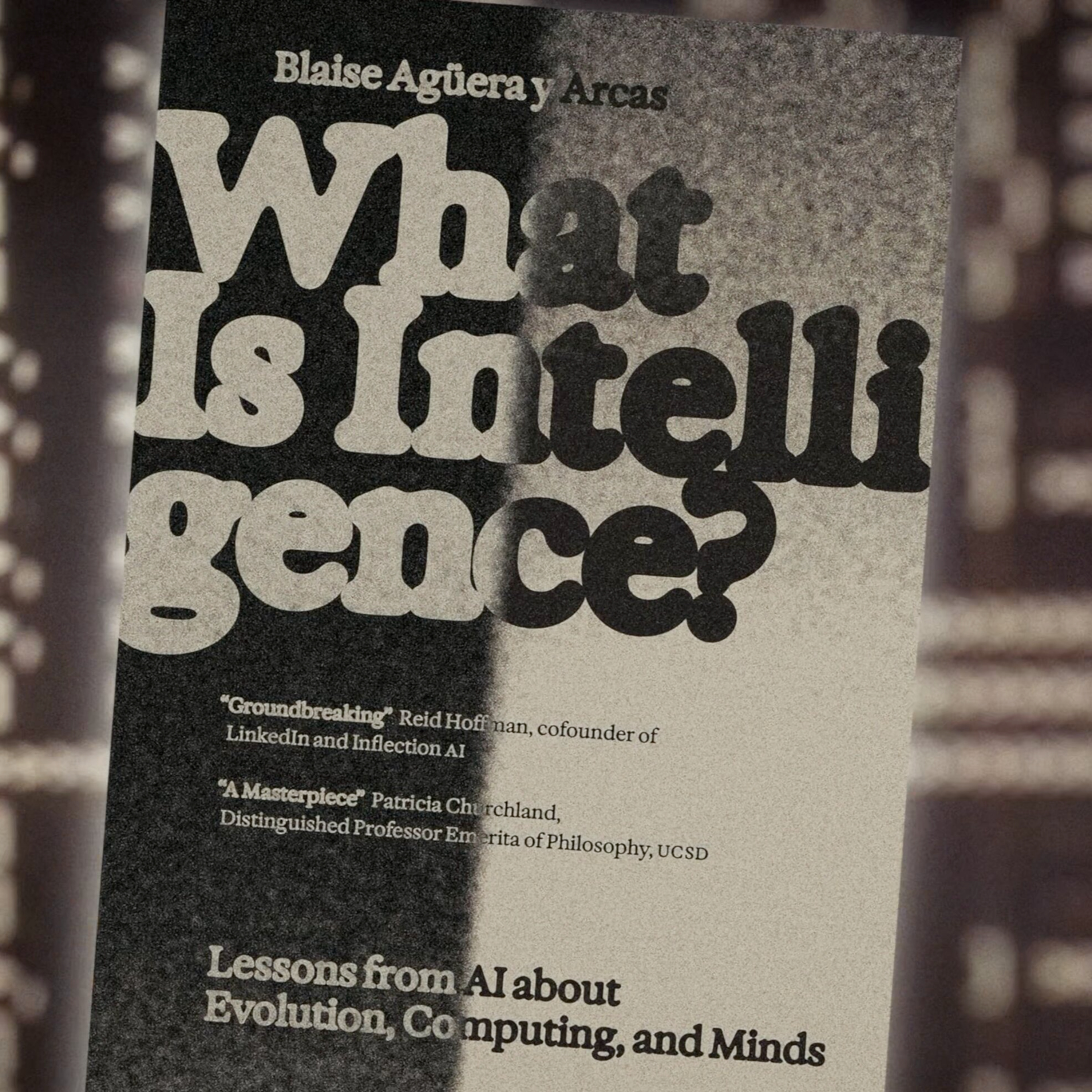
What if life itself is just a really sophisticated computer program that wrote itself into existence? Blaise Agüera y Arcas presenting at ALife 2025 — the most technically detailed public walkthrough of the ideas in his *What is Life?* and *What is Intelligence?* books that we've come across.He covers the BFF experiments (self-replicating programs emerging spontaneously from random noise), the mathematical framework connecting Lotka-Volterra population dynamics with Smoluchowski coagulation, eigenvalue analysis of cooperation matrices, and his central claim that symbiogenesis — not mutation — is the primary engine of evolutionary novelty.The experimental results are genuinely striking: complex self-replicating code arising from random byte strings with zero mutation, a sharp phase transition that looks like gelation, and a proof that blocking deep symbiogenetic ancestry trees prevents the transition entirely.A few things worth flagging for critical viewers:— The substrate is more carefully engineered than the framing sometimes suggests. The choice of language, tape length, interaction protocol, and step limits all shape what emerges. Their own SUBLEQ counterexample (where self-replicators *don't* arise despite being theoretically possible) highlights that these design choices matter substantially — and a general theory of which substrates support this transition is still missing.— The leap from "self-replicating programs on fixed-length tapes" to "life was computational and intelligent from the start" involves significant philosophical extrapolation beyond what the experiments directly demonstrate.— The Bedau et al. (2000) open problems paper he references at the start actually sets a higher bar for Challenge 3.2 than BFF currently meets: it asks that "the internal organization of these 'organisms' and the boundaries separating them from their environment arise and be sustained through the activities of lower-level primitives" — whereas BFF's tape boundaries are fixed by design, not emergent. --- TIMESTAMPS: 00:00:00 Introduction: From Noise to Programs & ALife History 00:03:15 Defining Life: Function as the "Spirit" 00:05:45 Von Neumann's Insight: Life is Embodied Computation 00:09:15 Physics of Computation: Irreversibility & Fallacies 00:15:00 The BFF Experiment: Spontaneous Generation of Code 00:23:45 The Mystery: Complexity Growth Without Mutation 00:27:00 Symbiogenesis: The Engine of Novelty 00:33:15 Mathematical Proof: Blocking Symbiosis Stops Life 00:40:15 Evolutionary Implications: It's Symbiogenesis All The Way Down 00:44:30 Intelligence as Modeling Others 00:46:49 Q&A: Levels of Abstraction & Definitions --- REFERENCES: Paper: [00:01:16] Open Problems in Artificial Life https://direct.mit.edu/artl/article/6/4/363/2354/Open-Problems-in-Artificial-Life [00:09:30] When does a physical system compute? https://arxiv.org/abs/1309.7979 [00:15:00] Computational Life https://arxiv.org/abs/2406.19108 [00:27:30] On the Origin of Mitosing Cells https://pubmed.ncbi.nlm.nih.gov/11541392/ [00:42:00] The Major Evolutionary Transitions https://www.nature.com/articles/374227a0 [00:44:00] The ARC gene https://www.nih.gov/news-events/news-releases/memory-gene-goes-viral Person: [00:05:45] Alan Turing https://plato.stanford.edu/entries/turing/ [00:07:30] John von Neumann https://en.wikipedia.org/wiki/John_von_Neumann [00:11:15] Hector Zenil https://hectorzenil.net/ [00:12:00] Robert Sapolsky https://profiles.stanford.edu/robert-sapolsky --- LINKS: RESCRIPT: https://app.rescript.info/public/share/ff7gb6HpezOR3DF-gr9-rCoMFzzEgUjLQK6voV5XVWY
Embed this episode
Ready to play
Evolution "Doesn't Need" Mutation - Blaise Agüera y Arcas
No transcript for this episode yet
Similar Episodes
No similar episodes found.