
EPISODE · Jun 30, 2026 · 1H 41M
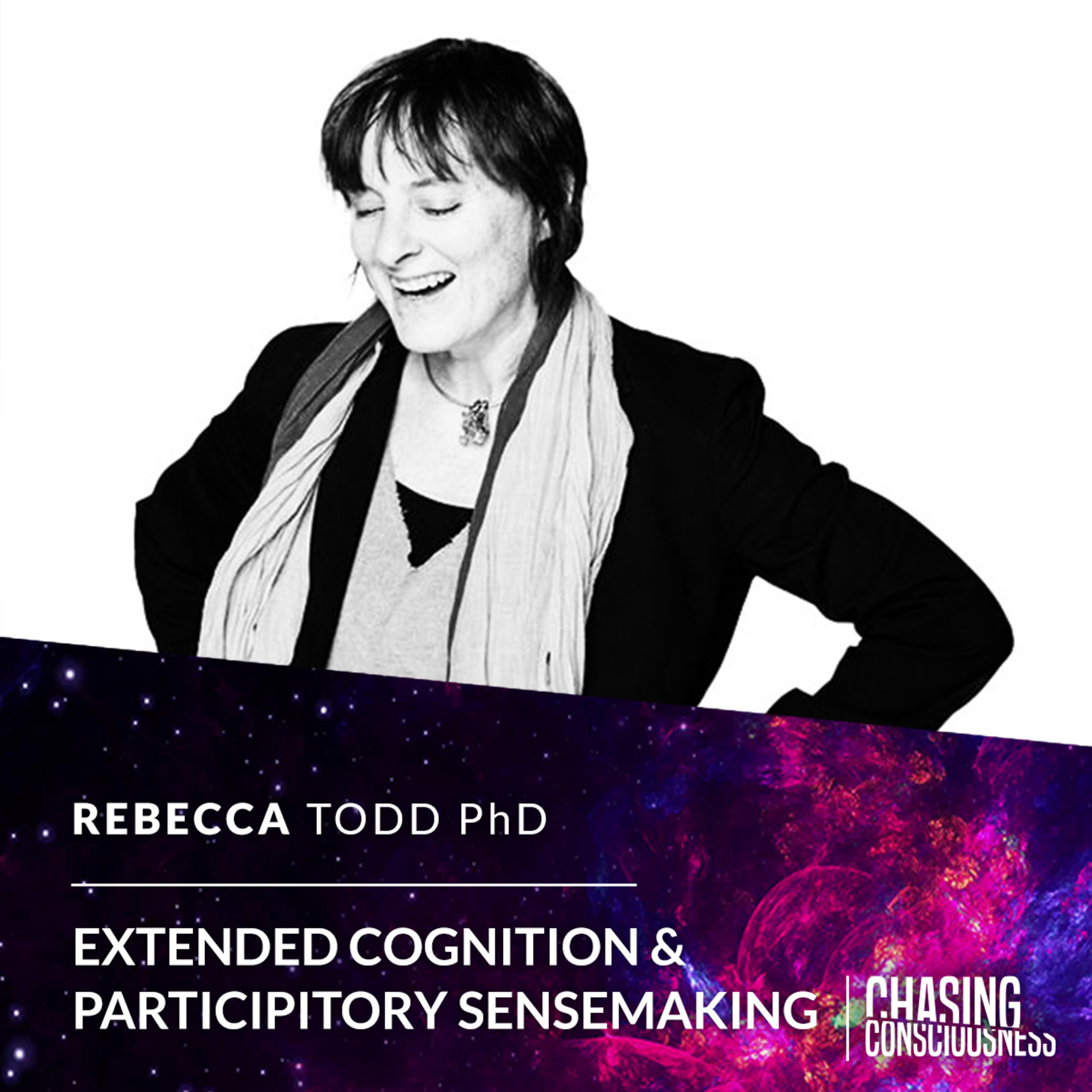
EXTENDED COGNITION & PARTICIPATORY SENSE-MAKING - Rebecca Todd PhD #89
from Chasing Consciousness · host Freddy Drabble
How separate is the cognition in our heads from cognition with our bodies, our tools, our communities and our ecosystems? What is participatory sense making and why is our world becoming less and less disposed to doing it? What does connecting cognitively with the world beyond our own bodies do for our sense making, and so for the future of our species?In this episode we have the intriguing topic of extended cognition to explore, and in particular the field of participatory sense-making. So we get into the extended component of the 5E’s model of embodied cognition; how our technologies, including AI, are much more influential on our cognition than mere tools that we set aside after use; we talk about our co-dependence on the natural world, and what happens to cognition and our society when our sense of “kinship” with it is lost; And we get into detail on the crucial process of participatory sense making, and how important it is to arrive to consensus rather than getting bogged down in polarisation, which in turn allows us to decide on urgent solutions as a species.Fortunately these are the exact specialisations of our guest, psychologist, cognitive scientist and philosopher at the University of British Columbia, Rebecca Todd. With a background also in neuroscience, she’s authored nearly 100 academic papers, whilst her substack hosts her much loved writings for the general What we discuss:00:00 Intro.06:05 Extended cognition defined.08:45 Distributed cognition - Edward Hutchins.09:00 Attention, learning and memory are all distributed.10:00 Can we identify the cognitive boundary between self and other?14:30 Heidegger’s warning about undermining the influence of technology.17:00 We give our tools too much credit.19:00 Large Language Model’s effect on extended cognition.23:00 Individualistic, extractive, competitive motivations for technology.24:00 Self AS relationship rather than IN relationship - Dr. Yuri Celidwen.28:10 Non-verbal communication.29:46 Feedback loops between nature and our minds.33:50 Connection to nature and mental health.37:20 Belonging and ‘kinship’ with the natural world.39:45 Objects can have personality - Object personality Synesthesia.44:20 Risk of appropriation, when applying indigenous ideas of ‘belonging’.46:50 The ‘Trim Tab’ analogy — small interventions can lead to big changes in direction, Greg Watson.53:15 Participatory Sense-making explained.57:30 Shifts happen before and after moments of synchrony.59:30 Conditions required for participatory sense-making.01:02:20 The 4 R’s: Reciprocity, Respect, responsibility and relevance.01:03:05 Neurodivergence: bridging the way we see the world differently.01:12:15 The new lack of bandwidth for complexity and nuance - information overload.01:15:30 Creating the time and space needed to do participatory sense-making.01:19:30 Food together is a magical ingredient.01:23:30 Openness and listening can be trained.01:24:20 Is consensus necessary.01:29:10 Tolerance of diversity rather than unified consensus.References:Beck Todd Substack, “Towards an ecology of mind”Andy Clarke and David Chalmers, “Extended Cognition” paperEdward Hutchins - Distributed Cognition paper.Fernando Rosas - Statistical boundaries between agents.Karen McClean - SPIN Lab (human-robot interactions through the sense of touch)Shirley Turcotte - Indigenous Focusing-oriented Therapy (IFOT)“Participatory Sense-making with the More than Human World” With Yuri Celidwen.An interview with Dr. Greg Watson - Ex US agricultural ministerHannah De Jaegher & Ezequial Di Poalo, “Participatory Sensemaking, An enactive approach to social cognition”. V.J .Kirkness, “First Nations and Higher Education: the four 4’s”“The Multiplicity of Worlds” with Penijean Gracefire et al.Ed Young, “An immense world”“Community Out of the Ashes” with Eli Oda Shina.Gabor Mate, “In the realm of hungry ghosts - Encounters with Addiction”
Embed this episode
NOW PLAYING
EXTENDED COGNITION & PARTICIPATORY SENSE-MAKING - Rebecca Todd PhD #89
No transcript for this episode yet
Similar Episodes
No similar episodes found.
Similar Podcasts
No similar podcasts found.