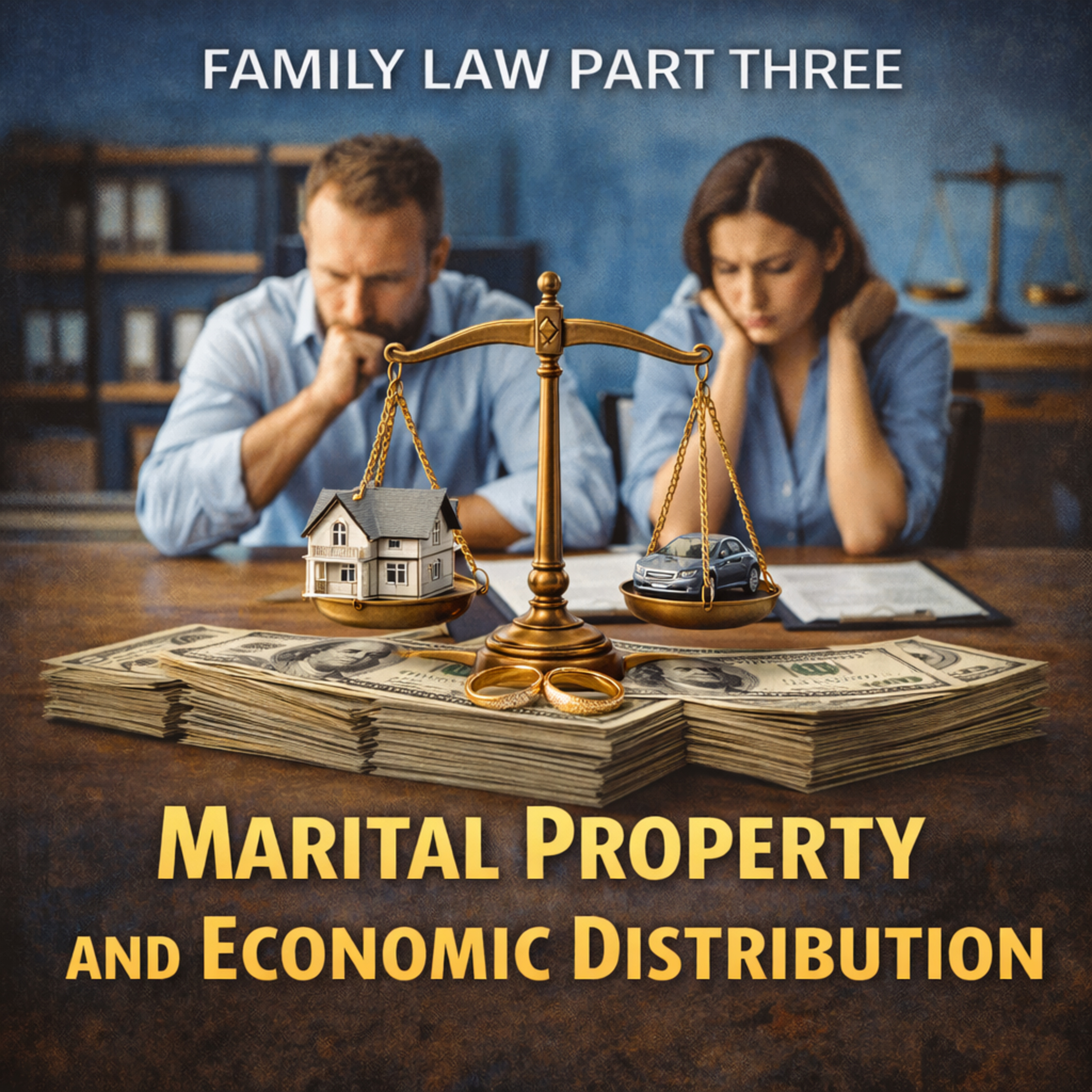
Family Law Part Three - Marital Property and Economic Distribution episode artwork

EPISODE · Feb 25, 2026 · 45 MIN

Family Law Part Three - Marital Property and Economic Distribution

from Law School · host The Law School of America

This conversation delves into the complexities of marital property and economic distribution in divorce, emphasizing the importance of understanding the economic partnership theory. It outlines a three-step process for property division: classification, valuation, and distribution, while addressing common misconceptions and gray areas in family law. The discussion also highlights the implications of goodwill, professional licenses, and the impact of dissipation on asset division.Most people assume divorce is about emotional battles and custody fights—until you realize the real war is fought on the spreadsheet. The hidden battlefield? Family courts unraveling the marital partnership by dissecting assets down to cold, hard numbers. In this episode, we expose the ruthless logic behind property division, revealing how courts classify, value, and distribute assets in divorce — with surprising rules, complex gray areas, and critical exam tactics every legal student must master.You’ll discover how modern law views marriage as an economic partnership, and why the old title system has been replaced by a smarter, fairer approach. We break down the three essential steps: classification, valuation, and distribution — explaining why every detail, from premarital property to business goodwill, can make or break your case. Learn the key distinctions: how the law treats inherited land versus assets bought with marital wages, and why a Porsche bought with a paycheck during marriage is actually marital property, regardless of whose name’s on the title.We analyze notorious gray areas that trip up students and practitioners alike. For example, you’ll understand the controversial treatment of personal injury awards—are they marital or separate? — and how jurisdictions like New York treat professional degrees as property, valuing future earnings. Delve into complex topics like active versus passive appreciation, co-mingling and tracing funds, and transmutation: when a house’s character flips from separate to marital simply because someone’s name gets added. You’ll also see how courts handle the valuation date—should assets be calculated at separation or trial? — and how they value intangible assets like goodwill, with formulas from Pereira and Van Camp to precisely apportion growth.The stakes? Massive. A misclassification or misvaluation can cost you entire assets or lead to unfair windfalls. We reveal the practical strategies for securing a fair share, such as how to spot dissipation—spending marital funds intentionally prior to divorce—and how debts are divided, exposing the dangers of third-party creditors ignoring court orders. Plus, understand how the legal systems in equitable distribution states differ from community property regimes, and why the final distribution hinges on a court's discretion or a strict 50-50 split.Perfect for law students tackling property questions, divorce practitioners refining their strategy, or anyone wanting to demystify the hidden mechanics of divorce asset division. Master this framework, follow the rules to the letter, and you'll unlock the secret to turning complex chaos into a clear, fair outcome. Accuracy in classification is your best chance to win—get that right, and you've already won half the battle.This episode transforms a dense, rule-driven subject into a precise blueprint—arming you for exams, courtrooms, and real-world cases. Whether you're preparing for bar day or just want to understand how your friends’ divorces really work behind the scenes, tune in and dominate the economic divorce terrain.TakeawaysDivorce is often more about economic distribution than emotional battles.The economic partnership theory redefines marriage as a financial venture.Classification of assets is crucial in determining property division.family law, divorce, marital property, economic distribution, classification, valuation, distribution, goodwill, professional licenses, dissipation

This conversation delves into the complexities of marital property and economic distribution in divorce, emphasizing the importance of understanding the economic partnership theory. It outlines a three-step process for property division: classification, valuation, and distribution, while addressing common misconceptions and gray areas in family law. The discussion also highlights the implications of goodwill, professional licenses, and the impact of dissipation on asset division.Most people assume divorce is about emotional battles and custody fights—until you realize the real war is fought on the spreadsheet. The hidden battlefield? Family courts unraveling the marital partnership by dissecting assets down to cold, hard numbers. In this episode, we expose the ruthless logic behind property division, revealing how courts classify, value, and distribute assets in divorce — with surprising rules, complex gray areas, and critical exam tactics every legal student must master.You’ll discover how modern law views marriage as an economic partnership, and why the old title system has been replaced by a smarter, fairer approach. We break down the three essential steps: classification, valuation, and distribution — explaining why every detail, from premarital property to business goodwill, can make or break your case. Learn the key distinctions: how the law treats inherited land versus assets bought with marital wages, and why a Porsche bought with a paycheck during marriage is actually marital property, regardless of whose name’s on the title.We analyze notorious gray areas that trip up students and practitioners alike. For example, you’ll understand the controversial treatment of personal injury awards—are they marital or separate? — and how jurisdictions like New York treat professional degrees as property, valuing future earnings. Delve into complex topics like active versus passive appreciation, co-mingling and tracing funds, and transmutation: when a house’s character flips from separate to marital simply because someone’s name gets added. You’ll also see how courts handle the valuation date—should assets be calculated at separation or trial? — and how they value intangible assets like goodwill, with formulas from Pereira and Van Camp to precisely apportion growth.The stakes? Massive. A misclassification or misvaluation can cost you entire assets or lead to unfair windfalls. We reveal the practical strategies for securing a fair share, such as how to spot dissipation—spending marital funds intentionally prior to divorce—and how debts are divided, exposing the dangers of third-party creditors ignoring court orders. Plus, understand how the legal systems in equitable distribution states differ from community property regimes, and why the final distribution hinges on a court's discretion or a strict 50-50 split.Perfect for law students tackling property questions, divorce practitioners refining their strategy, or anyone wanting to demystify the hidden mechanics of divorce asset division. Master this framework, follow the rules to the letter, and you'll unlock the secret to turning complex chaos into a clear, fair outcome. Accuracy in classification is your best chance to win—get that right, and you've already won half the battle.This episode transforms a dense, rule-driven subject into a precise blueprint—arming you for exams, courtrooms, and real-world cases. Whether you're preparing for bar day or just want to understand how your friends’ divorces really work behind the scenes, tune in and dominate the economic divorce terrain.TakeawaysDivorce is often more about economic distribution than emotional battles.The economic partnership theory redefines marriage as a financial venture.Classification of assets is crucial in determining property division.family law, divorce, marital property, economic distribution, classification, valuation, distribution, goodwill, professional licenses, dissipation

NOW PLAYING

Family Law Part Three - Marital Property and Economic Distribution

0:00 45:31

No transcript for this episode yet

We transcribe on demand. Request one and we'll notify you when it's ready — usually under 10 minutes.

The Small Business Startup School – Business Notes | Financial Literacy | Retail Psychology – For Professionals & Entrepreneurs The Small Business Startup School Inc. Starting or buying a small business? While personal circumstances may vary, business patterns remain timeless. On The Small Business Startup School, we explore strategies, insights, and practical solutions to help entrepreneurs confidently navigate their journey.Hosted by Ola Williams—a retail entrepreneur, fintech founder, and financial coach with over two decades of experience—this podcast marries financial awareness and retail psychology with optimism to deliver actionable takeaways.Join us to learn, grow, and connect as we uncover the keys to business success.Let’s continue to learn together and be encouraged to keep on connecting! The 48 Laws of Power by Robert Greene (Full Audiobook) Robert Greene Amoral, cunning, ruthless, and instructive, this multi-million-copy New York Times bestseller is the definitive manual for anyone interested in gaining, observing, or defending against ultimate control – from the author of The Laws of Human Nature.In the book that People magazine proclaimed “beguiling” and “fascinating,” Robert Greene and Joost Elffers have distilled three thousand years of the history of power into 48 essential laws by drawing from the philosophies of Machiavelli, Sun Tzu, and Carl Von Clausewitz and also from the lives of figures ranging from Henry Kissinger to P.T. Barnum.Some laws teach the need for prudence (“Law 1: Never Outshine the Master”), others teach the value of confidence (“Law 28: Enter Action with Boldness”), and many recommend absolute self-preservation (“Law 15: Crush Your Enemy Totally”). Every law, though, has one thing in common: an interest in t Guardians Of Innocence Guardians Of Innocence Guardians of Innocence is a powerful and informative podcast designed to equip parents, teachers, and communities with the knowledge and tools needed to protect children from the growing threat of trafficking. Each episode dives deep into the tactics traffickers use to target vulnerable children—both online and in real life—and provides actionable advice on how to recognize the warning signs.Through expert interviews with cyber safety professionals, law enforcement, and survivors, we uncover the latest grooming methods, share real-world stories, and empower listeners to become vigilant guardians of innocence in their own families and communities.Guardians of Innocence is more than just a podcast; it’s a call to action to safeguard our children, raise awareness, and foster a united front against trafficking.Listen. Learn. Protect. The Laura Ingraham Show Laura Ingraham The most-watched woman in the history of cable news brings her no-holds-barred political and cultural commentary to podcasting with The Laura Ingraham Show. A bestselling author, breast cancer survivor, and mother of three internationally adopted children, Laura was the most listened-to woman in talk radio before launching her own podcast. A trailblazer across media platforms, she brings a unique perspective to this twice-weekly show, drawing on her experience as a white-collar criminal defense litigator and a Supreme Court law clerk.New episodes drop twice a week—delivering the clarity, courage, and common sense America needs.

Frequently Asked Questions

How long is this episode of Law School?

This episode is 45 minutes long.

When was this Law School episode published?

This episode was published on February 25, 2026.

What is this episode about?

This conversation delves into the complexities of marital property and economic distribution in divorce, emphasizing the importance of understanding the economic partnership theory. It outlines a three-step process for property division:...

Can I download this Law School episode?

Yes, you can download this episode by clicking the download button on the episode player, or subscribe to the podcast in your preferred podcast app for automatic downloads.
URL copied to clipboard!