
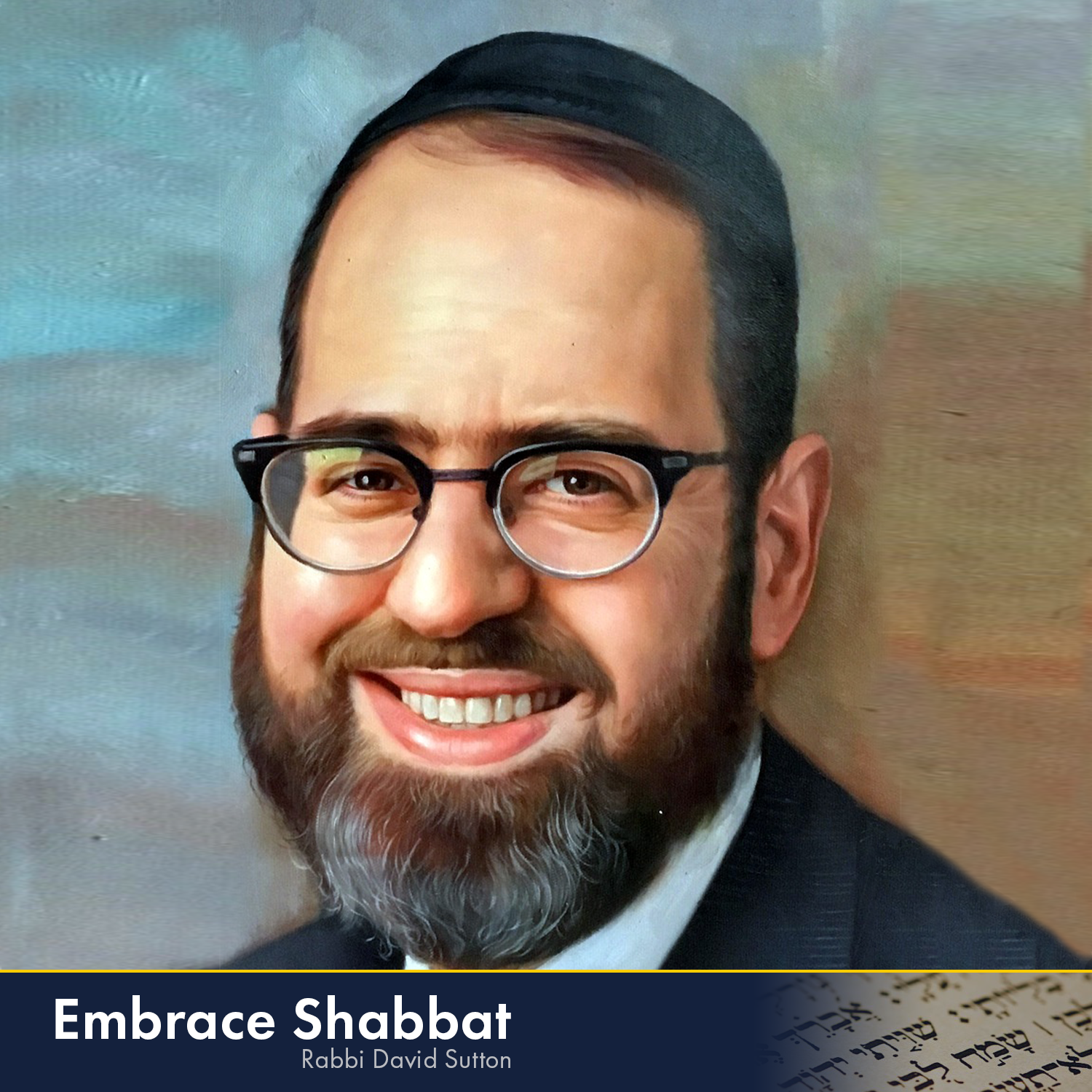
EPISODE · Nov 10, 2023
Family Time on Shabbat: Preserving Tradition
from Embrace Shabbat · host Rabbi David Sutton
Shabbat is a day especially suited for quality family time, as parents and children sit around the table together for long periods. One might wonder, is this just a nice custom that evolved, or is there a source in the Torah for this aspect of Shabbat? The Torah commands in Parashat Kedoshim, קדושים תהיו...איש אמו ואביו תיראו ואת שבתותי תשמורו – “You shall be sacred… Each person shall revere his mother and his father, and you shall observe my Shabbatot.” These verses incorporate three different commands: being “sacred,” respecting parents, and observing Shabbat. To explain the connection between these mitzvot , the Hatam Sofer writes that kedushah is preserved among the Jewish People through the parent-child relationship. Parents transmit to their children the laws, traditions, values and customs that make us a sacred people, and this transmission succeeds only if the children respect their parents and heed their guidance and instructions. This process occurs primarily on Shabbat, when parents are free from work and thus have time to sit with their children. Thus, the command of קדושים תהיו , being a sacred nation, is fulfilled through the mitzvot of respecting parents and Shabbat, as it is by children spending time listening to their parents on Shabbat that the principles of kedushah are transmitted and thereby preserved. Rashi, in his comments to these verses in Sefer Vayikra, gives a different explanation for the connection between the commands of Shabbat and respecting parents. He writes that the Torah juxtaposed these two commands to teach us that one should not violate Shabbat for the sake of respecting his parents. If his father or mother asks him to perform some action on Shabbat that constitutes a Shabbat violation, he must refuse the request. Although he is required to obey his parents, his parents are required to obey G-d, and thus G-d’s laws take precedence over the parents’ wishes. The Meshech Hochmah raises the question of why such an inference was necessary. Is it not obvious that we should not violate G-d’s word for the sake of fulfilling the wishes of another human being? Wouldn’t we have intuitively understood that our obligations to Hashem take precedence over our obligations to other people, who are also bound by His laws? The Meshech Hochmah answers that although it is evident that we may not transgress G-d’s laws to grant another person’s request, one might have nevertheless assumed that obeying parents marks an exception to this rule. As we know, the Ten Commandments were engraved on two stones, one which contained the five commandments that relate to our duties to Hashem ( מצוות בין אדם למקום ), and the other which contained the five commandments governing our responsibilities to other people ( מצוות בין אדם לחבירו ). Revealingly, the command to respect parents – כבד את אביך ואת אמך – was engraved on the right stone, the stone which contained the מצוות בין אדם למקום . The Meshech Hochmah explains that our entire religion is based upon our belief in the Revelation at Sinai. We were not present when G-d revealed Himself to our ancestors at Sinai, but those who were present told of this event to their children, who conveyed this information to their children, and so on. This is how we know of the Revelation and why we believe in our obligation to Torah – through the transmission from parent to child over the course of the generations. It emerges, then, that our entire faith hinges upon the parent-child relationship. As such, honoring parents involves more than our appreciation to our parents for all they’ve done for us. It is the key to the successful transmission of our mesorah (tradition). For this reason, one might have assumed that honoring parents’ wishes overrides our responsibilities to Hashem, since our entire religion depends upon respect for parents. Similarly, the Ramban writes in this commentary to Sefer Devarim that the memory of the Revelation is preserved for all time by parents telling of the event to their children. Children understand that parents would not tell them nonsense, and we therefore do not entertain any doubts about the truth of this event. The Hatam Sofer , elsewhere in his writings (responsa, Y.D. 356), observes that with the exception of the story of Bilam, we have eye-witness testimony to all the events recorded in the Torah. All Am Yisrael – 600,000 adult men, plus the women and children – witnessed the miracles of the Exodus and the Revelation at Sinai. And as for the earlier events, Adam clearly knew that he and the whole earth were created, and he told about it to his offspring, including Noach, whom he knew. Noach lived long enough to know the patriarchs, and thus they heard firsthand accounts about events such as the flood, the Tower of Babel, and so on. They transmitted all this information to their offspring, and thus all Beneh Yisrael received this tradition. In essence, then, our tradition is testimony to the truth of all these events. This point is made also by the Sefer Ha’ikarim , who emphasizes that our religion cannot be sustained without children respecting their parents. For this reason, he writes, the Torah commands in Parashat Ha’azinu, שאל אביך ויגדך זקניך ויאמרו לך – “Ask your father, and he will inform you; your elders – and they will tell you.” On this basis, the Sefer Ha’ikarim explains the severe punishment the Torah decrees upon a בן סורר ומורה , the wayward thirteen-year-old son who shows signs of complete disobedience and utter disregard for his parents’ authority, such as stealing their money and using it for self-indulgence. The source of our faith is our tradition, and so a child who severs the connection to his parents undermines the entire foundation of our religion. Therefore, Shabbat, which is the day to bolster our emunah , is the day of tradition, the day when parents and children are to strengthen their bonds to ensure the successful transmission of our mesorah . Shabbat is the day of kedushah , and as the Hatam Sofer teaches, kedushah is maintained through the relationship between parents and children, which is strengthened specifically on Shabbat. Let us, then, use Shabbat as a time to reinforce the bonds between the generations, between parents and children, which will have the effect of reinforcing our faith and thus reinforcing our special bond to the Almighty.
What this episode covers
Weekly Shabbat thoughts with Rabbi David Sutton
NOW PLAYING
Family Time on Shabbat: Preserving Tradition
No transcript for this episode yet
Similar Episodes
Jun 1, 2025 ·89m
Apr 6, 2025 ·110m
Mar 31, 2025 ·11m
Mar 23, 2025 ·87m
Mar 16, 2025 ·55m
Mar 9, 2025 ·90m