
EPISODE · Jun 4, 2026 · 17 MIN
Finding Common Ground After Trump's Political Betrayal
from The Forum with Josh Cowen Podcast · host Josh Cowen
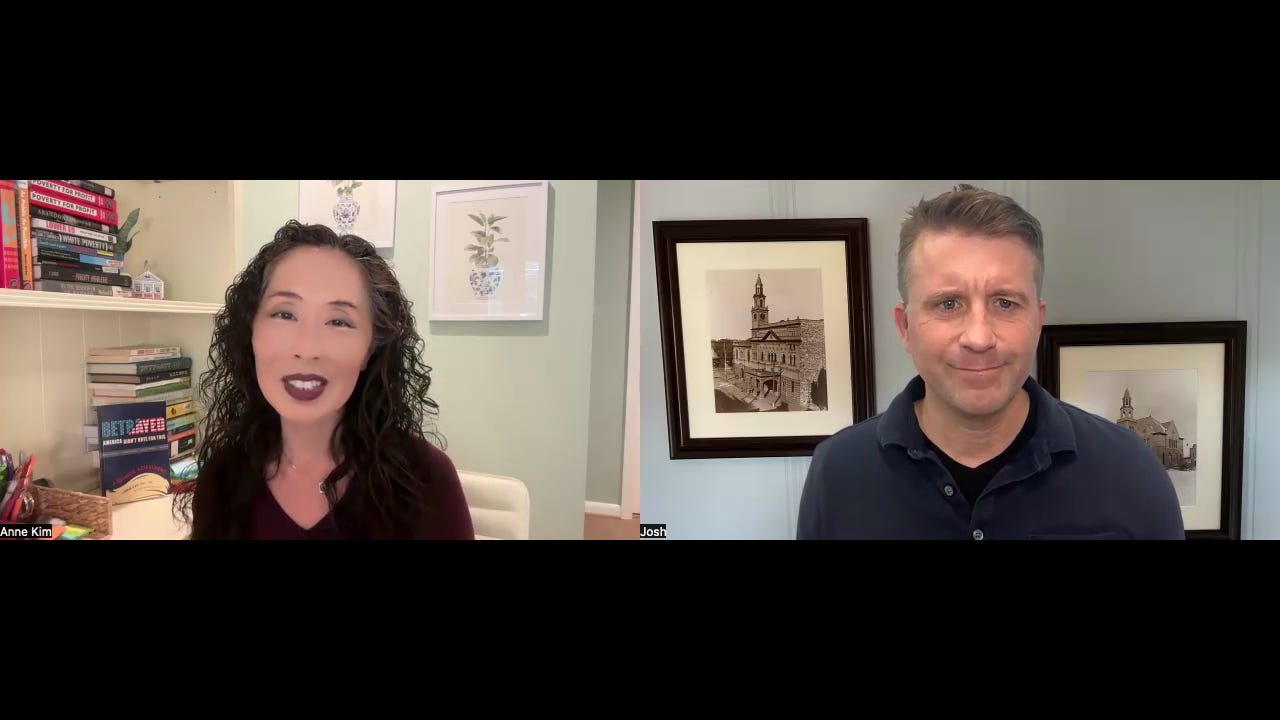
This week I’m talking to Anne Kim, co-editor of a new book called Betrayed: America Didn’t Vote for This. It’s a compilation of chapters by seasoned policy experts, and longtime policymakers and advisors at senior levels of the federal government. It’s basically a damage assessment that takes a look at where we are midway through Trump’s second term, what’s been done and what’s coming ahead.Betrayed is published by the bipartisan Common Sense Coalition, of which Anne is also executive director.Anne Kim is a journalist, lawyer, former senior staffer on Capitol Hill, and veteran of several D.C.-based think tanks. She’s also the author of Poverty for Profit: How Corporations Get Rich Off America’s Poor (The New Press, 2024) and Abandoned: America’s Lost Youth and the Crisis of Disconnection (The New Press, 2020).A Conversation with Anne KimThanks for being here. Before we get into the questions, tell me a little bit about your own background professionally, and the background you’re bringing to the work we’re about to talk about.Sure. As you mentioned, I’m a journalist, a lawyer. I worked on the Hill. I worked in a couple of DC think tanks. And I’ve worked in private sector. I was actually a corporate securities lawyer before I went on to public policy. So I feel like I’ve had a little bit of a 360 view from the government side, from the public policy side.And from the media side. All of these things have come into play in our writing this volume with my co-editor and contributors for the Common Sense Coalition.The title is a provocation — Betrayed. That’s a strong word. Who exactly does this book argue was betrayed, and is it making a claim about bad outcomes or something more specific — that voters were actively misled about what they were getting?So the book is, it says on the cover, it’s a damage assessment. And what we are is a coalition of about, you know, 45 policy experts, former government, former military, who all got together to put together a fact-based analysis of what Trump administration policies have done.And that’s where we get to the concept of betrayal. And you did mention that it’s a strong word. Yeah, it’s a strong word. It’s an emotional word, it’s an evocative word, it’s also a deliberate word. And I think it has different meanings for different audiences. For those who may have supported Trump in the past, it really could be kind of a personal betrayal. He did promise that he would bring down prices on day one.He also promised that he would not take the U.S. into unnecessary wars. That promise has been broken too. I mean, for those who have had this very personal relationship, loyalty to Trump, it really may be a visceral reaction to them that does qualify as betrayal.For others, some of us who kind of knew what might be happening with the second Trump administration, the betrayal is a little bit different. It’s about this administration’s betrayal of the values and the foundational principles of our democracy. And we go into that with 12 chapters in our book. The rule of law, the collapse of civil discourse, an economy that’s become unaffordable.You know, there are a lot of things upon about which the things that we have counted on for generations have been eroded.The Common Sense Coalition isn’t a progressive outfit — this is a centrist, cross-aisle project. How do you get people from different political traditions to agree on what a betrayal even looks like, when they may disagree about what the promise was in the first place?Betrayal, I guess, you could argue is in the eye of the beholder. You know, as I mentioned, it means different things to different people. What we try to do in this book, though, is just to make the argument about the depth and the breadth of the destruction.And we have chosen to do so with facts, and we have synthesized these facts into an argument. You know, I mentioned that we have footnotes, 643 footnotes, so this is not conjecture, it’s not hyperbole, it’s a fact-filled synthesis, and it’s 12 chapters. We’re not trying to do this, like, florid rhetorical exercise. You know, we try to make it as accessible and readable as possible. In that way, we’re kind of inspired by the original Common Sense, written by Thomas Paine, because that was a 47-page pamphlet that was really intended for regular people, you know, to make the case against the monarchy, to make the case that here’s the stakes of a revolution.That’s not what we’re calling for in this case, but Paine laid out in a very accessible way the damage that’d been done by the king at that time, and the political stakes if regular people didn’t act. And that was an inspiration for both the name of the coalition, but also for the argument that we try to make within the book.Future generations have no reason at this point to believe what their government is telling them, because there is active misinformation being pumped out by multiple agencies on multiple platforms.—Anne KimMy work and writing is mostly focused on the politics of schools, kids and families. Your previous book Abandoned was really about what happens when systems fail young people who have already fallen through the cracks. How does the damage you document in Betrayed land on kids specifically — whether that’s schools, nutrition programs, health coverage, or something else — and is any of it reversible before a generation gets lost?Thank you for that question. My 2020 book, Abandoned, was about youth disconnection. It’s about the 4.5 million, probably more now after the COVID pandemic, of young adults who are neither in school nor working and how they had been abandoned by the various government systems.They’re supposed to be helping them, whether it’s foster care, justice system, or education. With this book, Betrayed, if you read the introduction to the book, there is a reference to kids and grandkids. You know, that was, future generations were very much on the minds of all of us who contributed to this volume. And the argument in the book is not only that this Trump administration has just kind of wrecked our present, but they’ve really destroyed our future, too. And to your point, I do think some of this could be irreversible, because in the space of 16 months this administration has managed to destroy institutions and structures that have taken decades to build, and there are a few specific impacts like right now that are going to have, you know, long-term implications for kids. For instance, I just saw, I think, Kaiser—KFF—put out a stat the other day that more than 1.7 million low-income kids have lost Medicaid as a result of various cutbacks that are taking place. I mean, these kids growing up without access to health care now are going to be suffering immense long-term health consequences as a result of not getting preventive care, not getting acute things taken care of, not getting vaccinations, you name it. So there’s that.The Department of Education, you know well what’s happened there. And then, next month, we’re going to be seeing huge changes in access to higher ed, because of enormous changes in higher ed financing, right? So, people who are getting nursing degrees can no longer finance their education if they can’t afford to do so, thanks to the changes in the Graduate Plus program for graduate loans. So yeah, that’s going to have an enormous impact on careers, on economic mobility of future generations.We have a chapter on climate change. You know, this administration has completely walked back prior administration’s commitment to a clean energy future, allowing China to leap ahead. So not only are we putting climate at risk for future future generations, but our ability to compete in the clean energy space as a result of that. And then, kind of the big picture view is faith in government.Future generations have no reason at this point to believe what their government is telling them, because there is active misinformation being pumped out by multiple agencies on multiple platforms.And a lot of what this government has done right now has been against the interests of children and the families, and it’s going to be very, very, very hard to rebuild that trust.Irreversible? Possibly.Where in this book did the evidence or argument genuinely surprise you — where did what voters actually wanted diverge most sharply from what the political conversation suggested they wanted?Well, if you mean, you know, where did the nation and voters get way more than they bargained for, it probably would have to be immigration enforcement. I mean, it really has been much more destructive than I think anyone would have predicted. That chapter lays out in very stark terms the actual hazards to public safety that have resulted as a result of these immigration crackdowns, and I think the scale of that is much more than anyone anticipated.And, you know, nobody expected that U.S. citizens would also be at risk of death. You know, it’s bad enough what’s happening to people generally, but the level of violation of civil rights, human rights, the deaths and the injuries that are happening in detention centers. The economic impact, also, of the immigration enforcement surge has probably much starker than anyone expected as well. There’s a great Brookings report that just came out this week estimating that the United States has lost 688,000 jobs as a result of the 2025 immigration surge. Their analysis found that for every “excess arrest,” 13 jobs were affected. And so, I mean…it has been catastrophic.This hijacking of government to serve the profit interests of companies that make their living from government money is a huge theme of the Trump Administration.—Anne Kim You’ve written extensively about how corporations profit off poverty — the poverty industry, as you’ve called it. Does Betrayed connect that thread to the current moment? Is what we’re seeing in this administration just more of that, or is there something structurally different happening?There’s definitely some commonality in themes. The book you’re referring to is Poverty for Profit, and that really looked at the privatization of public services and how for-profit actors have really taken advantage of government programs that were intended to help the poor, but instead are profiting from themselves. And that is definitely happening today in real time. I’ll just give you a couple of instances. First of all, we’ve had this long-going privatization of criminal justice, private prisons. So, who is running the immigration detention camps? Well, it’s GEO Group, it’s CoreCivic, it’s these companies that have been running private prisons for decades now. If you just look up GEO Group and look at their stock price, they’re profiting from the $80 billion that’s expected to be coming their way from the One Big Beautiful Bill on immigration enforcement. So these contractors are being hired at enormous expense, often without competitive bids to carry out the administration’s agenda. So that is one way in which there is this group of corporate middlemen. And another example of that is the Medicaid work reporting requirements. So there’s been a lot of reporting lately, actually, by contractors who have been hired by the states to actually stand up the compliance regimes that will have to be in place for people to report their work effort in order to qualify for Medicaid. Now, I have to clarify that most working age people who are on Medicaid are working already, you know. In fact, like Walmart, McDonald’s—these employers have huge numbers of people on their payrolls who get Medicaid because their wages are not high enough to qualify for any kinds of other kinds of insurance. They’re working. These are the folks who are going to have to be logging every hour that they’re working at Walmart in order to qualify.Who is going to be monitoring those benefits? The contractors that the states have brought in at enormous expense, and millions of people are going to lose their Medicaid rolls. And that’s something that I talk about in Poverty for Profit too, like just a really human impact of having these companies in there administering programs, profiting from the programs, and taking advantage, triaging or arbitraging little inefficiencies in their programs to profit for themselves. And this hijacking of government to serve the profit interests of companies that make their living from government money is a huge theme of the Trump Administration. Right? I mean you can count multiple ways every day covered in news of the ways in which the Trump administration has tipped the scales in favor of friends and allies, and using the government as an instrument of corruption. Even small things like, you know, repainting the reflecting pool in front of the monument. That was a no-bid contract that cost way more than it’s supposed to, and it looks bad too.We have to drag ourselves back into a space where we can try to find common ground. As well as common sense, and rebuild the republic that we are in danger of losing. And we have to do so in as measured a way as possible, to reach out to those who may have been in a different space from us.—Anne KimYou and I can both write about what went wrong. But I think about this a lot with my own readers — the question isn’t just “what happened” but “what do we do.” Given the political environment, what does meaningful accountability look like, and is “common sense” — the thing your coalition is named for — actually available to us right now as a political resource?That’s a tough question. It’s not an easy question. I think it really is up to each one of us, you and I, and anyone listening to this to make common sense available as a resource to themselves.To their friends and family, you know, and that’s kind of the purpose of the book, to take down the temperature, go back to facts.What we don’t want to see, I think is really dangerous, is numbness, is apathy. A lot of people are in this “I just can’t tune in right now” kind of space, even as kind of democracy is crumbling before our eyes.And I for one worry that this kind of willful blindness is going to enable everything we hold dear as Americans slip away.But let’s take down the temperature a little bit, and try to rebuild those bridges that others out there are trying so hard to tear apart. And in terms of practical things to do. The conversations have to happen.Voting has to happen.You know, civic engagement has to happen. And I think even volunteering within the community will happen, you know, and rebuild some of that civic engagement that we’ve seen dissolve as a result of what’s been happening over the last decade.Hear, hear. Well, let’s let that be the last word.Anne Kim is the co-editor of this new book, Betrayed: America Didn’t Vote for This, and executive director of the Common Sense Coalition. This is a public episode. If you'd like to discuss this with other subscribers or get access to bonus episodes, visit joshcowen.substack.com/subscribe
Embed this episode
Ready to play
Finding Common Ground After Trump's Political Betrayal
No transcript for this episode yet
Similar Episodes
No similar episodes found.
Similar Podcasts
No similar podcasts found.