
EPISODE · Feb 23, 2026 · 16 MIN
Foundations of QbD in Living Systems (QbD Part-1)
from Biomanufacturing & Fermentation Technology · host prasad ernala
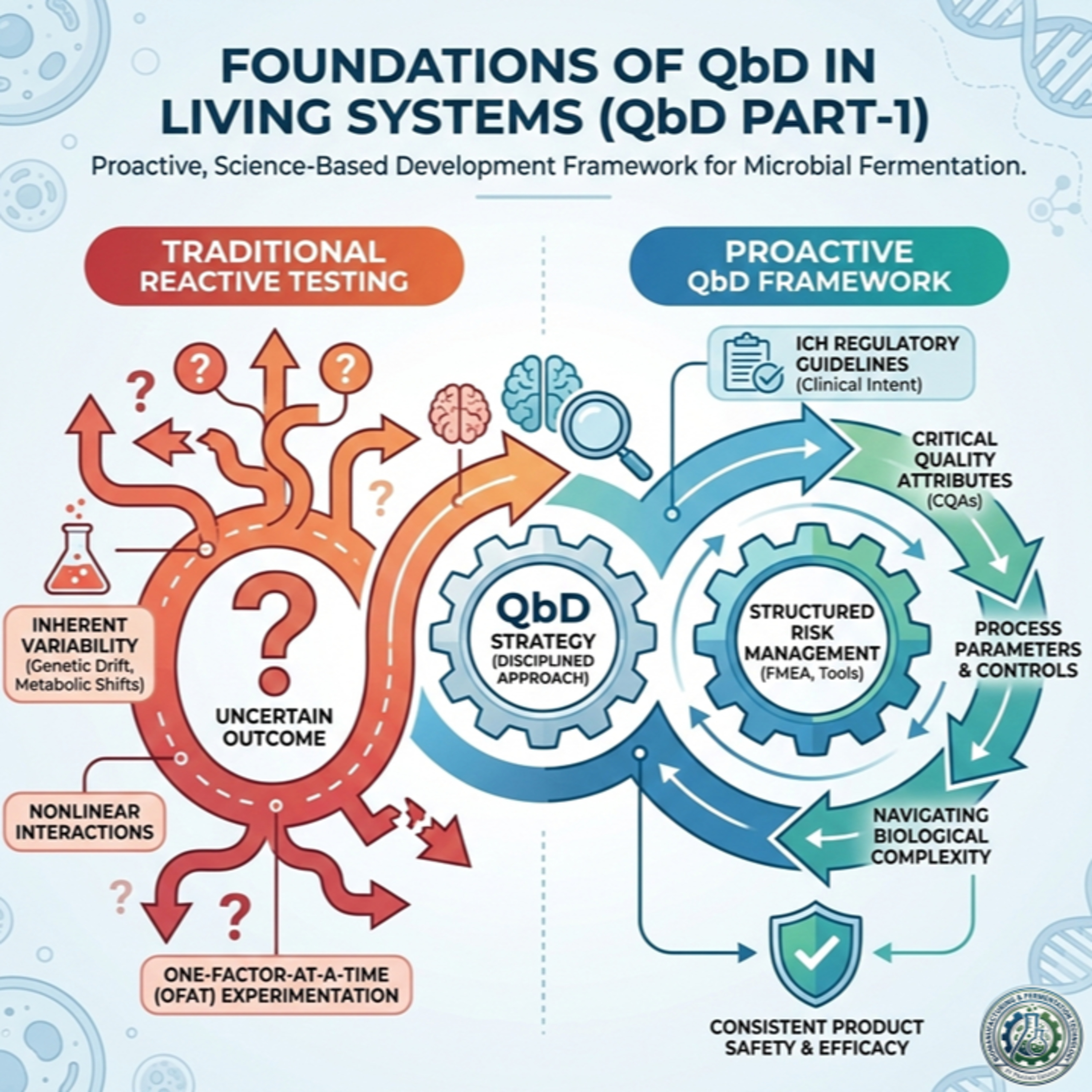
This part explores the application of Quality by Design (QbD) principles to microbial fermentation, moving away from traditional reactive testing toward a proactive, science-based development framework. It highlights how the inherent variability of living systems—driven by genetic drift, nonlinear metabolic shifts, and environmental interactions—requires a more sophisticated approach than simple one-factor-at-a-time experimentation. By utilizing ICH regulatory guidelines, manufacturers can link a product’s clinical intent to critical quality attributes and specific process parameters. The discussion emphasize using structuredrisk management tools, such as FMEA, to identify how upstream biological fluctuations propagate through themanufacturing lifecycle. Ultimately, the material frames QbD as a disciplined strategy for navigating biological complexity to ensure consistent product safety and efficacy.#Foundations of QbD in Living Systems (QbD Part-1)#Bioprocess #ScaleUp and #TechTransfer,#Industrial #Microbiology,#MetabolicEngineering and #SystemsBiology,#Bioprocessing,#MicrobialFermentation,#Bio-manufacturing,#Industrial #Biotechnology,#Fermentation Engineering,#ProcessDevelopment,#Microbiology,#Biochemistry,#Biochemical Engineering, #Applied #MicrobialPhysiology, #Microbial #ProcessEngineering, #Upstream #BioprocessDevelopment, #Downstream Processing and #Purification,#CellCulture and #MicrobialSystems Engineering, #Bioreaction #Enzymes, #Biocatalyst #scientific #Scientist #Research
What this episode covers
This part explores the application of Quality by Design (QbD) principles to microbial fermentation, moving away from traditional reactive testing toward a proactive, science-based development framework. It highlights how the inherent variability of living systems—driven by genetic drift, nonlinear metabolic shifts, and environmental interactions—requires a more sophisticated approach than simple one-factor-at-a-time experimentation. By utilizing ICH regulatory guidelines, manufacturers can link a product’s clinical intent to critical quality attributes and specific process parameters. The discussion emphasize using structuredrisk management tools, such as FMEA, to identify how upstream biological fluctuations propagate through themanufacturing lifecycle. Ultimately, the material frames QbD as a disciplined strategy for navigating biological complexity to ensure consistent product safety and efficacy.#Foundations of QbD in Living Systems (QbD Part-1)#Bioprocess #ScaleUp and #TechTransfer,#Industrial #Microbiology,#MetabolicEngineering and #SystemsBiology,#Bioprocessing,#MicrobialFermentation,#Bio-manufacturing,#Industrial #Biotechnology,#Fermentation Engineering,#ProcessDevelopment,#Microbiology,#Biochemistry,#Biochemical Engineering, #Applied #MicrobialPhysiology, #Microbial #ProcessEngineering, #Upstream #BioprocessDevelopment, #Downstream Processing and #Purification,#CellCulture and #MicrobialSystems Engineering, #Bioreaction #Enzymes, #Biocatalyst #scientific #Scientist #Research
NOW PLAYING
Foundations of QbD in Living Systems (QbD Part-1)
No transcript for this episode yet
Similar Episodes
Apr 21, 2026 ·13m
Apr 19, 2026 ·16m
Apr 17, 2026 ·13m
Apr 13, 2026 ·11m
Apr 11, 2026 ·16m