
Wait, you're listening to Radio Lab from WNYC. Hey, I'm Jad Abumrod. I'm Robert Krollwich. This is Radio Lab.
Very good to actually be back here talking to you. Yes, it's been a while. Yes, we're going to tell those people who might have missed what you've been doing, what you've been doing. We just finished our first mini season of our first spinoff called More Perfect.
When you're going to have part two? Part two is coming soon. I don't know. Not tomorrow.
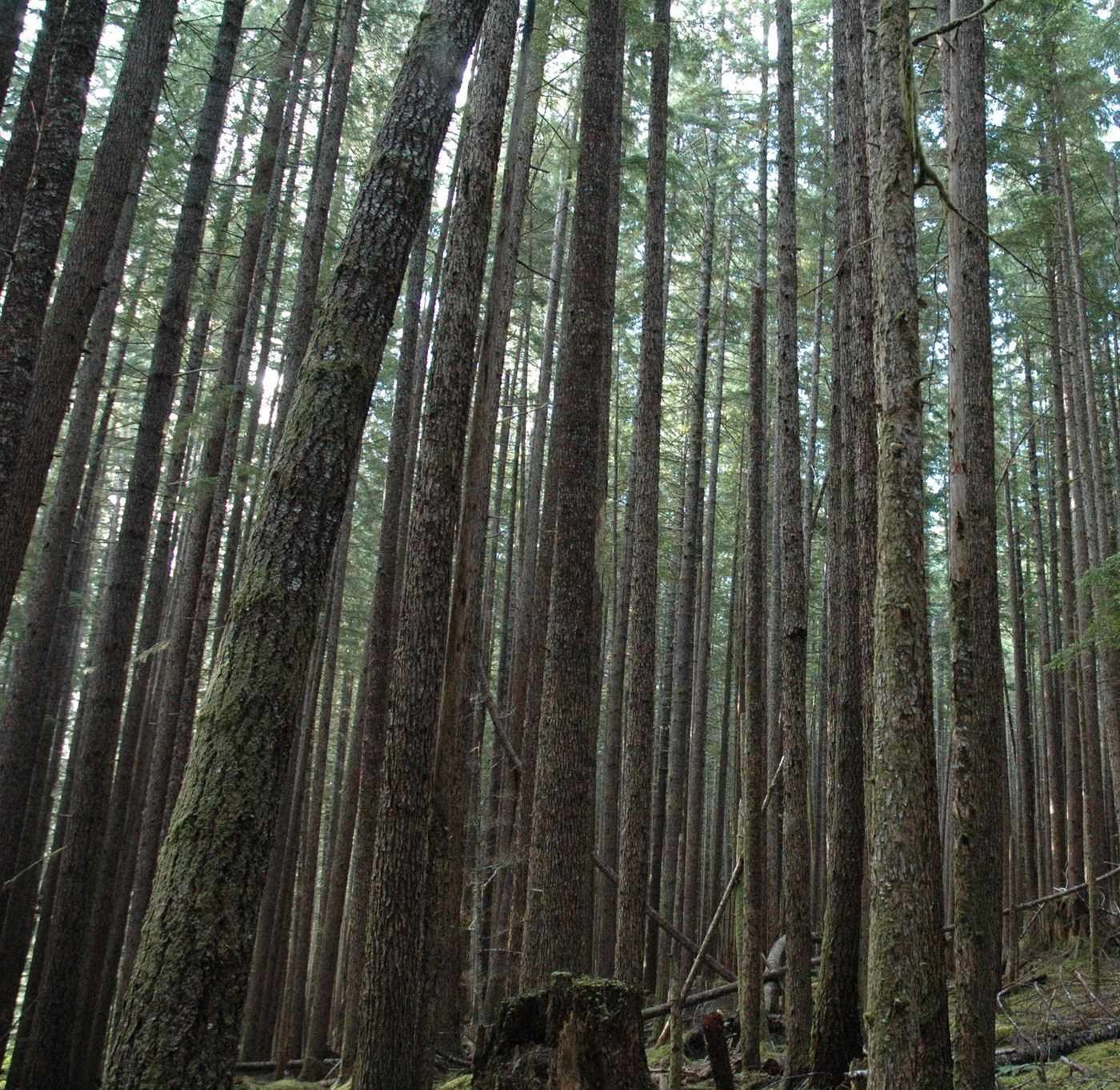
Okay, but not long because there are definitely stories still for sure. If you haven't checked it out, check it out at RadioLab.org. We're really proud of it. I'll be rescue you from this awkward situation by bringing you back to Radio Lab where I'd like to begin by building a tall, dark, dense, green forest.
Towering trees to your left. I need a bird, not a lot of birds actually, and a little wind. Do you mean sound? Yeah, birds please.
Birds. Why? We haven't even started this. Why?
I want wind birds. I'm not like your sound puppet here. But I can't. How do I?
Alright, never mind. This story. You'll get your sound at some point. Begins with a woman.
At the time actually, she was a very little girl who loved the outdoors. And I mean, really loved the outdoors. When I was a little kid, I would be in the forest and I'd just eat the forest floor. And I know lots of kids do that, but I was sorry.
Did you mean you got down on all fours and just... Yeah, I would just eat the dirt. This is Suzanne Simard. And so my mom always talks about how she had to constantly be giving me worm medicine because I always had worms.
She's a forestry professor at the University of British Columbia. I might as well start the story back when she was a little girl. Well, when I was a kid, I grew up in the rainforest of British Columbia and my family spent every summer in the forest. And her family included a dog named Jiggs.
And so in this particular summer when the event with Jiggs happened... What kind of dog is Jiggs, by the way? He was not a wiener dog. He was a...
You don't know what your dog was? Not a basset hound, but he was a beagle. Beagle. Yeah, he was a curious dog.
And on this particular day, she's with the whole family. They're all out in the forest. It was summertime. And Jiggs at some point just runs off into the woods, just maybe to chase a rabbit, whatever.
Couple minutes go by. And all of a sudden we could hear this barking and yelping. And we were all like, oh my goodness, Jiggs is in trouble. And so the whole family and uncles and aunts and cousins, we all rush up there.
But they follow the sound of the barking and it leads them to an outhouse. And when they go in... And there is Jiggs at the bottom of the outhouse. Probably six feet down at the bottom of the outhouse pit.
Oh dear. Where we've all been, you know, doing our daily business. Yeah. He'd fallen in.
He's looking up at us quite scared and very unhappy that he was covered in toilet paper. And of course we had to get Jiggs out. I mean, Jiggs was part of the family. Yes.
And since he was so deep down in there, we had to dig from the sides. To sort of like widen the hole. Basically expanding it from a kind of a column of a pit to something that we could actually grab onto his front legs and pull them out. And so we're digging away.
And Jiggs was, you know, looking up with his paws, you know, and looking at us waiting. And they're digging and digging and digging. And all of a sudden, she says she looks down into the hole. She says she looks down into the ground and she notices at all around them where the soil has been cleared away.
There are roots upon roots upon roots in this thick, crazy, tangle. We're sitting on the exposed root system, which is like, it is like a mat. It's just a massive mat of intertwining exposed roots that you could walk across to never fall through. She says it was like this moment where she realizes, oh my God, there's this whole other world right beneath my feet.
Jiggs had provided this incredible window for me, you know, in this digging ex-capade to see how many different colors they were, how many different shapes there were that they were so intertwined as abundant as what was going on above ground. It was magic for me. Well, what's the end of the story? Did Jiggs emerge?
Jiggs emerged. We pulled Jiggs out and we threw him in the lake with a great deal of yelping and cursing and swearing, and Jiggs was cleaned off. But that day with the roots is the day that she began thinking about the forest that exists underneath the forest. Now, if you fast forward roughly 30 years, she then makes a discovery that I find kind of amazing.
She's working in the timber industry at the time. This is by the way what her entire family had done, her dad and her grandparents. And when I came on the scene in 1980s as a forester, we were into industrial large-scale clear-cutting in western Canada. Huge machines, loaders and cats.
She says a timber company would move in and clear-cut an entire patch of forest and then plant some new trees. And my job was to track how these new plantations would grow. And she says she began to notice things that, you know, one wouldn't really expect, like trees of different species are supposed to fight each other for sunshine, right? Yeah, absolutely.
And they have to... They shade each other out. They push each other away so they can get to the sky. But she was noticing that in a little patch of forest that she was studying, if she had, say, a birch tree next to a fir tree.
And if she took out the birch... The Douglas fir became diseased and died. There was some kind of benefit from the birch to the fir. There was a healthier community when they were mixed and I wanted to figure out why.
Well, of course, there could be a whole number of reasons why, you know, one tree is affected by another. But she had a kind of, maybe a jig-zion recollection. Blackback. Yes, because she knew that scientists had proposed years before that maybe there's an underground economy that exists among trees that we can't see.
And she wondered whether that was true. And so I designed this experiment to figure that out. It was a simple little experiment. So you had to get a tree in the forest, got some trees.
Douglas fir birch and cedar. And then I would cover them in plastic bags. So I'd seal the tree in a plastic bag and then I would inject gas, so tagged with an isotope, which is radioactive. So these trees were basically covered with bags that were then filled with radioactive gas, which the trees would suck up through photosynthesis.
So now they had the radioactive particles inside their trunks and their branches. We had a Geiger counter out there. As soon as we labeled them, we used the Geiger counter to run it up and down the trees and we could tell that they were hot. And the idea was she wanted to know, like once the radioactive particles were in the tree, what happens next?
Were they in the tree or were they going down to the roots? And then what happens? And what she discovered is that all these trees, all these trees that were of totally different species were sharing their food underground. Like if you put a food into one tree over here, it would end up in another tree maybe 30 feet away over there.
And then a third tree over here and a fourth tree over there and a fifth tree over there, sixth, seventh, eighth, ninth, tenth, eleventh. All of them all turned out one tree was connected to 47 other trees all around it. It was like a huge network. And we were able to map the network.
And what we found was that the trees that were the biggest and the oldest were the most highly connected. And so we've identified these as kind of like hubs in the network. And when you look at the map, what you see are circles, sprouting lines and connecting to other circles, also sprouting lines. And it gives you a lot like an airline flight map.
But even more dense. It's an incredible communications network that people had no idea about in the past because we didn't know how to look. It's definitely crazy. I mean, you're out there in the forest and you see all these trees and you think they're individuals just like animals, right?
But no, they're all linked to each other. This is Jennifer Phasier. She's a science writer. And I write a blog called The Artful Amoeba at Scientific American.
I like your title. Thank you. I spoke to her with our producer, Luddef Nasser. And she told us that this network has developed a kind of a nice, punny sort of name.
The Wood Wide Web. The Wood Wide Web. I mean like the World Wide Web. It's not the Wood Wide Web.
It sounds a little bit like an over-foot. The Wood Wide Web. So this Wood Wide Web. Is this just like the roots like what you saw in the outside?
No, no, no, no. It's far more exciting than that. And sophisticated and interesting and astonishing. What?
It involves a completely separate organism. I haven't mentioned yet. I mean, this is going places. What?
We check where we go. I'm not going to tell you. I'm going to just go there. We might look for ourselves.
I don't know where you were that day. Animque and Stephanie Tam are intern. And he's our producer. We decided also to check it out for ourselves.
This thing I'm not telling you about. We went to the Bronx to the botanical gardens. That's how far you have to travel to New York to get to actual greener. Actually, there was a beautiful green sword in New York has.
And when we went up there, there was this tall man waiting for us, an expert. Is that Roy? That is. Roy.
His name is Roy Howing. And Roy, by the way, comes out with this strange, it's like a rake. He's their trowel. It has like an expandable, uh, uh, it's a truffle rake, but which in extent, oh, listen to that.
Oh, that sounds dangerous. So we're up there in this old forest with this guy. So there's an oak tree right there. It should have some.
And he starts digging with his rake at the base of his tree. He shoves away the leaves. He shoves away the topsoil. And the tree feel you're ripping the leaves out like that.
And so now we're down here, pulled out a sapphire root. It's just getting started. They're called feeder roots. We're carefully examining the roots of this oak tree on our knees with our noses in the ground.
And we can't see anything. I don't mean I see the dirt. You're changing white yet? You can see anything.
It's early in the season. He says something about that's the wrong season. I thought, okay, so this is just stupid. But then, finally, he gives us a magnifying glass.
You want those little jewelers glasses hand held? Have a look there. And he hands it to hand. Wow.
You see it? Oh yeah. Do you like it? Oh my gosh, I do see them.
What do you think? Little white threads attached to the roots smaller than an eyelash. Maybe just a tenth of the width of your eyelash. But white translucent and hairy sort of.
And while it took us a while to see it, apparently these little threads in the soil. They're everywhere. And when you measure them, one study we saw found up to seven miles of this little threading. And a pinch of dirt.
What? A pinch. Mm-hmm. What is a thing?
Is it like a plant? What is it? What kind of creature is this thing? Yes, what is it?
This is the funness. Which by the way is definitely not a plant. We've been in the category and for a long time they were thought of as plants. But now we know after having looked at their DNA that fungi are actually very closely related to animals.
They're one of our closest relatives actually. Now back in the day. This all has a history of course. When people first began thinking about these things, we're talking in the 1600s.
They had no idea what they were or what they did. But ultimately they figured out that these things were very ancient because if you look at 400 million year old fossils of some of the very first plants. You can see, even in the roots of these earliest land plants. You can see those threads.
This is a really ancient association. And then later scientists finally looked at these things under much more powerful microscopes. And realized the threads weren't threads really. They were actually tubes.
Hollow. These little tubes. Tubes. And the tubes branch and sometimes they reconnect.
So there seemed to be under the ground this fungal freeway system connecting one tree to the next, to the next, to the next. People speculated about this but no one had actually proved it in nature in the woods until Suzanne shows up. And there was a lot of skepticism at the time. But over the next two decades we did experiment after experiment after experiment that verified that story.
Why is this network even there? Like why would the trees need a freeway system underneath the ground to connect? And why would the fungi want to make this network? Why are they going to this trouble of creating this big network?
Yeah. Well, they do it because the tree has something the fungus needs and the fungus has something the tree needs. Let me just back up for a second so that you can set the scene for you. When you go into a forest you see a tree, a tall tree.
So what does the tree do? What's its job? It's job. It soaks in sunshine.
It takes the CO2 out of the air carbon dioxide which has of course carbon C in it. Oxygen. Yeah. And it keeps the sea.
Carbon which is science-speak for food. It's a tree that's stored into sugar which it uses to make its trunk and its branches. Anything thick you see on a tree is just basically air made into stuff. Carbon and sugar are the same thing?
Yeah. You can think of the carbon as basically the sugar that builds the tree. However, if that's all they had was carbon, it'd only be this tall. That's Roy again.
He's holding his hand maybe a foot off the ground. It'd be a teeny tree. It would be smaller. So if all the tree could do is get carbon from the air, you'd have a tree the size of a tulip.
A floppy tulip. Huh. A tree needs something else. And what a tree needs are minerals.
Minerals from the soil. Very similar to the sorts of vitamins and minerals that humans need. What kind of minerals does a tree need? Like nitrogen and phosphorus.
Magnesium. Potassium and calcium and copper. Why? What do these do for the tree?
I can I tree stand up straight without minerals or can... It can't. No. So for example, lignin is important for making a tree stand up straight and lignin is full of nitrogen.
But also compounds like nitrogen is important in DNA, right? It's an integral part of DNA. Well, into like crucial. If I want to be a healthy tree and reach for the sky, then I need rocks in me.
Somehow liquid rocks. You do. You need the nutrients that are in the soil. And that's where the fungus comes in.
The fungus has this incredible network of tubes. That's it's able to send out through the soil and drop water and mineral nutrients that the tree needs. Wait, I thought tree roots just sort of did. Like I thought I always imagined tree roots were kind of like straws.
Like the tree was like already doing that stuff by itself. But it's the fungus that's doing that stuff? Yes. In a lot of cases it is the fungus because tree roots and a lot of plant roots are not actually very good at doing what you think they're doing.
She says the tree can only suck up what it needs to do these mostly to the teeny tips of its roots. And that's not enough bandwidth. Wait, so the fungus is giving the tree the minerals. What is the tree giving back to the fungus?
Remember I told you how trees make sugar. Yeah. So that's what the tree gives the fungus. The fungi needs sugar to build their bodies the same way that we use our food to build our bodies.
They can't photosynthesize. They can't take up CO2. And so they have this trading system with trees. She says, what will happen under the ground is that the fungal tubes will stretch up toward the tree roots and then they'll tell the tree.
With their chemical language. I'm in the neighborhood. Can you soften your roots so that I can invade your root system? And the tree gets the message and it sends a message back and says, yeah, I can do that.
I can start softening up my cell walls and make room for you. And then those little tubes will wrap themselves into place. It's a little bit of a little rice thread. You can see the white stuff is the fungus.
And we saw this in the Bronx. The little threads just wrapping themselves around the tree roots. The last part of the root is tangled around the edge. And it's in that little space between them that they make the exchange.
What exchange would that be, Robert? That would be sugar. Minerals. Sugar.
Minerals. Sugar. Minerals. Sugar.
Minerals. Sugar. Minerals. Sugar.
Minerals. Sugar. Minerals. And so on.
Well, that's a miracle. That's like, that is, I got to say, doing the story. This is the part that knocked me silly. We'll be right back.
Hello, this is Ricardo from Beautiful Monroe, New York. Radio Lab is supported in part by the Alfred P. Sloan Foundation, enhancing public understanding of science and technology in the modern world. More information about Sloan at www.slone.org.
Each story you hear on Planet Money starts with a question. What happens if we refund tariffs? Why are groceries so expensive? At NPR, we stand for your right to be curious.
Because the forces shaping our world can be hard to see. Follow NPR's Planet Money wherever you get your podcasts and start seeing how the economy really works. I'm Jack O'Rone. I'm Robert Goldwich.
This is Radio Lab. So what was the answer to my question about how does the fungus get the minerals? Oh, it's a three-pronged answer. What a fungus does is it hunts, it mines, it fishes, and it strangles.
What? How the hell the hell? I'm not making this up. In 1997, a couple of scientists wrote a paper which describes how fungi have developed a system from mining.
What the tubes do is they worm their way back and forth through the soil until they bump into some petals. These little soil particles? Pockets of minerals. And then they secrete acid, and these acids come out and they start to dissolve the rock.
It's like they're drilling. And the fungus actually builds a tunnel inside the rock. It can reach these little packets of minerals and mine them. What?
If you look at these particles under the microscope, you can see the little tunnels. They curve, sometimes they branch, they look just like mining tunnels. This is very light if you had a little helmet with a light on it, like a human. Yeah, maybe not with a helmet.
No whiteness of tubes or something like that. And that's just the beginning. Jennifer told a lot of tonight about another role that these fungi play. And that's hunter.
Hunter. What do you mean like the plant is hunting? Oh, no. I mean for water.
The fungus is hunting. The fungus is hunting. How do you mean? So they're the little insects that live in the soil.
It's just adorable little creatures called springtails. They're sort of fleasized and they spend lots of time munching leaves on the forest floor. They're called springtails because a lot of them have a little organ on the back that they actually can kind of like deploy and suddenly they spring way up high in the air. In the David Attenborough version, if you want to look on YouTube, he actually takes a nail.
This pin will give you an idea. He'll poke it at this little springtail and the springtail. And don't see it anywhere. It's gone into the air.
Then of course, because of the V.C. they take a picture of it. It's doing like a triple-double-axle backflip or something into the sky. It's the equivalent of a human being jumping over the Eiffel Tower.
There you have it. One of the things they eat is fungus. But then scientists did an experiment where they gave some springtails some fungus to eat. They sort of put them all together in a dish and then they walked away.
And then they came back. And they found that most of the springtails were dead. Instead of eating the fungus, it turns out the fungus ate them. In the little springtail bodies, there were little tubes growing inside the wood.
And this is what makes it even more gruesome. They somehow have a dye. Don't ask me how they know this or how they figured it out. But they have a little stain that they can put on the springtails to tell if they're alive or dead.
When they did this, they saw that a lot of the springtails that had the tubes inside them were still alive. Oh, that's cruel. Yes. The fungus were literally sucking the nitrogen out of the springtails.
And it was too late to get away. No link anymore. And then they did experiments with the same fungus that I'm telling you about that was capturing the springtails. And they hooked it up to a tree.
To try to calculate how much springtail nitrogen is traveling back to the tree. Well, 25% of it ended up in the trees. So they figured out who paid for the murder. The trees did.
Yes. Is there anyone who's job is to draw little chalk outlines around the springtail? Inspector tail is his name. He's the only springtail with a trench coat and a fedora.
That's crazy. I can go better than even that. They have found salmon in tree rings. As in the fish.
In the tree? In a way. Apparently bears park themselves in places and grab fish out of the water and then take a bite and throw the carcass down on the ground. The fungi, after it's rained and snowed and the carcass seeped down into the soil a bit, the fungi then go and they drink the salmon carcass down and send it off to the tree.
Oh, fuck off. That's evidence of an animal. I was like, whoa. That's insane.
Salmon rings in tree. That's insane. Look, and there are forests that we are trees that designed as a found. We're up to 75% of the nitrogen in the tree turned out to be fish food.
From just bears throwing fish on the ground? If you would take away the fish, the trees would be blitzed hobble really. Is it as dramatic in the opposite direction? The fungus would be given the trees a lot of minerals.
From the trees perspective, how much of their sugar are they giving to the fungus? I asked who's in about that. 2% or .00001% or? No.
People have been measuring this in different forests and ecosystems around the world. The estimate is anywhere from 20 to 80% will go into the background. What? 20 to 80%.
The tree goes down to the mushroom theme. Into the roots and then into the microbial community which includes the mushroom team. The point here is that the scale of this is so vast. We didn't know this until very, very recently.
You have a forest, you have mushrooms, now it turns out that they're networked. Together they're capable of doing things, of behaviors, forrestrial behaviors that are deeply new. We're just learning about them now, and they're so interesting. Just for again.
Let's say it's times are good. The tree has a lot of sugar. I don't really need it all right now. I'll put it down in my fungi.
And then when times are hard, that fungi will give me my sugar back. And I can start growing again. The fungi will give me my sugar back. It's like a seed.
It is like a bank. She says we now know the trees give each other loads. Oh yeah, back and forth. Seasonally.
They can also send warning signals through the fungus. Yeah, so we've done experiments in other people in different labs around the world. They've been able to figure out that if a tree's injured. It'll cry out in a kind of chemical way.
And those chemicals will then move through them that we're getting worn, neighboring trees or seedlings. That's something bad is happening. I'm under attack. There's an enemy in the mist.
So if a beetle were to invade the forest, the trees tell the next tree over. Here come the people revere, sort of. Yes, that seems to be what happens. So you can see this is like a game of telephone.
One tree goes, oh, oh, oh, oh, oh, oh, oh, and then they do stuff. They start producing chemicals that taste really bad. So the beetles don't want to eat them. We go, egh, I don't want that.
One of the spookiest examples of this, Suzanne mentioned, is an experiment that she and her team did, where they discovered that if a forest is warming up, which is happening all over the world, temperatures are rising. You have trees in this forest that are hurting. They don't do well in warm temperatures and their needles turn out sickly yellow. They will say, no, this is not so good.
Signal through the network. But also. The other important thing we figured out is that as those trees are injured and dying, they'll dump their carbon into their neighbors. So carbon will move from that dying tree.
So its resources, its legacy will move into the micro-islenetwork into neighboring trees. Oh, so it says to the newer, the healthier trees, here's my food. Take it, it's yours. Or it could be like, OK, I'm not doing so well, so I'm going to hide this down here in my my ceiling.
I don't know if you're a bank or if you're not. So it's not necessarily saying, give it to the new guy. We don't know. I mean, again, it's a tree.
I'm just trying to say, I understand. I realize that none of these conversations are actually spoken. Give it to the new guy. Give it to the new guy.
That's what she's saying. Yes, yes. Suzanne says she's not sure if the tree is running the show and saying like, give it to the new guy. Or maybe it's the fungus under the ground.
It's kind of like a broker and decides who gets what. You know, I don't completely understand. She says, one of the weirdest parts of this though is when sick trees give up their food. The food doesn't usually go to their kids or even the trees are the same species.
What the teen found is the food ends up very often with trees that are new in the forest and better at surviving global warming. It's as if the individual trees were somehow thinking ahead to the needs of the whole forest. So we know that Douglas fir will take a dying Douglas fir will send carbon to neighboring Ponderosa pine. And so why is that?
So and I think that the whole forest then there's an intelligence there that's beyond just the species. Wait a second. Wait a second. You just used a very interesting word.
I know Robert, I have to, you know what, it's 10 o'clock. I have to go. All right. I'm so interested.
But I have to. Unfortunately, right at that point Suzanne basically ran off to another meeting. Hello Suzanne speaking. Oh, there you are.
Hi Robert. We did catch up with her a few weeks later. When we last left off, I'm just saying you just said intelligence. Now isn't, doesn't, don't professors begin to start falling out of chairs when that word gets used regarding plants?
Yes. We don't normally ascribe intelligence to plants and plants are not thought to have brains. But when we look at the below ground structure, it looks so much like a brain physically. And now that we're starting to understand how it works, we're going, wow, there's so many parallels.
I do find it magical. I think there is something like a nervous system in the forest because it's the same sort of large network of new plants. It's almost as if the forest is acting as an organism itself. You know, they talk about how honeybee colonies are sort of superorganisms because each individual be sort of acting like it's a cell in a larger body.
Once you understand that the trees are all connected to each other, they're all signaling each other, sending food and resources to each other. It has the feel, the flavor of something very similar. Special thanks to Dr. Theresa Ryan of the University of British Columbia faculty of forestry to our interns, Tefany Tam, Roy Halley of the New York Botanical Garden, the Stevenson Swansons, and the University of Columbia.
Thank you, Dr. Jordan, the Stevenson Swansons there, and to Annie McEwen and Ben Affairal who both produces this piece. Thank you. Alright, go with it.
Okay, it's time for us to go and lie down on the soft forest floor. Yeah, and may hopefully not be liquefied by the fungus beneath us. Bye, I'm Robert Colwich. I'm Jack Ebonrod, the Radio Lab.
Thanks for listening. This is Roy Halley, researcher specializing in fungi at the New York Botanical Garden. This is Jennifer Fraser, and I'm a freelance science writer and blogger of the Artful Amita at Scientific American. Radio Lab is produced by Jack Ebonrod.
By Jack Ebonrod. Doing Keith as our director of Sound Design. Lauren Wheeler, senior editor. Your New York is our senior producer.
Our staff includes Simon Adler, Brenna Feral, David Gebel. Matt Keelty, Robert Colwich, Annie McEwen, Andy Mills, Litties Nasser, Melissa O'Donnell. Kelsey Padgett, Ariane Wack. I'm Molly Webster.
With help from Alexandria Lee Young, Jackson Rooch, and Cheru Sinha. Our fact-truckers are Eva Dasher, Emma Phil Harris. And remember, if you're a springtail, don't talk to strange mushrooms. Actually, that's a good advice for anyone.
Thank you. Bye. In this message...