
EPISODE · May 16, 2026 · 13 MIN
Fundamentals of Investing — Episode 8 — Planning for Retirement, the Honest Way
from The Unlearned Investor Podcast · host The Unlearned Investor
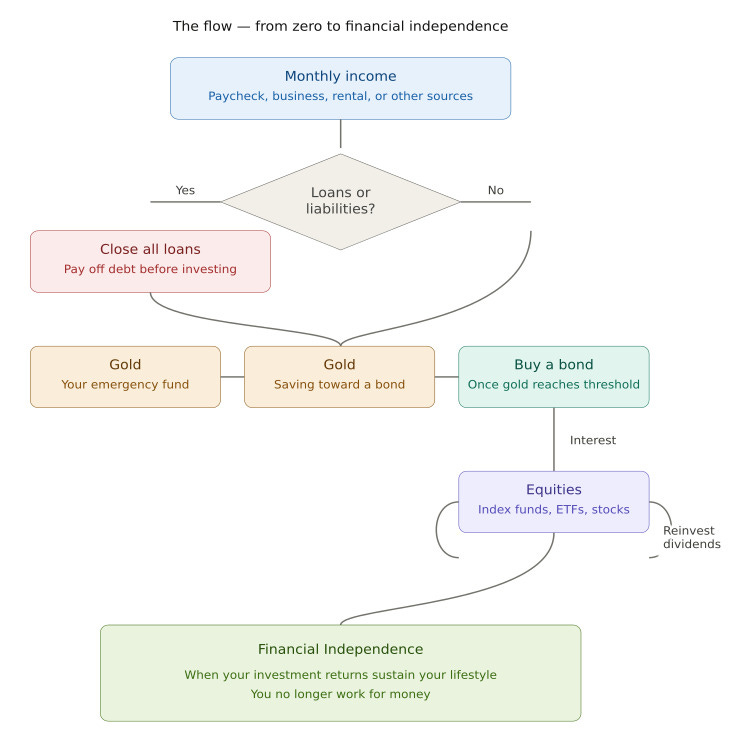
A 65-year-old retired schoolteacher with a steady pension can put 100% of her savings into stocks tomorrow.A 25-year-old software engineer earning twice her income probably shouldn’t.If that sentence made you stop and re-read it — good. Most of what you’ve been told about retirement planning starts with a number — your age — and works backwards. Subtract your age from 100. That’s how much you should keep in equity. The rest goes to bonds. Clean. Tidy. Wrong.Here’s the conventional wisdom you’ve probably absorbed without realising it. The young should take risks. The old should play safe. There’s even a famous formula. The 100-Minus-Age Rule — subtract your age from 100, and that’s your equity percentage. A 30-year-old gets 70% equity. A 70-year-old gets 30%.Beautifully simple. It also quietly assumes everyone the same age has the same life. The same income. The same debts. The same family backing. The same fears.Real life doesn’t work that way.1. Four People, Four Very Different MapsForget age brackets. Here are four situations that actually matter.The Loaded-with-Loans Mid-Career Earner. Forty-ish. Decent salary. A home loan, maybe a car loan, possibly a personal loan from a few years ago. The instinct says — start investing aggressively to catch up. The math says — close the loans first. Paying off an 18% loan is a guaranteed 18% return. No equity portfolio reliably beats that. Pay off the loan. Then talk about investing.The 21-Year-Old with No Backing. Just started earning. No safety net. No parents to fall back on. One job, one paycheck. The goal here isn’t growth — it’s a foundation that won’t crumble. We’ll get to exactly how to build it in the next section.The 30-Something with No Loans, No Backing. Single income. No debt. Decent savings discipline. But no parental safety net, no fallback if the job disappears. Same foundational principles apply — just starting from a stronger base.The Cushioned Investor. A retired schoolteacher with a monthly pension covering her expenses. Or a senior executive with multiple income streams. Or anyone whose daily life is already paid for by something that isn’t their portfolio. These investors can go heavily into equity even in their sixties. Their bills don’t depend on the market. A 50% crash doesn’t touch their groceries.Four people. Four different ages. Four very different allocations. And it all boils down to one fundamental question.Are you going to eat out of your portfolio?If yes — if you need your investments to pay your rent, your bills, your medical costs — then you cannot afford to lose them. You need stability, predictability, capital preservation.If no — if your daily life is funded by something else entirely — then you can let your portfolio swing wildly without it touching your life. You can take risk. You can ride out crashes.This is the difference Wall Street calls risk tolerance vs. risk capacity.Risk tolerance is how much volatility your emotions can handle. Can you sleep when your portfolio drops 30% in a month?Risk capacity is how much volatility your life can handle. Can your bills get paid if your portfolio drops 30% in a month?Most retirement advice optimises for risk tolerance — basically asking “how brave do you feel today?” Bravery dies fast in a real crash. What survives is structure. Risk capacity is the structural question. And risk capacity should drive your allocation — not age, not vibes, not Instagram.2. The Emergency Fund — Why I Disagree with EveryoneEvery personal finance article tells you the same thing. Park your emergency fund in cash. Keep three to six months of expenses in a savings account or a low-risk bond fund.I think both options are quietly broken.Cash in the bank doesn’t beat inflation. I covered this in Episode 2 — inflation eats your money in the background, every single day. Your savings account pays you maybe 3% or 4% interest. Inflation runs at 5% or 6%. Your “safe” emergency fund is silently shrinking. Every year you have to top it up just to maintain the same purchasing power. You’re not building a cushion. You’re refilling a leaky bucket.Bonds aren’t safe enough for an emergency fund either. Yes, the risk is small. But it isn’t zero. Bond prices fall when interest rates rise. Companies default. Even government bonds can have bad years. And the yields, after inflation, often barely keep up. An emergency fund needs to be available and preserved. Bonds compromise on both.So where does an emergency fund actually belong?Gold.Hear me out. Gold isn’t a “growth” asset — it doesn’t aim to make you rich. Its job is something else entirely. Gold keeps pace with inflation. When your currency loses value, gold catches up. When the cost of groceries doubles over a decade, gold roughly doubles too. The emergency fund you stored in gold can still buy you six months of groceries — ten years from now.The history is on my side here. I’ve covered it in detail in my gold series — gold has been money for five thousand years. Currencies have come and gone. Empires have fallen. Banks have collapsed. Gold has just sat there, doing its job — quietly preserving value.Yes, gold has down years. It’s volatile in the short term. But for an asset you’re holding for emergencies — not selling on a Monday afternoon for a quick profit — that volatility doesn’t matter. What matters is that the purchasing power survives.Cash leaks. Bonds wobble. Gold endures.That’s why every time I say “emergency fund” in this article, I mean gold — physical gold or a physically-backed gold ETF. Not cash. Not bonds.3. The Journey — From Zero to Financial IndependenceHere’s the full flow I follow for anyone starting out. The chart below shows it in one picture. Let me walk you through it.It all begins with monthly income. A paycheck, business income, rental income, pension, royalties, side hustle — whatever the source, you need something coming in every month. No income, no investment plan. That’s not a finance principle — that’s just math.The first question — do you have loans or liabilities?If yes — high-interest personal loans, credit card debt, car loans — pay them off before anything else. No investment plan survives high-interest debt. Paying off an 18% loan is an 18% guaranteed return. No equity portfolio reliably beats that. No bond comes close. Until that debt is gone, every dollar you invest is fighting a losing battle against compounding running in reverse. (Long-term, low-interest home loans are a separate conversation — strategic debt, not destructive, as we covered in Episode 3.)If no — skip ahead. You’re ready to start building.Build the emergency fund in gold. Three to six months of expenses, parked in gold. Not because you’ll spend it casually — because if life throws something brutal at you, that fund will still buy you what it was meant to buy six months of, even ten years later.Keep saving in gold, but with a new target. Once the emergency fund is full, don’t stop accumulating gold. Keep adding to it — but now you’re saving towards a different goal. The minimum amount you need to buy a meaningful bond — a government bond, a corporate bond, or a bond fund unit.Buy the bond. Once the gold pile crosses the threshold, sell the chunk you need and buy your first bond. Now you have two assets working for you. Your emergency fund is intact. Your bond starts paying you interest.Send bond interest into equities. This is where the engine starts humming. The interest your bond pays doesn’t go back into cash. It doesn’t get spent. It goes directly into equities — index funds, broad ETFs, or carefully researched individual stocks (Episode 6 and 7 covered all of these). Your safe asset is now feeding your growth asset.Reinvest equity dividends back into equities. Whatever dividends your equity holdings pay, plough them right back into more equities. This is compounding doing its quiet, ruthless work.Keep the engine running. Stay in the cycle. Keep adding to gold. Keep buying bonds when the gold accumulates enough. Keep routing every bond’s interest into equities. Keep reinvesting every dividend. Each piece feeds the next.At some point — and this might take a long, long time — your bond interest alone will start covering a meaningful chunk of your monthly expenses. Keep going.Then, at some other point — further along the road — your combined investment returns will be enough to fully sustain your lifestyle. Bond interest plus equity dividends plus modest equity growth — together, covering rent, groceries, bills, the occasional holiday.This is the moment I call Financial Independence. You no longer have to work for money. You can keep working if it brings you joy — most people do — but money is no longer the reason you show up. That’s the real prize. Not retirement. Not a yacht. The freedom to do what gives you joy without checking your bank balance first.4. The Tortoise LessonThe fastest way to build wealth is to build it slowly.Read that again. It’s not a contradiction — it’s the entire game. Every decade produces a fresh crop of investors who got rich quickly. Almost all of them give it back. Meanwhile, the people who quietly compounded across the same decades did the boring thing — paid off debt, kept their emergency fund in gold, bought bonds when they could, routed every cent of interest into equities. They didn’t win because they were fast. They won because they kept showing up.Markets reward presence. Thirty years of being there beats three years of being right.The Bottom LineYour age doesn’t decide your allocation — your situation does. Ask the one question that matters — am I going to eat out of this portfolio? Close your loans first, then build your emergency fund in gold — not cash, not bonds. Run the cycle — gold to bonds, bond interest to equities, dividends back to equities. Stay in it long enough, and one day you’ll find yourself financially independent — free to work because you want to, not because you have to.In the next episode, we’ll cover the popular terms in finance and investing you need to understand before you start putting money to work — the jargon Wall Street uses to make simple things sound complicated, translated into plain English.DISCLAIMER: I am not a financial advisor. This is for educational purposes only. Always do your own research and speak with a certified financial professional before making investment decisions. Get full access to The Unlearned Investor at unlearnedinvestor.substack.com/subscribe
Embed this episode
NOW PLAYING
Fundamentals of Investing — Episode 8 — Planning for Retirement, the Honest Way
No transcript for this episode yet
Similar Episodes
No similar episodes found.
Similar Podcasts
No similar podcasts found.