
Oh wait, you're listening to Radio Lab from WNYC. So in a nutshell, this story starts with a sheep that provokes a goose which goes to rats and bees, but especially most recently to a snail that eats fish. Okay. Okay.
Okay. Okay. I mean, I don't need to tell the story. You got it.
No, I just am like, I'm ready. Okay. We're following. Is that a food chain?
No. The sheep provokes a goose and the goose has gone to rats and bees, but especially most recently has gone to a snail that eats fish. I need it one more time. I need one more time.
All right. I am Lulu Miller. I'm not. If not, sir, this is Radio Lab.
And today I'm going to walk you, Lulu, through that little riddle animal by animal, which is actually a journey through some science that sounds silly, but actually has the ability to completely change what you feel. And how you feel? Literally. Okay.
So start with the sheep. Okay. But to actually get to the sheep, we got to start with a guy. Members and guests, the honorable William Proxmire, Senator from Wisconsin.
William Proxmire, Democrat from Wisconsin served over 30 years, 1957 and 1989. He was tall, athletic, people knew him in the Senate as a maverick, as a champion of the people as a quote, friend of the little guy. Thank you, Andy. I very much appreciate that that gracious introduction wasn't long enough, but it was a great one.
And Proxmire earned this reputation for a lot of different reasons. For one, for a while you had not missed a vote. I haven't missed a vote since 1966. Always voted.
That's 22 years. Actually, he still holds the Senate record for number of consecutive votes, not missed. I just think he will elect it to be here and to vote and to do your job. He also couldn't stand money in campaigns.
That's not the way it ought to be. How people could just buy elections. It's wrong. During his last two campaigns, he refused campaign contributions and spent less than $200 out of his own pocket.
But the thing that Proxmire was really known for was he hated the government wasting taxpayer money, unnecessary stuff. But for the biggest in the brain, he would go after. That is disgraceful. We should be cutting that.
The military, the medical industry, tax dollars, we spend in agriculture. But even stuff like... Air Force One was a hundred and eighty million dollar plane. How his colleagues traveled.
Ridiculous. Often by private jet. They should travel coach, not first class coach. Even like his office.
It's different than a lot of scientists' room. Unlike his colleagues who would have the government pay for fancy furniture. There's a lot of standard government issues in this room. I don't pay much attention to a room I mean.
Maybe I should. The people are important. But the room doesn't and the decorations don't have to be a terrible interior decorator. And during his career, Proxmire got so fed up with the spending he saw all around him that to shame his civil servant colleagues who were doling out money.
He created this award. The Golden Fleece Award. Golden Fleece had a lot of appeal because Golden stands for the money rip off and Fleece for the fact that it is a rip off. That's your shape?
Yeah. Ever since 1975, March of 1975, every month I've given an award, a Golden Fleece, the most disgusting, revolting, repulsive, waste of the taxpayers' money by the federal government. And is this just like a fax? He came out in a newsletter that he would send out to everybody and including the press.
And this is just for any big project waste. Yeah, a lot of different government projects. A lot of them were these ridiculous sounding research projects. First Golden Fleece we gave to an agency that spent the first one went to the National Science Foundation.
Spent $83,000 and tried to find out why people fall in love. Which makes him seem like such a grinch, right? Yeah. But to him he was like, look, you could spend $10 million on this.
You'll never find out why people fall in love. And it's even they could give you the answer I want to know because the great thing about love is it's misty and much the science can weigh it and measure it and just say goodbye. Love is mysterious and that's how it should be forevermore. And then he gave one to the Agriculture Department for a $46,000 study of how long it takes to cook breakfast.
And then I gave it to an agency that spent $103,000 and tried to find out whether a sunfist at Finca Kila, more aggressive than Sunfist at drink in Sunfish. One to view a law enforcement assistance administration for a $27,000 inquiry into why inmates want to escape from prison. And he gave it to the Department of Agriculture for spending thousands of dollars to find out if you took pregnant pigs when they were confined in their pregnancy and required those pigs to jog an hour and a half day in a treadmill. With ease their tensions.
Well, we found out after several months of that the pregnant pigs wouldn't fall. And it just sort of goes on and on. He gave one to the Smithsonian for spending $89,000 to produce a dictionary of an obscure and unwritten Mayan language. One to the FAA for spending $57,000 to study body measurements of flight attendants.
And to the healthcare financing administration, which quote, clipped the taxpayer $45 million by allowing Medicare to flip the bill for cutting toenails. How do these things happen? That's the question. They happen because people come in and they'll spend $50,000, $60,000 before coffee in the morning.
And another $100,000 and they get goes on and on and on day after day after day. And pretty soon money loses all significance. And one way to get on top of that is to point out how utterly ridiculous and shameful it is to waste the taxpayers money in that way. I sort of think of him like our curmudgeonly watchdog.
Yeah. He's like the one paying attention to these studies that nobody else paying attention to. And he's calling people out. Totally.
You know, it's vital to have someone on the inside who's doing that. You're right. We do need watchdogs. We do need people to hold everybody accountable.
But you know what? The researching made fun of. It's actually very important. Okay.
So this is Alan. Alan Leshner and I am currently unemployed. Alan is kidding. He is retired after an illustrious career.
It was the CEO of the American Association for the Advancement of Science. He was the publisher of the Journal of Science. He held several leadership roles at the National Science Foundation. And then I ran two different institutes of the National Institutes of Health.
And at the time I became most aware of the Golden Fleece, I by then was at a fairly high level at the National Science Foundation. Actually, before we go too far, like, did you ever actually interact with William Proxmire? And if so, what was he like? Was he kind of a grump?
Actually, he could be very charming. I didn't know him personally that well, although I did have opportunity to have to sit across what you might think of as a witness stand as he interrogated me about why was the National Science Foundation supporting this weird stuff. And again, you know, the research he made fun of actually was terrific. I'm going to give you a couple examples.
Please do. OK. So for example, Alan said back in 1970s, the NIH, one of the things they were looking at was alcohol use on rats, which, you know, back then did it look funny to be studying alcoholic rats? It seemed a little weird, of course.
I was absurd. But we need to talk. And when Proxmire heard about it, he gave it a Golden Fleece and he said that it was, quote, an attempt to turn rats into alcoholics. But a lot of what we came to understand about alcoholism started with studies of rats.
Or. Now we had one that I want to tell you about. 1980, a Golden Fleece to the Federal Highway Administration. For spending over $240,000 to produce a computerized system that gives local directions to people who can't or won't read maps.
Think about that. That doesn't take any explanation at all. Right. I mean, just look at your phone.
I mean, it's just absurd. It's ridiculous. And Alan told me about one of my favorites. That actually predates the Golden Fleece word, but was constantly ridiculed in Congress.
The Department of Agriculture had a grant studying the sex life of the screwworm. Now, frankly, that sounds rather silly. But this screwworm is like a plague for cattle. And through this grant, they were able to figure out to sterilize it.
And probably has saved millions and millions. Of cows or dollars? Millions and millions of cows. Which is billions and billions of dollars.
But any time Alan tried to make his case, the Proxmire. He cut me right off and go to the next one. And Alan, he felt for Proxmire. He was looking to make the headline.
This was all just a publicity stunt. And his staff were very competent. They were very good at this. They could find these funny titles.
And every grant has a public abstract. So they'd read the abstract. They'd understand 10% of what it said. And then.
Senator William Proxmire hands out Golden Fleece awards. Proxmire would send out that newsletter with a new Golden Fleece award winner every single month to every major news outlet. And ridicule's grants to scientists. Often they would make national newspapers.
Wasting government money by studying why rats and monkeys quench their teeth. And Proxmire would boast about how his Golden Fleece awards would get funding cut from a lot of these projects. Proxmire bestowed one of his Golden Fleece awards on the scientists. That some projects would just completely fall apart.
And many scientists thought it ruined their careers. He gave out these awards every month for over 150 months in a row. So from 1975 to 1987. And then he retired in 1989.
The final question is, do you plan to take the Golden Fleece award with you as you leave the Senate? Or are you going to have a designated successor? Well, I hope that we can continue the Golden Fleece award in perpetuity. I'd love to have it continued, but I just don't know.
I think it's achieved something. And we have a nose. We need it. Even though Proxmire didn't end up choosing a successor and there is no longer such thing as the Golden Fleece award, Alan says.
Over the course of the last 30 years, Mr. President. Senator from New Hampshire. It's continued to live on.
Many policy makers, members of Congress. The amendment will prevent the waste of approximately $15.5 million. Have made the same kinds of mockery. On wasteful research involving sending Russian primates into space.
Of research projects that they don't understand. Let me repeat that because one may wonder why we're spending money to send Russian primates into space. I wonder that myself. This is crazy.
Your government spent half a million dollars to study Panamanian mail fraud calls. Really? Proxmire died in 2005. And I mean, he did a lot as a senator.
But I also think about how one of his essential legacies is that he made this template for going after basic science research. And if you think back to that first one. That was that in March of 1975. The very first Golden Fleece award.
Try to find out why people fall in love. You know, it's easy to make fun of love. Do we like love? Love is a very important phenomenon in human life.
People kill over love. People uproot their lives because of love. They start families because of love. What are the mechanisms?
What are the characteristics that make someone feel that they are in love or that they love someone? And to Allen, these questions in and of themselves, they are worth asking. Even if you don't know what the benefits are going to be because most or much of the time, you don't know what the ultimate benefit will be of basic research. And so to Allen, Proxmire and his Golden Fleece award fundamentally misunderstood how science works.
Like science, you don't know. That's the whole thing. Yeah. As an outsider, like you certainly don't know what is and isn't important.
But then even if you're on the inside of making a study, you don't know ahead of time what study is going to be a big breakthrough and what's not. Yeah, totally. Yeah. I feel like I heard this from my dad growing up all the time.
He's a scientist. Like you sprinkle the funds to test all the things. Its accident discoveries are often accidental and like that you have to like fund the whole endeavor and a lot of them won't work out. But that's part of science.
Right. Exactly. If you just say we're not investing in that because that question is too silly, then you don't allow for some answer that will lead to a new question that will lead to a bigger question that will lead to a bigger question. Like you're cutting off curiosity and ultimately that's an injustice to science.
And so what happened is in 2012, this congressman, Jim Cooper, he brought together all of these people from science foundations, organizations, universities, publications, they got together and we're like, you know what? We are sick of the legacy of the Golden Fleece, of politicians belittling our publicly funded research. And so you know what? You know what?
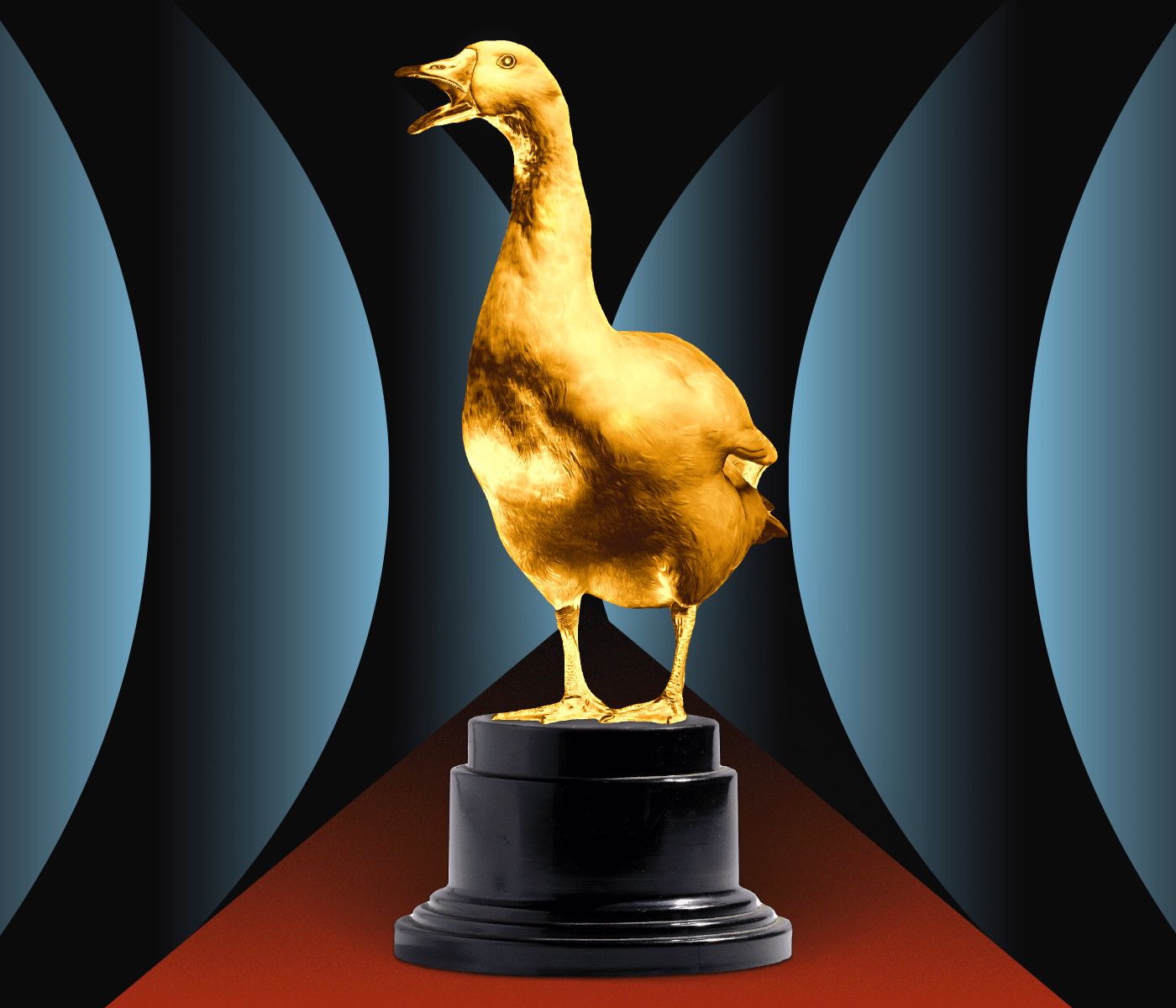
Screw you, Golden Fleece. We are making our own award. Thank you for joining us for the 11th annual Golden Goose Awards ceremony. The Golden Goose Awards.
Ah, ah, that's a goose. The award is in its 11th year. Okay, well there's a map. And so for the most recent one, we sent our producer, Maria Paz Gutierrez, to cover it.
Is this a bad big deal? I don't think so. I'm using science. It was held in Washington DC.
Hi. In a big fancy building near the Capitol. I'm asking people what they're wearing. What are you wearing?
That's a good question. I am wearing a suit. It's like mostly blue, but then there's the subtle light blue. It's a statement.
It's a window pane. Hello. Oh my God, so she's like Joan Rivers red carpeting. She's Joan Rivers red carpeting.
What are you wearing? Oh, I am wearing a pinstripe suit. Far out. And a flowery t-shirt, which matches my personality.
Yeah, a lot of outfits. What are you wearing? I'm wearing a tiger print paisley pants that are from J-Grew and brown livers. I'm going to like steal this outfit from the robot.
But away from the red carpet. Good evening, everybody. To the ceremony. So on the website they describe it in a very government like formal way, where it's like an award that would recognize the tremendous human and economic benefits of federally funded research by highlighting examples of seemingly obscure studies that have led to major breakthroughs and resulted in significant societal impact.
Seemingly obscure is maybe the- Yeah, so if I was writing that, it would be- Yeah, how would you write it? The award for studies that the US government funded that sounded dumb or frivolous at first, but turned out to change the world. Oh, okay, nice. The Golden Goose Award is honored over 70 researchers who have discovered remarkable solutions and treatments for a variety of illnesses and auto-immune disorders, led to foundational research which brought us COVID-19 vaccines and transformed society, as you've heard here tonight a little bit, with so many new technologies.
Okay, so quick recap. Started with the sheep, Golden fleece, which provoked a goose, Golden Goose, which has gone to bees and rats, which is to say bees and rats and rats. And which brings us to- Very first award this year goes to the story. The latest batch of award winners.
First one to these two researchers. Applying their principles of frugal science, they developed a paper microscope as you saw called the Foldscope. Foldscope? Incredible, right?
Yeah, it's a little microscope made out of paper and it's tiny little lands, it almost looks like a little bead and it all gets origamied together into a microscope. And microscopes this powerful usually cost thousands of dollars, but they made one for less than one, less than a dollar. That's phenomenal. The Foldscope has been used to diagnose infectious diseases, diagnose new species, identify fake drugs among many other applications.
So would you welcome Dr. Prakash and Dr. Sobolsky for this day? And this one is just- Our second award is- Wow.
After a graduate student at the University of Michigan. He was working in an optical, like a laser lab kind of thing, and late one night, he has an accident and gets laser flashed in one of his eyes. And he's like, oh my God, oh my God, I'm probably going to go blind. So he goes to see an ophthalmologist and the doctor's like, no, you're fine.
Didn't do anything wrong. I was totally fine. And then the two of them team up, bring on a bunch of their colleagues. Research collaboration, a remarkable collaboration resulted in the development of a bladeless approach to corrective eye surgery, also known as bladeless lacy.
What? That's the story of how lacy was invented? Yeah, bladeless lacy came from an accident. Wow.
And since then, over 20 million people have had the surgery. Wow. Okay, so- Our final recipient here this evening. It was this award winner where I was like, oh, yeah, come on.
We have got to do a story about this. It is just too good. That story, the end of our little Barnyard riddle, it's all coming up after the break. What's up?
What's up? Okay. So a sheep that provokes a goose that goes to bees and rats, but most recently to a snail that eats fish. Does it work for you?
Okay. So the story starts with this guy, Waldemaro Olivera. How should I refer to you? Are you a professor?
Yeah. Or is it just call me Toto? He goes by the name Toto. He goes by the name Toto.
Toto. How did you get that nickname, by the way? I grew up in the Philippines. And the Filipino term for little boys is Totoi with a Y.
But my cousin couldn't pronounce it. She would call me Totoi. And the nickname stuck. So Totoi grows up an only child in the Philippines.
My parents encouraged me to have hobbies. So I guess I started- So that you weren't bugging them, right? Right. Because I spent a lot of time alone.
And one of the things that Totoi did while he was alone was when he was nine years old, his dad would play tennis near his school. And so I'd meet him to hit your right home. And because he was the only child he would have to play with, he would just sort of sit by the side of the tennis court. It was sort of a clay court.
And in those days- In the Philippines, because I guess there's so many beaches there, what they would do is they'd gather up all of these seashells and then send them to tennis courts. And then crush the shells and then put the crushes over the court. So that was like the surface of the court. And so next to the tennis court, there'd be these huge piles of seashells.
So while I was waiting for my dad, I'd go through the pile and pick up interesting pretty shells- Take them home- And give the shells in cigar boxes. And over time it becomes this hobby where you go pick out these shells- I kind of felt like I was saving them from being crushed. His parents got him on a microscope. So I could look up them more- Look.
For beginning shell collectors. And cigar boxes in his room start to pile up. He's talking them under his bed. But then one day at the tennis court, his dad's playing.
Little totoes digging through this pile of shells. When he sees this one particular shell. Kind of like a tulip. Basically looks like an ice cream cone, but less than an inch.
And covered in these delicate lines. And so toto carefully picks up the shell. Because he knows from reading his books that the snail that used to live inside it- It's deadly. It's a killer.
Wait, what? Yeah, you don't expect that from a snail. So he was holding onto the shell of a cone snail, which is this venomous snail- That according to these books, we're capable of killing people. No.
In fact, there's one kind of cone snail, which is the most intense. It's called the geography cone snail colloquially known or it's been called the cigarette snail. Because if you a person gets stung by it, you have enough time to smoke one cigarette before you are dead. Before you're dead?
Yeah. That's not true. That's not true. That's an old wives tale.
Right. So it takes several hours typically before. It's not much more cone for them. That's not a joke.
I've never heard of like a killer snail. Yeah, I know. I know. That's amazing.
Now, just for a minute, I want to step away from totoe- Introduce you to somebody else. Okay. So, we're at the Cosmenshell Collection at Occidental College in Los Angeles, California. Joseph is director and curator of the collection and he teaches biology literally down the street from my house.
I actually live closer to his lab than he does. And I got to say, when we went into his office. Oh, wow. What the heck is this thing?
We had a little shell fashion show. Wow. He's got this huge wall. Wow.
I'm here for the shells and you already have not disappointed. See here. Of all sorts of shells. There were fantastic big shells.
It's like my whole arm. Tiny shells. Yeah. Like grains of sand.
Colorful shells. Collarly colored shells you could wear. That goes on your head there. Ooh.
Scary shells. It's like hairy. Like hairy shells. Like it has an aesthetic.
Like it knows what it's doing. Fab shells, grab shells. Some snails do it better than others. And wait, wait, wait.
What is this little ice cream sundae over here? Oh, right. Ice cream cone. Kind of a geographic.
That is the deadliest cone snail. This one is the deadliest. So Joseph, aside from overseeing a shell collection, not unlike Toto, he is one of the world's foremost experts in cone snail biology. And he said one of the big reasons he got into it and was fascinated by cone snails is they are snails that hunt fish and eat fish.
And is that that weird? Yeah. Just think of a fish. And think of a snail.
Okay. I see you. I see you. Fish are like, oh darn fast.
Snails are notoriously extraordinarily slow. Okay. It's like a turtle hunting a cheetah. Yeah.
Like how would that happen? How could that possibly work? How could it? Yeah.
I'm going to help you through this. It's going to be okay. Okay. Great.
So Joseph walked me into his lab. There's a room with a bunch of small aquariums all around. We can move around the animals. And in one of the tanks.
Humans have been stung by. Oh, yeah. Let's see. We're four tiny, hangry cones.
It's like my thumb. It's like a thumb side. I live in a little background. Sure.
Conestral background. Basic biology. Give it to me. So the way Joseph explained it to me is that these cone snails are basically vampires.
When the sun is out. They're hiding away. Hiding into the rocks because they don't want to be preyed upon. At night.
When the sun goes down. They come out. And they move among the sand. In the darkness.
Searching for their prey. And just like vampires. Con snails want nothing to do with old fish. For the feed on the fresh blood of their victims.
They want to know their lives to feed on them. And so. I'm going to be at feed. I could try to feed.
Are you kidding? Joseph pulls out from another tank. Tiny little fish. Little guppy.
Oh, it's jumping. It's jumping. And then he grabs a razor. And he basically slits.
Oh, okay. The guppy is thrown. You just killed it there. By severing the spinal cord.
Then I'm going to use my tongs. So he grabs a little guppy. By the tail. They're dependent in there.
Lowers it into the tank. And then. Here we go. Maybe the fish.
He starts wiggling it. So it seems alive. Yeah. Wiggling.
Wiggling. And what happens is this snail near the fish. A little tube. I see it.
I see it. I see it. And this little tube keeps growing and growing and growing. Like it's almost feeling its way through the water until it gets right up next to the fish.
And then. All of a sudden. Oh. This little shute.
This little bony harpoon that it has concealed in this tube. Like it's like spring loaded. It shoots it right into the fish. What?
And if you just imagine like the harpoon that the old time you whalers would use or something. Like it's literally that. So it fires this harpoon. Which accelerates basically the rate of a bullet coming out of a gun.
Now the harpoon isn't the thing. The harpoon is just a delivery device. So the harpoon pierces the fish and then behind the harpoon is this venom. So the venom comes rushing down this tube.
Instantly knocks out this fish. Paralyzes the fish. And then injected. Then pulled back.
Obviously our fish was already dead to prevent excess cruelty to the fish. But Joseph says in the wild. You can see breathing movements. As the snail slowly pulls the fish in.
And then what happens is. Whoa. The snail's mouthy stomachy part emerges from the shell. He's swallowing it.
Oh, that's actually swallowing it. Yeah. Quickly just go in gulfs the fish. And then after he'd said it basically burps out the bones and the scales and the harpoon.
Oh, wow. You don't expect that from a snail. So, okay. So back to Toto.
It's kind of a long story. Little Toto finds this terrifying. Beautiful con show. As it to his collection.
And then when he gets to high school he actually has this chemistry teacher. He gave me all these works to read. Encouraged me to try to classify the different shells. And sets him on this path to really studying science.
So 1961, he finishes undergrad. Goes to the US to get his PhD. I worked on DNA. Including with a Nobel prize winner.
But I also wanted to return to the Philippines. That's what I always had planned. And my parents have no other children. And so they expected me to return.
So Toto starts splitting his time. Going back and forth between the Philippines and the US. But the problem was the Philippines was. Frustrating.
He couldn't import the equipment he needed to research DNA. It was hard. So he was like, okay, what can I actually study here? And then he thought, oh yeah.
Consnails. He remembers these shells from his childhood. They're all over the Philippines. So quite readily available.
By this point he teamed up with a colleague down the hall. Lourdes Cruz. She goes by Lully. We decided we'd do research together.
Toto was like, look, the thing that I love about Consnails. The thing I always found so fascinating was there. Venom. This powerful venom that could not only kill a fish, but could also kill people.
Because the venom he says paralyzes your diaphragm. So you suffocate. And Toto was like, well, clearly there is something incredible and powerful inside of this venom. But what?
What's the thing that can paralyze a person in here? Nobody knew. So Toto and Lully go around buying up all these cones, Snail. From fishermen, as many of us we could.
They would bring up to the lab, crack open the snail. And then we would push out the venom from the venom gland. And through some fancy chemistry, they would break that venom down. To the individual components.
And once they did, they were like, wait a second. Astonished that there was this complexity. This venom had like 200 different parts to it. And they figured, because they'd read about snakes.
When you get bitten by a cobra, there's one very major component in the venom that causes paralysis. So they're like, one of these 200 in the snail venom has to be the thing that's doing it. And the rest is just filler. So to find it, they did something kind of fine.
They took these lab mice and put them upside down on a wire grid. So they grabbed the grid with their toes. And the mice would hang on for as long as you wish, you know, hours. And then they would take one part of the venom.
Injected into a mouse. Into its abdomen. And see whether the mouse fell. Paralysis.
But they would do tiny, tiny, tiny minuscule doses. So it wouldn't kill them. It wouldn't paralyze their diaphragm. But it would paralyze their paws.
Okay. So they're basically just going down this list, injecting one after the other. Exactly. Right.
So they're looking for the one part that causes paralysis. Okay. Got it. Okay.
So they're going down the list and they're like, nope, not that one. That one doesn't seem to do anything. Not that one. And one day in the lab, at the University of Utah, where Toto was working, this undergrad, he'd hired.
Named Craig Clark. Came in the lab, took a look around and was like, this whole thing, hanging the mouse upside down. It's very nice. But I have a better idea.
We should inject the venom components directly into the brain of a mouse. Okay. Seems weird, right? I thought, what?
You're just going to kill them. So I wasn't convinced. That does seem like a bad idea. Like putting venom right in the brain.
Right. It seemed to me. What are you going to learn, right? Did he want to do it just because he thought it'd be more efficient?
No, no. He's a very creative guy and it's a little hard to explain, you know, why people get their ideas. Don't you get it, Lulu? He's just creative.
Okay. And I was kind of dragging my feet, but he persisted. And eventually Toto was like, okay, sure. We can try.
So they take some of these components of the venom and one by one, they inject a tiny, tiny bit into the brains of these mice to their surprise. Their results were spectacular. What they find is that each one of these parts of the venom that previously had done nothing, now each one of them was causing mice to behave in a totally different way. So one of the components makes mice start scratching themselves.
One makes mice run around in circles. Then other makes them stand on their back legs. Then other causes mice to shake. Another one causes mice to become really hyperactive.
Another one causes mice to slow down. Another one causes mice to just go to sleep. And so that's when everything changed because now everything became interesting. It's sort of like they went looking for a hammer and they found a hardware store full of tools.
Right. That's exactly right. Which meant for Toto, why does it put mice to sleep? Now each part of the venom, why does it make mice scratch?
Ask some interesting question about like how the brain works or how the brain and the body communicate. It opened up all kinds of possibilities. And it's like forget the paralysis thing. Let's take one of these, one of these new tools and figure out what it's actually doing.
That's exactly. That was our hope. Yeah. So Toto applied to the US government for funding twice.
Yes. Got denied twice. I'm a persistent guy. And on an appeal.
He got it. From the National Institute of General Medical Sciences. So they decided to focus on the part of the venom that was causing mice to shake. Which they called.
The shaker peptide. The shaker peptide. It's clearly potent. Incredibly potent.
So it's a good one to study. Very, very small amounts would cause mice to shake. Like is it they're having a seizure or something? It was like a tremor, uncontrollable tremor.
And eventually they really figured out that this tiny little shaker peptide, what it was doing is it was jamming up this one little thing in the mouse's brain. Called a calcium channel. So in your brain, in a mouse brain, whatever, you basically have electrical signals kind of moving all around all the time, right? Also in the brain, you have these calcium channels that are sort of like.
Sort of like a switch. They have to be open for the signal. To pass through. To get to where they need to go.
Right. And so there were. People were calcium channels along known thing. Did people know that that.
They were known but not well understood. And that discovery led to other groups making other discoveries about other calcium channels, you know, and the rest of the body. And the first group injected the shaker peptide into a mouse's spinal cord. And what they found when they looked at the spinal cord was that the peptide bound to a very, very specific place.
It only bound to the region where pain fibers come in. Okay. So for example, like, let's say you get hurt somewhere on your arm or something. There's this like very specific spot where your nerves like basically take that pain to your spinal cord.
And just as it enters the spinal cord to go to your brain, it has to go through these calcium channels. And so this little peptide was blocking those calcium channels, therefore blocking pain. Yeah. So the calcium channels, the pain signal never reaches the brain.
Meaning you don't receive pain at all. Right. Right. So a biomedical company made a drug based off this little shaker peptide and they did human trials.
And it worked like gangbusters. It totally blocked the perception of pain. In 2004, nearly 40 years after Toto started studying the snail venom, the FDA approved this drug for use in the US. A year later in 2005, the European Union also approved it.
It is a thousand times more powerful than morphine. What? That's very safe for several reasons. One is that you don't build up a tolerance for it over time.
It just keeps working the same amount unlike opioids. Also unlike opioids, if you get off it, there's no withdrawal. It's like a whole other kind of painkiller. Why isn't this what we're all getting every time we get ahead of aggregate into a car crash?
So there are a few downsides. Well, first of all, it's of course more expensive than opioids, which are dirt cheap. And then thing two is that you need to administer it basically inside the spinal cord. So you need like a special implant pump that will like pump the medicine in for you.
And so they'll use this as sort of a last resort for people who are, you know, extreme, desperate cases, people with MS or AIDS or cancer. And it is making a really big difference for them. And what's interesting is usually most drugs you tweak them a bit and change, you know, their chemistry a bit. But in this case, the commercial product is identical to what the snails make.
You know, it's absolutely... Where does that tell you? Well, I think it says that the snails are able to be pretty good at making drugs. And remember this drug just came from one of the venom components.
There were all these other ones. Remember the one that made them sleep, the ones that made them scratch? So are they continuing to look at other ones? Oh, yeah, no, no.
We have two that already reached you on clinical trials. One for epilepsy. One is a totally different kind of painkiller. Other news, there is fascinating research being done right now on snails.
They have one that hasn't yet reached clinical trials, but looks super promising. That venom includes insulin. Insulin that could possibly be way faster acting than the one we use now. Really fascinating.
Yeah, I mean, you would never even think of that. It's kind of mind-boggling to be honest with you. And the thing that I just marvel at is like this all began with Toto and his team looking at this one component from this one snails venom. That turned out to be very, very useful.
But the thing is, that was just one of 200 components. From one of as many as a thousand species of cone snail, which in turn is just one group in a way bigger super family of thousands more snails, many of which are venomous. It's like all of a sudden you're like, whoosh. This is an enormous, enormous kind of universe.
You know, if you tell people you're studying the venance of snails, they look at you a little funny. Because it sounds like trivial or because it sounds obscure? I don't know. I think, you know, my dad never understood why I was studying these snails.
And, you know, after 20 years or so towards the end of his life, he'd say to me, aren't you done with that project? How do you, I mean, isn't it finished yet? How do you persuade people to give you money to keep on studying those snails? So, let's just kind of, I think, intrinsically not a very easy thing to explain, right?
But we knew why we wanted to do it. A group of these highly venomous similes. The team would go on to discover the raw material for this non-opioic pain reliever powerful new tool for studying the central nervous system. So we welcome the awardees to the stage, Aldemira Olivera, Lordis Cruz, Michael McIntosh, and the family of Craig Clark to accept his award.
Please come on up. This episode was reported by Lutif Nasr and Maria Paz Gutierrez with reporting help from Aketi Foster-Keez. It was produced by Maria Paz Gutierrez and Matt Kilti with help again from Aketi Foster-Keez. Original music and sound design contributed by Matt Kilti with mixing help from Ariane Wack fact-checking by Emily Krieger.
Editing by Soren Wheeler, who thought the whole episode should have been five minutes shorter. Big special thanks to Erin Heath as well as Hailey Swenson, Gwendolyn Bogard, Valeria Sabate, and everyone else at AAAS who oversee the Golden Goose Awards. Can I pretty please host them next year? It really wants to.
Thanks to former Congressman Jim Cooper, who is to the Golden Goose what Proxmire was, to the Golden Fleece, thanks to Terri Lee Merritt at University of Utah, Jim Trenquata, John McCormick, and the Cosmin Shell Collection at Occidental College. And a final thank you to Toto's High School Chemistry teacher, Dolores Dolly Hernandez, to recognize her Toto actually named a new species of cone snail that he discovered after Conest Dolly A. So to all the chemistry teachers out there, keep doing what you're doing. Maybe one day you will have a murderous mollusk named after you.
And finally, I wanted to let folks know about a really great episode of On The Media, which has a surprise appearance in a way by Proxmire himself. So they recently did a segment that's called A Scientific Devolution, but I thought you might like to listen to it as a complimentary piece. I certainly did. The OTM team is always amazing.
So just check them out. A scientific devolution. That's all from us. Catch you next time.
Keep it. Keep it. Shelley. Keep it.
Snail. Snail. Snail you later. Snail you later.