
EPISODE · Mar 14, 2026 · 10 MIN
Goodhart's Law
from The World Systems Journal · host Poornachandra Upadhya
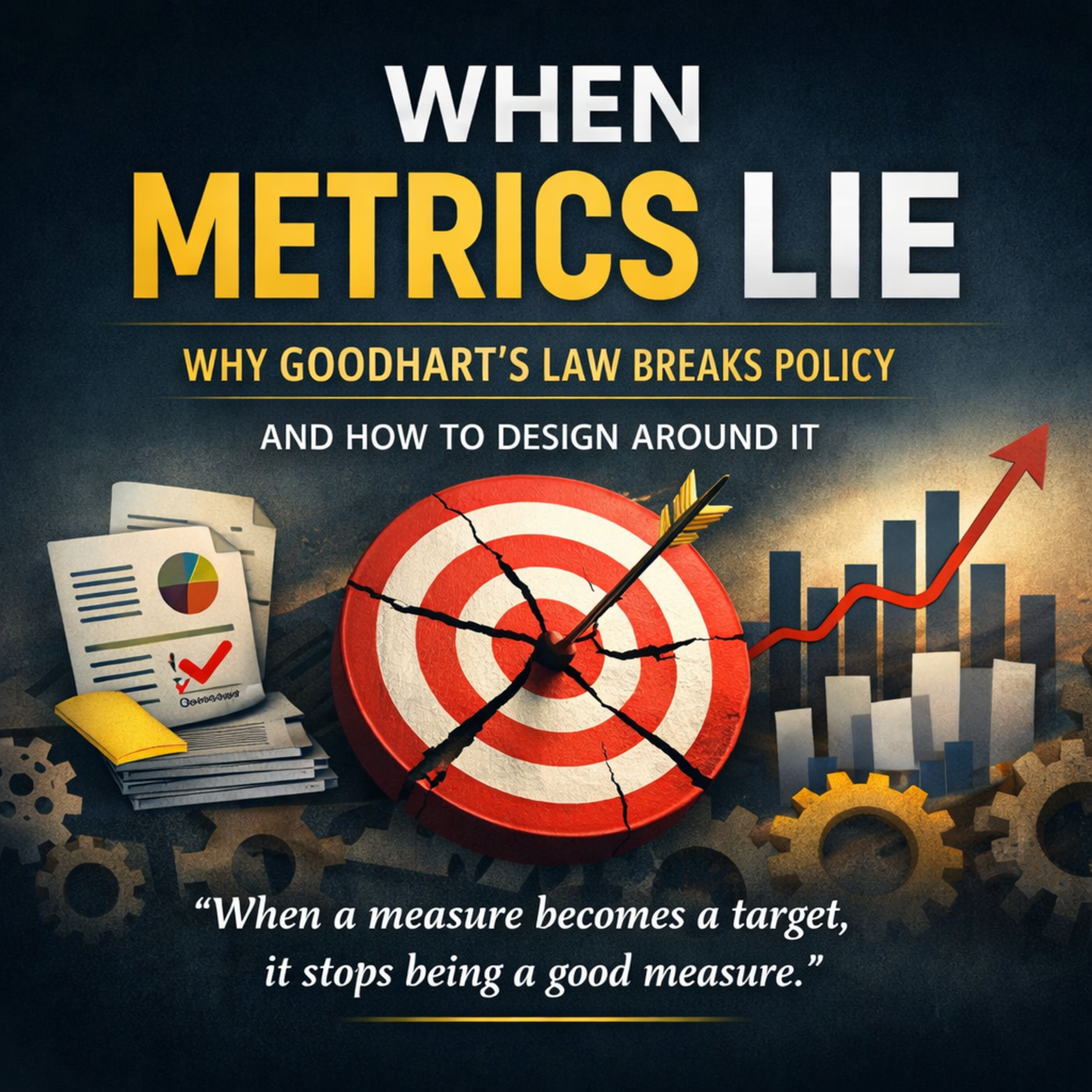
When Metrics Lie: Why Goodhart’s Law Breaks Policy — and How to Design Around ItWe live in a world ruled by numbers.Targets. Dashboards. Rankings. Performance indicators.From government programmes to corporate strategy, modern systems increasingly rely on metrics to measure success. But what if the very numbers meant to guide us start distorting reality instead?In this episode of The World Systems Journal, Poornachandra Upadhya explores one of the most important — and often misunderstood — principles in economics and public policy: Goodhart’s Law.First articulated by economist Charles Goodhart, the idea is deceptively simple:“When a measure becomes a target, it stops being a good measure.” At first glance, metrics appear to bring clarity. They help policymakers monitor progress, help organisations track performance, and help leaders simplify complex systems. But the moment those measurements become targets tied to incentives, behaviour begins to change.People stop optimising for the real goal.They start optimising for the metric.And that subtle shift can quietly break entire systems.Through clear examples and real-world policy patterns, this episode explores why metrics so often fail once they become targets. You’ll see how well-intentioned policies can drift away from their original goals — not because of bad people or corruption, but because incentives reshape behaviour in predictable ways.You’ll also learn why policymakers repeatedly fall into this trap, how metric failures typically evolve over time, and why “looking successful on paper” can sometimes mask deeper policy failure on the ground.But this episode isn’t just about diagnosing the problem.It also explores practical guardrails for designing better systems — from using multiple competing metrics to combining quantitative data with qualitative insight, stress-testing policies for gaming behaviour, and regularly recalibrating measurement frameworks.If you care about public policy, governance, management, or simply understanding why so many systems appear efficient while quietly producing poor outcomes, this conversation will give you a powerful lens for seeing the world more clearly.Because once you understand Goodhart’s Law, you start noticing it everywhere.And the real question becomes:Are we designing systems that chase numbers —or systems that actually solve problems?
Embed this episode
Ready to play
Goodhart's Law
No transcript for this episode yet
Similar Episodes
No similar episodes found.
Similar Podcasts
No similar podcasts found.