
EPISODE · Jun 3, 2025 · 19 MIN
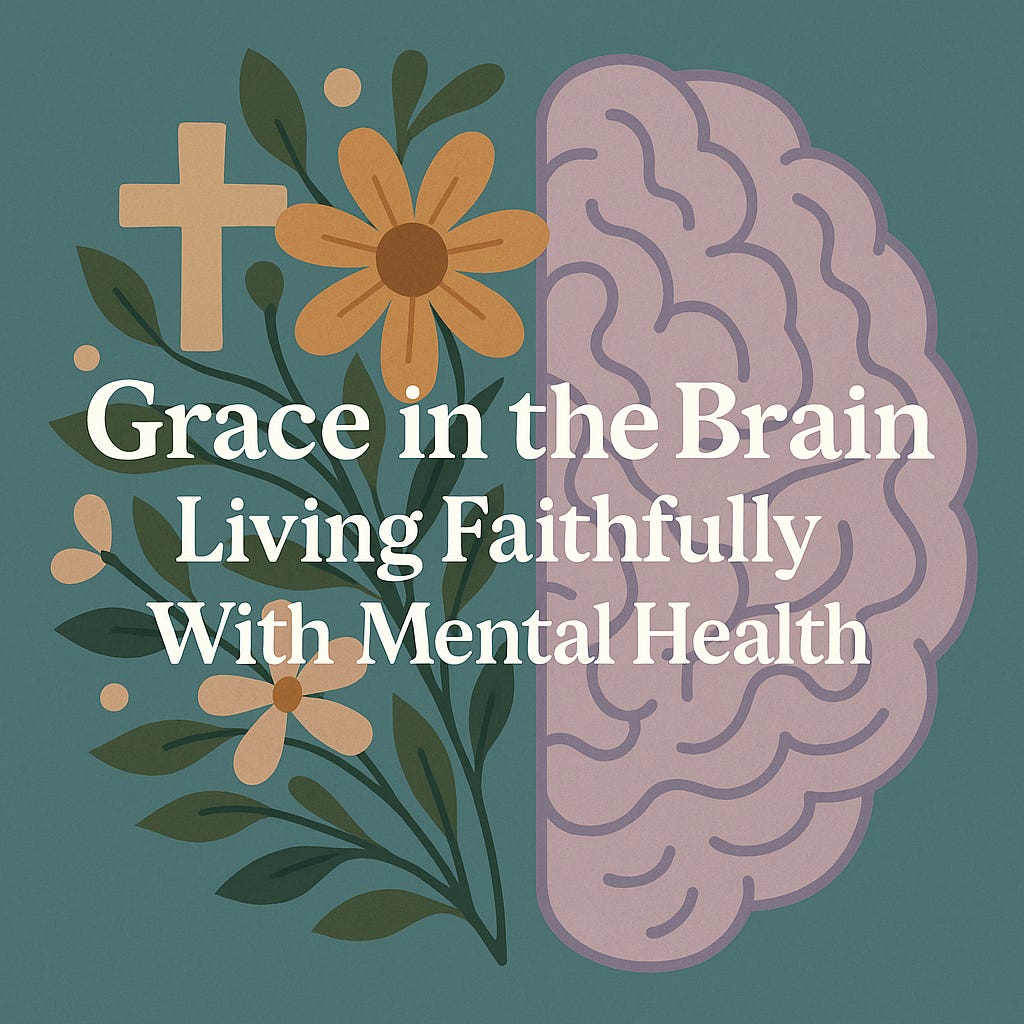
Grace in the Brain: Living Faithfully With Mental Health
from Whispers and Wonders with Garrett Andrew · host Dr. Garrett Andrew
Grace in the Brain: Living Faithfully With Mental HealthPreface to this SeriesIt’s not easy being a person of faith in a world where so many others of faith keep telling you to just… have more of it.Some of us were taught to be afraid of science. Afraid of anything not found in the Bible. Others were told their anxiety, depression, or ADHD was just a lack of faith. That if we prayed harder, or trusted more, we’d be fine.And we wonder too. Because doesn’t Jesus say not to worry?But if you’ve ever lived with real anxiety, the kind that presses in like a storm, that convinces you the worst is coming and you probably deserve it; you know those verses don’t help. They hurt. They isolate.This series is about that tension. About faith, mental health, and the quiet courage it takes to live with both.It’s my story. But I hope it opens space for yours, too. This isn’t a story of perfection. It’s a story of progress. A story about learning to believe in Christ. Not just as an idea, or a confession that gets you to heaven, but as a presence. A Love that tells you you are loved. And that you can love like Christ, too.Jesus said we’d do greater things than he did. I don’t know how that’s possible. But I’m starting to believe what he says about me. Not what others say. And maybe most importantly, not what I’ve often believed about myself. But what Jesus says, that I am the light of the world, and you are too.This is a story about learning to love myself. Even when I’m not very lovable. It’s about trusting I’m still beloved, even when I’m struggling. That help is holy. That grace doesn’t wait until we’re fixed; it meets us where we are.I’ve come to believe any help—therapy, medication, support—is a gift from God. And it’s taken me a long time to say that out loud.But I’m on the journey now. I have grace in the brain.If you’ve ever been told your faith wasn’t enough, or your mind was too much… this is for you.Part 1: Before I Could Say I’m Beloved, I Had to Say I’m Wired DifferentlyThis piece is available as both a full written essay and a podcast episode. Read below, or hit play to listen.The Night I Couldn’t Say YesIt happened at a monastery. A five-day silent retreat. I’d gone there needing something, I just didn’t know what. Maybe I was trying to outrun myself. Maybe I was hoping to run into God. Maybe both.One day, I decided I would spend the entire day repeating a single phrase to myself: I am the beloved. Over and over. Quietly, inwardly, prayerfully. It seemed like a good practice; something holy, something grounding. But what I didn’t know was that I had chosen that phrase because I didn’t really believe it. I was trying to convince myself.That night was the only time I locked my door.Until then, I’d slept in my little monastic cell with the door unlocked. There was no reason to be afraid. But that night, something shifted. I felt a presence, a heaviness, that terrified me. It wasn’t like other fears. It wasn’t panic or anxiety. It was as if something had come to ask a question I didn’t want to answer.Under the covers, I relived the worst moments of my life. Every shame. Every hidden sin. Every mask I’d worn so others wouldn’t worry about me. And the presence, I now believe it was God, asked me, again and again: Do you really think you are the beloved?And I knew the right answer. I knew what I was supposed to say. But something in me had to mean it this time.It wasn’t a spiritual attack. Not really. It was a spiritual unveiling. God wasn’t accusing me, God was showing me how I accused myself. How I judged myself unworthy of grace. How I believed love was for people who were better than me, stronger than me, more normal than me.And when I felt like I was asked, “Do you really think you are the beloved?” I didn’t answer yes. I couldn’t. Not yet. I answered no—quietly, maybe even unconsciously, and that only deepened my shame. It drove me further into the spiral. But it also became the turning point, the honest beginning of grace. Because sometimes grace waits for the no, so it can teach us how to say yes and mean it.But what grace doesn’t wait for is normal. Grace shows up in the silence and the shame and says, Even now. Even here. You are mine.It would take more time. There were more mistakes to come (and yet more to come I am sure). But something broke that night, and something opened.And this is where the series begins. Because if you’re waiting to be well to believe you are beloved, you’ll be waiting forever.But if you can say yes, trembling, imperfect, unready; you’ll find that grace is already there.In the brain. In the brokenness. In you.Masking and the MadnessThere’s a pattern many of us with ADHD or anxiety learn early: if you don’t want people to worry about you (and you don’t), you have to perform. You have to mask. You have to get good at pretending that everything is fine. That you’re on top of it. That you’re together. Because when you slip, people look at you differently. They lean in with concern; or worse, they step back in judgment.Masking becomes a form of survival. And in church circles, it can be even harder to peel it off. We learn early how to speak the language of spiritual success: prayer life, discernment, servanthood. We learn how to mimic “peace that passes understanding,” even when we’re coming apart inside.But masking is exhausting. And over time, it makes it harder to know who you actually are. It blurs the line between your coping mechanisms and your calling, your symptoms and your soul.For me, undiagnosed ADHD looked like laziness. Flakiness. Forgetfulness. Sudden bursts of creativity and connection too. It looked like being inconsistent with prayer, losing track of spiritual practices, zoning out in Bible study. It looked like underachievement and overcompensation at the same time. And it created this deep, gnawing feeling that I wasn’t enough; not spiritually, not emotionally, not humanly.And it wasn’t just forgetting birthdays or misplacing keys. It was interrupting people in vulnerable moments, shutting down in important conversations, impulsively spending money I didn’t have. It was saying yes to things I couldn’t handle, and then letting people down. It was misreading tone, missing cues, and making people feel unseen when I didn’t mean to. Or at least thinking that I had endlessly after interactions with people.It was slipping into addictions I swore I was done with. It was numbing myself with food, drink, or distraction. It was church meetings where I had emotional outbursts I couldn’t explain, followed by people quietly suggesting I needed medication. It was having a billion thoughts at once, chasing all of them, and realizing too late I had no idea what was happening around me. Those are the things that brought the real shame.And when I was anxious or depressed, it compounded the shame. Like many others with undiagnosed ADHD, I didn’t know that depression and anxiety often ride sidecar. In fact, studies show that up to 80% of adults with ADHD will experience at least one comorbid psychiatric condition in their lifetime; meaning another diagnosable mental health issue that co-occurs, such as anxiety or depression (Kessler et al., 2006 - https://doi.org/10.1176/ajp.2006.163.4.716).Reclaiming Scripture from ShameSo many of us grew up hearing verses that were supposed to convict us, but instead just confirmed our shame. “Be perfect, therefore, as your heavenly Father is perfect.” “The heart is deceitful above all things.” “All have sinned and fall short of the glory of God.”We heard them as judgments. We heard them as reasons we could never be enough. And when our mental health made it harder to do what others seemed to do so easily, stay organized, stay calm, stay connected, stay sane… it felt like proof. Proof we weren’t spiritual enough. Proof we were broken in ways even God couldn’t fix.But what if those verses were never meant to be clubs to beat us up? What if they were meant to open us up to mercy?“Be perfect” doesn’t mean flawless. The Greek word used, teleios, means complete, whole, mature. What if Jesus wasn’t commanding perfectionism, but inviting us into the wholeness of love? And he was. In context those verses are about loving our enemies. And for those of us who struggle with our mental health, sometimes, the greatest enemy we feel we have is the one looking at us in the mirror. The complete, whole, mature, perfection Jesus commanded, was the perfection of love no matter how good or bad someone else is. What if “the heart is deceitful” is less about original sin and more about the honest confusion of being human? About the way trauma, mental illness, and pressure can distort our inner compass, and our desperate need for grace to reorient us?And “all have sinned…” what if that’s not the end of the sentence, but the beginning of a solidarity? What if it’s not about shame, but about leveling the playing field? About remembering that grace isn’t earned by getting it all right?These verses, like our lives, need to be read in the light of love.Because love, real love, is what interprets Scripture rightly. Love is what Jesus embodied. Love is what casts out fear. And love is what brings us back to ourselves when the world, or our own minds, have made us feel unworthy.So if Scripture has been used to shame you, let grace reread it with you.Not as a weapon.But as a whisper:“You are still mine. Still worthy. Still beloved.”The Ongoing JourneyEven now, even medicated, even with tools I wish I’d had years ago, this isn’t easy. There’s no ribbon to wrap around it. No final act of healing that ties it all up. My brain still runs faster than I can follow. I still lose track of things, lose sleep, lose steam. Some days I still ask the question: Am I really the beloved?But I’ve learned to answer with something closer to yes. And even when I can’t say it fully, grace does not walk away.This series is a journey through that grace. Through diagnosis and doubt. Through Scripture and shame. Through the things we’ve been told and the truth that might still be waiting underneath.We’ll talk about the Bible and mental health. About prayer when it feels impossible. About Jesus and medication. About surviving church when your mind won’t sit still. About the holiness of neurodivergence, and the God who isn’t afraid of our wiring.Not because I’ve figured it all out. But because I’m learning not to hide anymore.So if you’re still masking, still spiraling, still wondering if there’s grace for you; there is.There always has been.Let’s walk this road together.One part, one breath, one brave yes at a time.I’d love to hear from you as this journey unfolds. What questions are you carrying? What parts of your story still need grace? Are there Scriptures or experiences you’d like me to reflect on in this series? Leave a comment, send a message, or share this with someone who might need it too. You’re not alone in this. Let’s keep walking, together.In the next part of this journey, I’ll share how I came to see my medication not as a sign of weak faith, but as a sacred act of grace. What Adderall taught me about prayer. What Lexapro taught me about love. And why I now believe some of the holiest things we do happen with therapists and in doctor’s offices, not just churches.You matter. Your mind matters. And grace was never waiting for you to earn it. If you're in a place of deep struggle, please know you're not alone. Help is available. You can call or text the 988 Suicide & Crisis Lifeline anytime for free, confidential support. You were made for love. Don’t suffer in silence.Whispers and Wonders is a reader-supported publication. To receive new posts and support my work, consider becoming a free or paid subscriber. Get full access to Whispers and Wonders at garrettjandrew.substack.com/subscribe
NOW PLAYING
Grace in the Brain: Living Faithfully With Mental Health
No transcript for this episode yet
Similar Episodes
Mar 26, 2026 ·1m
Mar 19, 2026 ·34m
Feb 18, 2026 ·11m
Feb 11, 2026 ·45m