
EPISODE · Mar 21, 2025 · 31 MIN
Gravitational Waves 3.0: Science with the Einstein Telescope
from Multi-messenger astrophysics · host Astro-COLIBRI
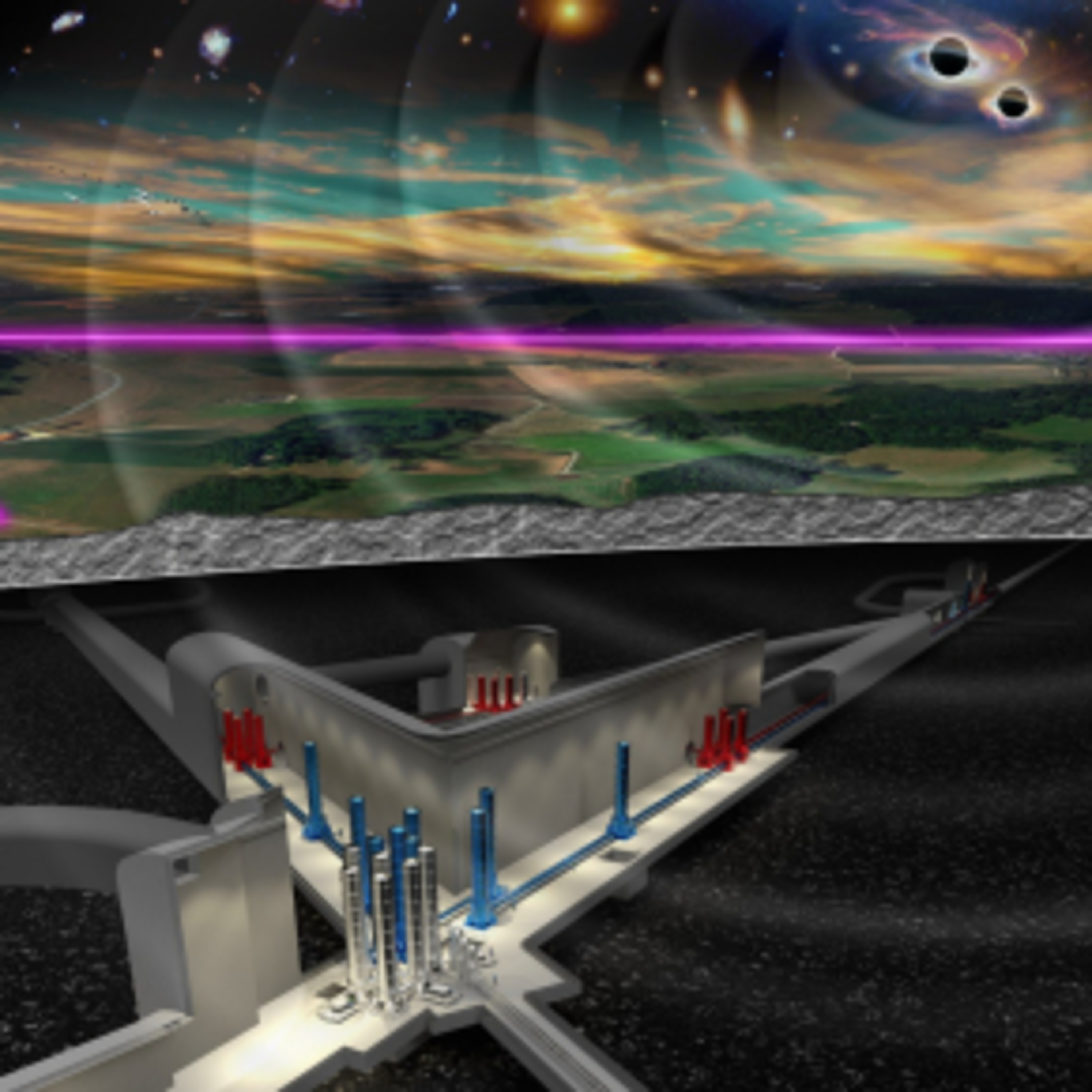
Welcome to this episode about the **Einstein Telescope (ET)**, a planned **third-generation gravitational-wave observatory** [see source].* **ET will revolutionize gravitational-wave astronomy** with **higher sensitivity** and a **broader frequency range** compared to current detectors [see source].* This allows deeper insights into **Fundamental Physics** (tests of General Relativity, search for dark matter), **Cosmology** (more precise Hubble constant measurement, early Universe studies), and the **Astrophysics of Compact Objects** (black holes, neutron stars, their formation and evolution) [see source].* A key focus is exploring the **physics of extreme matter** in neutron stars by observing mergers [see source].* **Multi-messenger astronomy** will be significantly advanced through improved event localization in combination with electromagnetic and neutrino telescopes [see source].* **Data analysis** of the expected large data volumes and **overlapping signals** presents a significant challenge, for which new methods are being developed [see source].**Reference:*** arXiv:2503.12263Acknowledements: Podcast prepared with Google/NotebookLM. Illustration credits: Marco Kraan, Nikhef
Embed this episode
Ready to play
Gravitational Waves 3.0: Science with the Einstein Telescope
No transcript for this episode yet
Similar Episodes
No similar episodes found.
Similar Podcasts
No similar podcasts found.