
EPISODE · Apr 22, 2026 · 20 MIN
Halving COGS Full-Stack Engineering in Tacrolimus Fermentation
from Biomanufacturing & Fermentation Technology · host prasad ernala
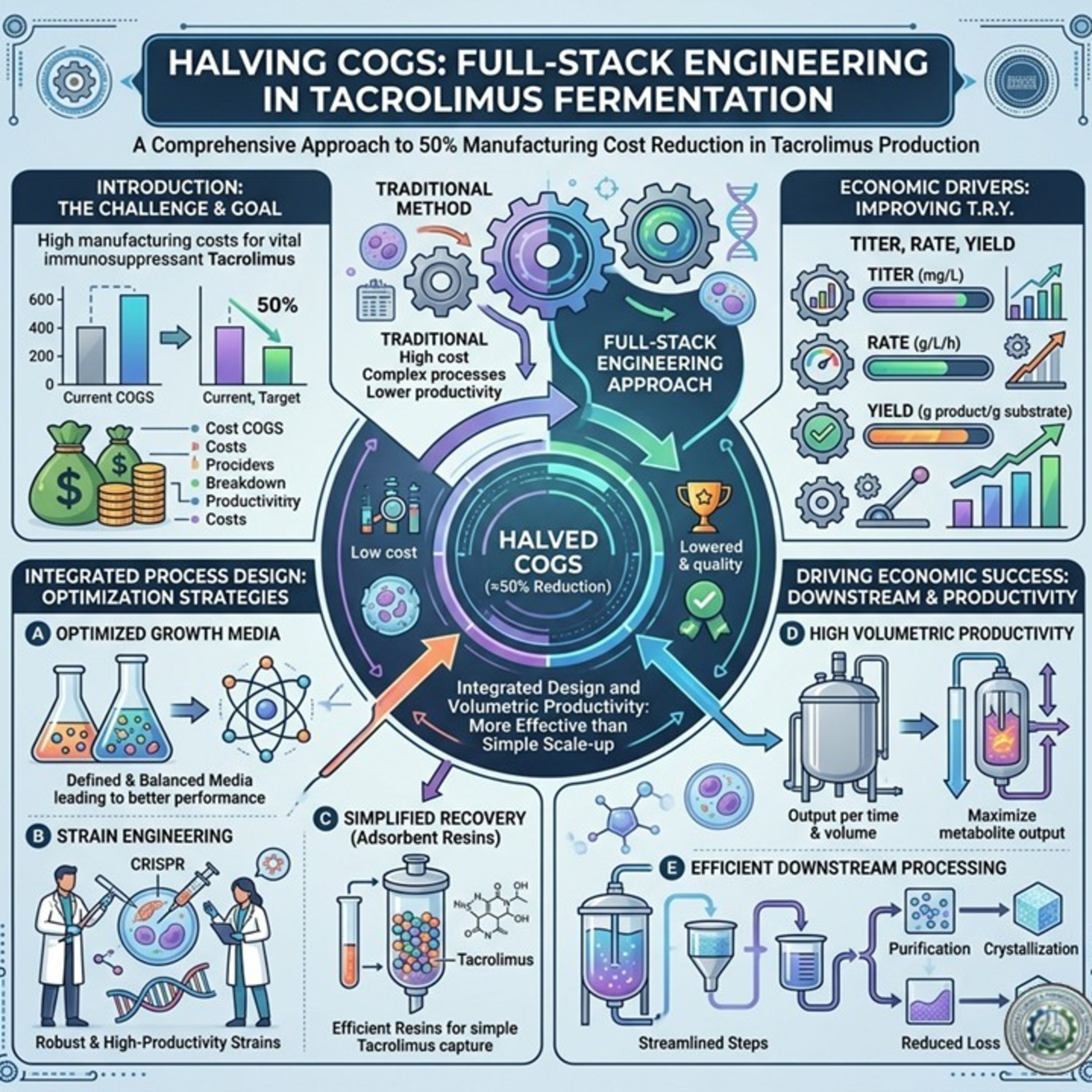
This episode explores strategies for reducing manufacturing costs in microbial fermentation, specifically focusing on the production of the immunosuppressant tacrolimus. The authors argue that a 50% reduction in costs is achievable by viewing the process as a comprehensive engineering challenge rather than focusing solely on biology. Key economic drivers include improving titer, rate, and yield, which together maximize the output of high-value metabolites relative to time and capital. Significant savings are realized by optimizing growth media, engineering robust strains, and utilizing adsorbent resins to simplify recovery. Furthermore, the text emphasizes that efficient downstream processing and high volumetric productivity are more effective at lowering unit costs than simply increasing the scale of production. Ultimately, the research demonstrates that integrated process design allows manufacturers to significantly decrease expenses while maintaining high product quality.#Bioprocess #ScaleUp and #TechTransfer,#Industrial #Microbiology,#MetabolicEngineering and #SystemsBiology,#Bioprocessing,#MicrobialFermentation,#Bio-manufacturing,#Industrial #Biotechnology,#Fermentation Engineering,#ProcessDevelopment,#Microbiology,#Biochemistry,#Biochemical Engineering, #Applied #MicrobialPhysiology, #Microbial #ProcessEngineering, #Upstream #BioprocessDevelopment, #Downstream Processing and #Purification,#CellCulture and #MicrobialSystems Engineering, #Bioreaction #Enzymes, #Biocatalyst #scientific #Scientist #Research
What this episode covers
This episode explores strategies for reducing manufacturing costs in microbial fermentation, specifically focusing on the production of the immunosuppressant tacrolimus. The authors argue that a 50% reduction in costs is achievable by viewing the process as a comprehensive engineering challenge rather than focusing solely on biology. Key economic drivers include improving titer, rate, and yield, which together maximize the output of high-value metabolites relative to time and capital. Significant savings are realized by optimizing growth media, engineering robust strains, and utilizing adsorbent resins to simplify recovery. Furthermore, the text emphasizes that efficient downstream processing and high volumetric productivity are more effective at lowering unit costs than simply increasing the scale of production. Ultimately, the research demonstrates that integrated process design allows manufacturers to significantly decrease expenses while maintaining high product quality.#Bioprocess #ScaleUp and #TechTransfer,#Industrial #Microbiology,#MetabolicEngineering and #SystemsBiology,#Bioprocessing,#MicrobialFermentation,#Bio-manufacturing,#Industrial #Biotechnology,#Fermentation Engineering,#ProcessDevelopment,#Microbiology,#Biochemistry,#Biochemical Engineering, #Applied #MicrobialPhysiology, #Microbial #ProcessEngineering, #Upstream #BioprocessDevelopment, #Downstream Processing and #Purification,#CellCulture and #MicrobialSystems Engineering, #Bioreaction #Enzymes, #Biocatalyst #scientific #Scientist #Research
NOW PLAYING
Halving COGS Full-Stack Engineering in Tacrolimus Fermentation
No transcript for this episode yet
Similar Episodes
Apr 21, 2026 ·13m
Apr 19, 2026 ·16m
Apr 17, 2026 ·13m
Apr 13, 2026 ·11m
Apr 11, 2026 ·16m