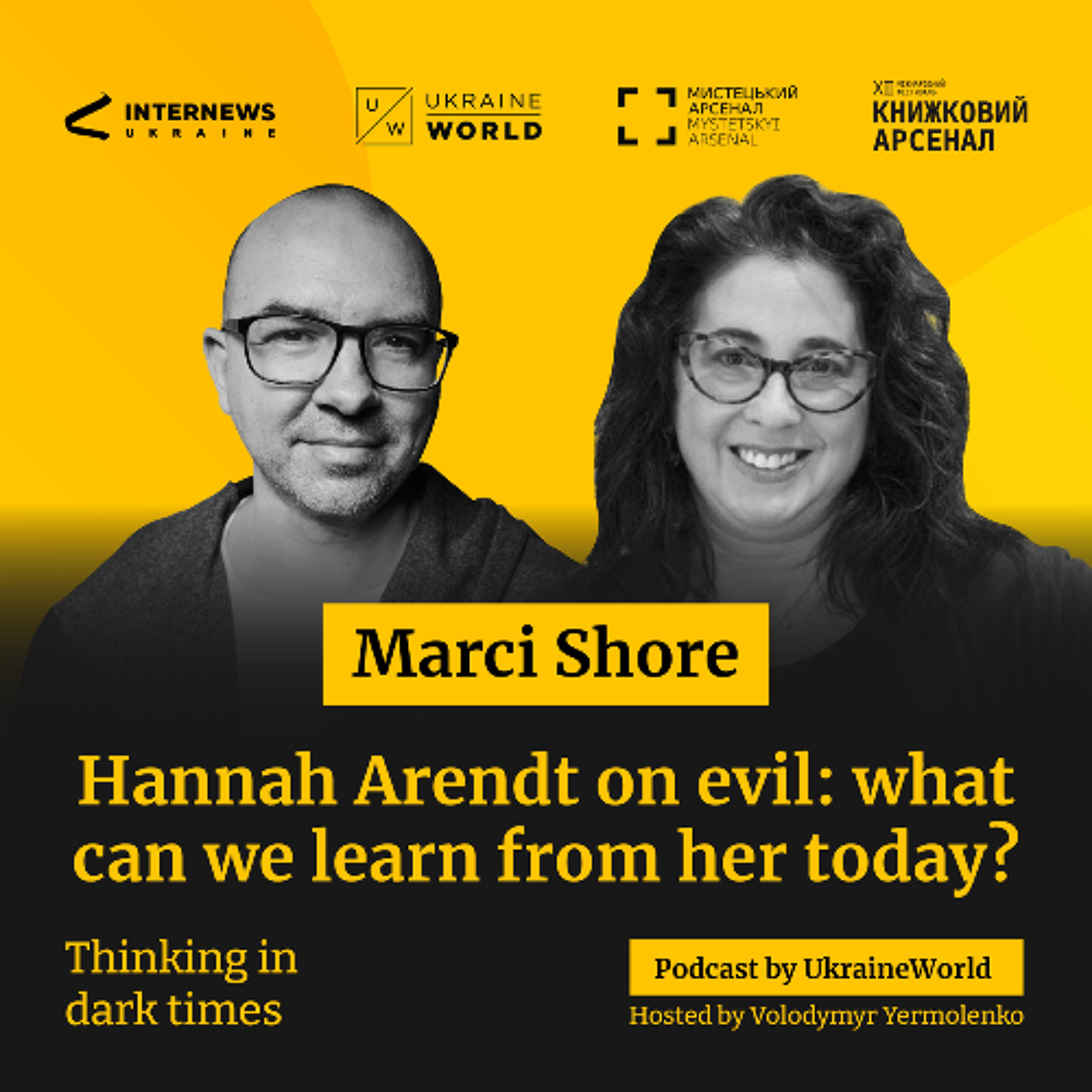
Hannah Arendt on evil: what can we learn from her today? - with Marci Shore episode artwork

EPISODE · Jun 20, 2025 · 51 MIN

Hannah Arendt on evil: what can we learn from her today? - with Marci Shore

from Explaining Ukraine · host UkraineWorld

Some might argue that the concept of evil is outdated in our relativistic age. And yet—how can we speak of war crimes, cruelty, or the neglect of human dignity without invoking the word evil? Perhaps it’s time to take it seriously again, to revisit the thinkers who have grappled with its meaning. One of them, of course, is Hannah Arendt. This is a conversation about Hannah Arendt and the concept of evil, which took place in Kyiv, the capital of Ukraine, on June 1st, at the Kyiv Book Arsenal—one of the country’s major literary events. Despite the ongoing war, the fair was full of people. My guest was Marci Shore, an American intellectual, historian, and university professor. She specializes in 20th-century European intellectual history, with a particular focus on Hannah Arendt. This year, Marci co-curated the Kyiv Book Arsenal’s focus topic, alongside Oksana Forostyna. My name is Volodymyr Yermolenko. I’m a Ukrainian philosopher, the editor-in-chief of UkraineWorld, and the president of PEN Ukraine. UkraineWorld is an English language media outlet about Ukraine run by Internews Ukraine, one of the country’s leading media NGOs. *** You can support our work at https://www.patreon.com/c/ukraineworld Your support is vital, as we increasingly rely on crowdfunding. Even a small monthly donation can make a big difference. You can also help fund our regular volunteer trips to Ukraine’s front-line areas, where we provide aid to both soldiers and civilians—mainly by delivering vehicles for the military and books for local communities. To support these efforts, you can donate via PayPal at [email protected]. *** Contents: 00:00 Intro 01:18 Support our work 04:44 Why is Hannah Arendt essential to understanding the 20th and 21st centuries? 06:16 What is Hannah Arendt's concept of 'radical evil'? 07:48 How are people made superfluous? 10:12 How has World War II shaped Arendt’s thought? 17:17 From “radical evil” to the “banality of evil”: connecting Arendt’s key concepts. 26:34 Marci Shore on the current situation in America 30:46 Thoughts on human dignity 32:14 Is the idea that 'everyone is replaceable' starting to repeat itself? 34:49 Why Sartre’s idea of “nothingness” might be dangerous? 42:14 Hannah Arendt: vita activa versus vita contemplativa 50:15 Outro

Some might argue that the concept of evil is outdated in our relativistic age. And yet—how can we speak of war crimes, cruelty, or the neglect of human dignity without invoking the word evil? Perhaps it’s time to take it seriously again, to revisit the thinkers who have grappled with its meaning. One of them, of course, is Hannah Arendt. This is a conversation about Hannah Arendt and the concept of evil, which took place in Kyiv, the capital of Ukraine, on June 1st, at the Kyiv Book Arsenal—one of the country’s major literary events. Despite the ongoing war, the fair was full of people. My guest was Marci Shore, an American intellectual, historian, and university professor. She specializes in 20th-century European intellectual history, with a particular focus on Hannah Arendt. This year, Marci co-curated the Kyiv Book Arsenal’s focus topic, alongside Oksana Forostyna. My name is Volodymyr Yermolenko. I’m a Ukrainian philosopher, the editor-in-chief of UkraineWorld, and the president of PEN Ukraine. UkraineWorld is an English language media outlet about Ukraine run by Internews Ukraine, one of the country’s leading media NGOs. *** You can support our work at https://www.patreon.com/c/ukraineworld Your support is vital, as we increasingly rely on crowdfunding. Even a small monthly donation can make a big difference. You can also help fund our regular volunteer trips to Ukraine’s front-line areas, where we provide aid to both soldiers and civilians—mainly by delivering vehicles for the military and books for local communities. To support these efforts, you can donate via PayPal at [email protected]. *** Contents: 00:00 Intro 01:18 Support our work 04:44 Why is Hannah Arendt essential to understanding the 20th and 21st centuries? 06:16 What is Hannah Arendt's concept of 'radical evil'? 07:48 How are people made superfluous? 10:12 How has World War II shaped Arendt’s thought? 17:17 From “radical evil” to the “banality of evil”: connecting Arendt’s key concepts. 26:34 Marci Shore on the current situation in America 30:46 Thoughts on human dignity 32:14 Is the idea that 'everyone is replaceable' starting to repeat itself? 34:49 Why Sartre’s idea of “nothingness” might be dangerous? 42:14 Hannah Arendt: vita activa versus vita contemplativa 50:15 Outro

NOW PLAYING

Hannah Arendt on evil: what can we learn from her today? - with Marci Shore

0:00 51:55

No transcript for this episode yet

We transcribe on demand. Request one and we'll notify you when it's ready — usually under 10 minutes.

The Cleveland Ukraine Podcast The Cleveland Ukraine Podcast Capturing the impactful stories of the Cleveland Ukrainian population at home and abroad. Sikkerhedsudvalget 24syv Siden 1946 har den amerikanske præsident hver dag modtaget den såkaldte PDB ‘The President’s Daily Brief’ om de aktuelle trusler mod verdens og USAs sikkerhed. 24syv giver nu alle lyttere - politikere, beslutningstagere og embedsmænd - et dagligt sikkerhedsbrief. I programmet ‘Sikkehedsudvalget’ vurderes alle aktuelle trusler mod rigets sikkerhed. Vid alt om terrorisme, Ukraine, Mellemøsten, cybertrusler, kritisk infrastrutur - og mød landets mest vidende eksperter og beslutningstagere. The Fight: A podcast on life & war in Ukraine. The Cipher Brief The Cipher Brief team brings you a brand new podcast that examines the war in Ukraine, and the impact it has on the world. Ukraine - History in the Making Emil Juhler When I started the conversation series ”Ukraine - History in the Making” I could have never imagined where this journey would lead me. It all started in March 2023 after I got home from an exchange stay in Chile and felt, that I had to do more for Ukraine, than what I did on my social media accounts and on the streets in the spring and summer of 2022. I think most of us remember that initial period after Ruzzia’s the full-scale invasion of Ukraine. Speaking from a European/Danish point of view it was a time of big fear, desperation and uncertainty, but also a time of high hopes, energy and big solidarity. In the very first conversation of the show with Veronika Netrebenko, she says the following about the feelings of Ukrainians during the Maidan Revolution: ”We understood we gotta fight for it, and it was something totally different, we felt different, we felt that we need to fight for it”. To a certain degree I believe you can say the same about what happened within the hearts and mi

Frequently Asked Questions

How long is this episode of Explaining Ukraine?

This episode is 51 minutes long.

When was this Explaining Ukraine episode published?

This episode was published on June 20, 2025.

What is this episode about?

Some might argue that the concept of evil is outdated in our relativistic age. And yet—how can we speak of war crimes, cruelty, or the neglect of human dignity without invoking the word evil? Perhaps it’s time to take it seriously again, to revisit...

Can I download this Explaining Ukraine episode?

Yes, you can download this episode by clicking the download button on the episode player, or subscribe to the podcast in your preferred podcast app for automatic downloads.
URL copied to clipboard!