
EPISODE · Feb 1, 2026 · 17 MIN
Harvest Timing as a Risk-Control Lever in Biomanufacturing
from Biomanufacturing & Fermentation Technology · host prasad ernala
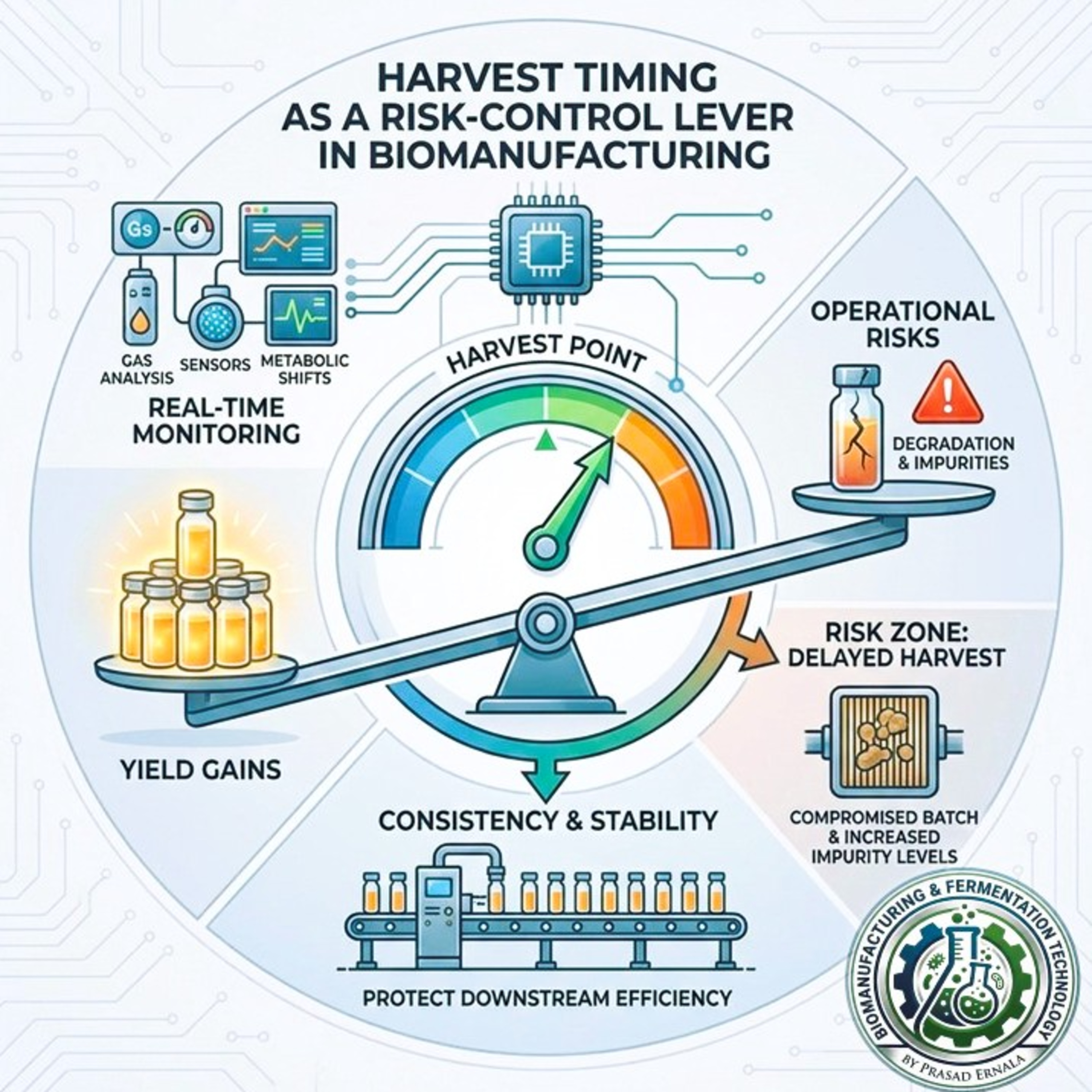
This episode examines how harvest timing serves as a vital tool for managing technical risks in industrial microbial fermentation. Rather than chasing the highest possible product concentration, manufacturers must balance marginal yield gains against the dangers of product degradation and increased impurity levels. My analysis highlights that a multi-layered decision architecture that uses real-time monitoring, such as gas analysis and sensors, to detect metabolic shifts before they compromise the batch. By identifying the specific point where operational risks outweigh production benefits, companies can ensure better consistency and protect downstream processing efficiency. Ultimately, the material advocates for a risk-first approach that prioritizes long-term manufacturing stability over laboratory-scale peak performance.#Bioprocess #ScaleUp and #TechTransfer,#Industrial #Microbiology,#MetabolicEngineering and #SystemsBiology,#Bioprocessing, #MicrobialFermentation, #Bio-manufacturing, #Industrial #Biotechnology, #Fermentation Engineering, #ProcessDevelopment,#Microbiology, #Biochemistry#Biochemical Engineering,#Applied #MicrobialPhysiology,#Microbial #ProcessEngineering,#Upstream #BioprocessDevelopment,#Downstream Processing and #Purification,#CellCulture and #MicrobialSystems Engineering,#Bioreaction #Enzymes #Biocatalyst #scientific#Scientist#Research
What this episode covers
This episode examines how harvest timing serves as a vital tool for managing technical risks in industrial microbial fermentation. Rather than chasing the highest possible product concentration, manufacturers must balance marginal yield gains against the dangers of product degradation and increased impurity levels. My analysis highlights that a multi-layered decision architecture that uses real-time monitoring, such as gas analysis and sensors, to detect metabolic shifts before they compromise the batch. By identifying the specific point where operational risks outweigh production benefits, companies can ensure better consistency and protect downstream processing efficiency. Ultimately, the material advocates for a risk-first approach that prioritizes long-term manufacturing stability over laboratory-scale peak performance.#Bioprocess #ScaleUp and #TechTransfer,#Industrial #Microbiology,#MetabolicEngineering and #SystemsBiology,#Bioprocessing, #MicrobialFermentation, #Bio-manufacturing, #Industrial #Biotechnology, #Fermentation Engineering, #ProcessDevelopment,#Microbiology, #Biochemistry#Biochemical Engineering,#Applied #MicrobialPhysiology,#Microbial #ProcessEngineering,#Upstream #BioprocessDevelopment,#Downstream Processing and #Purification,#CellCulture and #MicrobialSystems Engineering,#Bioreaction #Enzymes #Biocatalyst #scientific#Scientist#Research
NOW PLAYING
Harvest Timing as a Risk-Control Lever in Biomanufacturing
No transcript for this episode yet
Similar Episodes
Apr 21, 2026 ·13m
Apr 19, 2026 ·16m
Apr 17, 2026 ·13m
Apr 13, 2026 ·11m
Apr 11, 2026 ·16m